
Find legal forms, law schools, and legal resources
Try “residential lease” — forms for your state are shown first.
Try “Yale” or “University of Texas” — the full ABA directory is searchable as you type.
Minnesota sales · independent representative
Download the Minnesota commission agreement for independent sales representatives — with the Minnesota good-cause, cure, and pipeline protections of Minn. Stat. § 325E.37 built into the termination sections — in fillable Word and fillable PDF, with the Minnesota Instructions & Rider.
Selling in more than one state? This page is the Minnesota agreement — buy the state where the representative solicits.
Every file below is included: the fillable Word instrument, a fillable PDF, and the Minnesota Instructions & Rider.
The real document — not a mockup. Page 1 of the form included in your download.
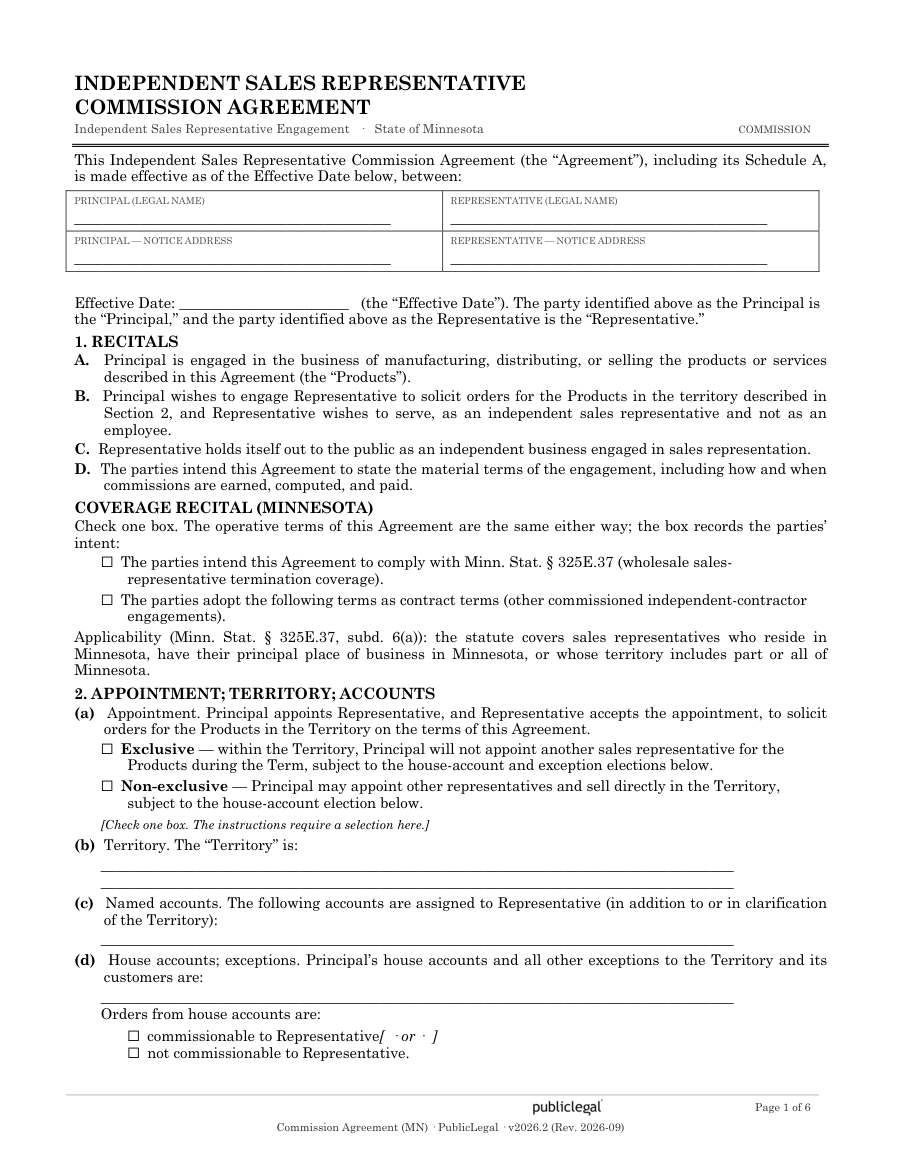
Every part of the instrument, in order — the sections, Schedule A, and the signature page.
About this form
A commission agreement is the written contract between a business (the principal) and an independent sales representative: it appoints the representative for a territory, sets the commission rate and when a commission is earned, fixes the payment date, and answers the questions that otherwise end up in disputes — pipeline orders at termination, expenses, authority limits, and confidentiality.
Minnesota gives sales representatives structural protections most states do not: termination only for good cause, a 90-day notice with a 60-day cure right, nonrenewal rules, and pipeline commissions under Minn. Stat. § 325E.37, plus the § 181.145 demand clocks. This Minnesota version is built on that statutory structure — not a generic form with a state name typed in — and Schedule A lays the rules out.
Your Minnesota Instructions & Rider covers the state specifics in plain language: the governing statute (or the absence of one), the payment deadlines, the statement habit that keeps disputes rare, notice templates, and step-by-step completion guidance with a worked example.
Both parties sign; the representative keeps a fully executed copy, and the detachable receipt proves delivery (some states require it — the rider flags them). No notarization is required.
ILRG provides self-help legal forms and download support. PublicLegal employment forms are provided for you to complete with your own business information. Commission payment rights and deadlines vary by state — the Instructions & Rider explains the rules in your state and the clauses this agreement uses to stay within them. If you are not 100 percent satisfied after purchasing from us, contact us for a refund.
The Minnesota commission agreement in fillable Word (.docx) with a fillable PDF, plus the Minnesota Instructions & Rider (state payment rules, completion guidance, and notice templates). A completed sample is available as an optional add-on.
It is the written contract between a business and an independent sales representative: it appoints the representative for a territory, states the commission rate and the event that earns a commission, fixes payment dates and account statements, sets term, termination, and pipeline rules, and limits the representative’s authority (no accepting orders or setting prices in the principal’s name).
Minnesota's act (Minn. Stat. § 325E.37 + § 181.145) does not itself require a written contract, but its payment-deadline and remedy rules apply to the relationship — and a signed writing is what fixes the commission terms so those deadlines can be enforced. The rider explains.
Minn. Stat. § 325E.37 + § 181.145 sets payment deadlines for Minnesota commissions, including at termination — this agreement's commission and pipeline sections are built around those rules, Schedule A cites them, and the rider explains them in plain language.
No — the agreement documents an independent-contractor relationship and says so expressly. Misclassification is a real risk when a worker is treated like an employee on paper-thin facts; the Minnesota rider carries the classification warning and the rules that follow if a worker is actually an employee.
Buy the state where the representative solicits customers. The agreement’s governing-law and exclusive-forum clause names that state, which keeps the sales-representative protections of that state’s statute (where one exists) aligned with the contract.