
Find legal forms, law schools, and legal resources
Try “residential lease” — forms for your state are shown first.
Try “Yale” or “University of Texas” — the full ABA directory is searchable as you type.
Connecticut divorce form
Download the Connecticut Dissolution Agreement for divorces with minor children. Put your property, debt, custody, and support terms in writing — instant secure access.
The written Dissolution Agreement Connecticut courts generally expect filed with an uncontested divorce.
Formalize how you and your spouse divide property and debts, and how custody, visitation, and support will work — the agreement courts expect with an uncontested divorce.
Download the files, complete them together on your own device, and sign before a notary. No online data entry.
A signed settlement agreement lets the final decree incorporate your terms without a contested hearing.
This packet includes 1 document in print-ready PDF format. Use the PDF files for print-ready review and signature preparation.
Court forms
This form plus the matching divorce complaint (dissolution of marriage), Dissolution Agreement, and dissolution of marriage judgment — every Connecticut document in one package.
$27.98 $39.97 Save $11.99
About this form
This agreement records the terms both spouses have agreed to, so the final decree can incorporate them.
See page 1 of the actual blank form and review a plain-language outline. The complete formatted documents are delivered after checkout.
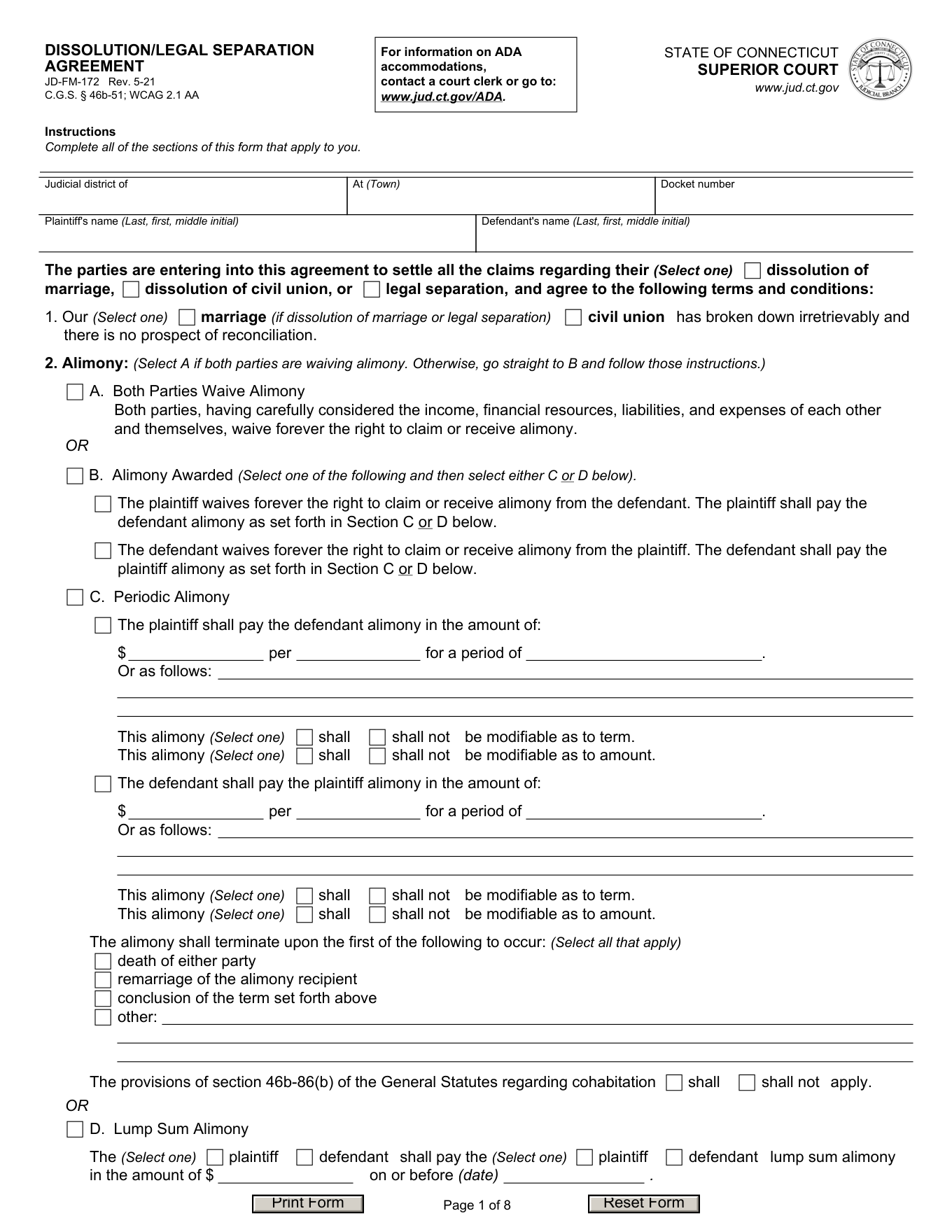
DISSOLUTION AGREEMENT (MINOR CHILDREN). Official JD-FM-172 plus official JD-FM-284 when there is a minor child.
ILRG is committed to top quality legal forms that are valid in all states. If you are not 100 percent satisfied after purchase, contact us for a full refund.
A written agreement between spouses that divides property and debts and sets out custody, visitation, and support terms for minor children. Courts generally expect it filed with the divorce so the final decree can incorporate its terms.
The 1 document listed on this page, delivered in PDF format.
Yes. A Dissolution Agreement is a contract between both spouses. It is typically signed before a notary and then filed with the court so the judge can incorporate it into the final decree.
This form works when both spouses have reached full agreement. If you disagree about property, debts, custody, or support, mediation or attorney help is the safer path before filing.
No. ILRG provides self-help legal forms and information, not legal advice. Consult a Connecticut attorney if you have significant assets, debts, or any disagreement about the settlement terms.