
Find legal forms, law schools, and legal resources
Try “residential lease” — forms for your state are shown first.
Try “Yale” or “University of Texas” — the full ABA directory is searchable as you type.
Washington employment · confidentiality, inventions
Download the Washington employment confidentiality agreement — protects confidential information and trade secrets, assigns employee inventions, with no non-compete — Washington law voids or severely restricts them — in fillable Word and fillable PDF, with the Washington Instructions & Rider.
Hiring in more than one state? This page is the Washington agreement — each state's version is drafted to its own covenant law.
Every file below is included: the fillable Word instrument, a fillable PDF, and the Washington Instructions & Rider.
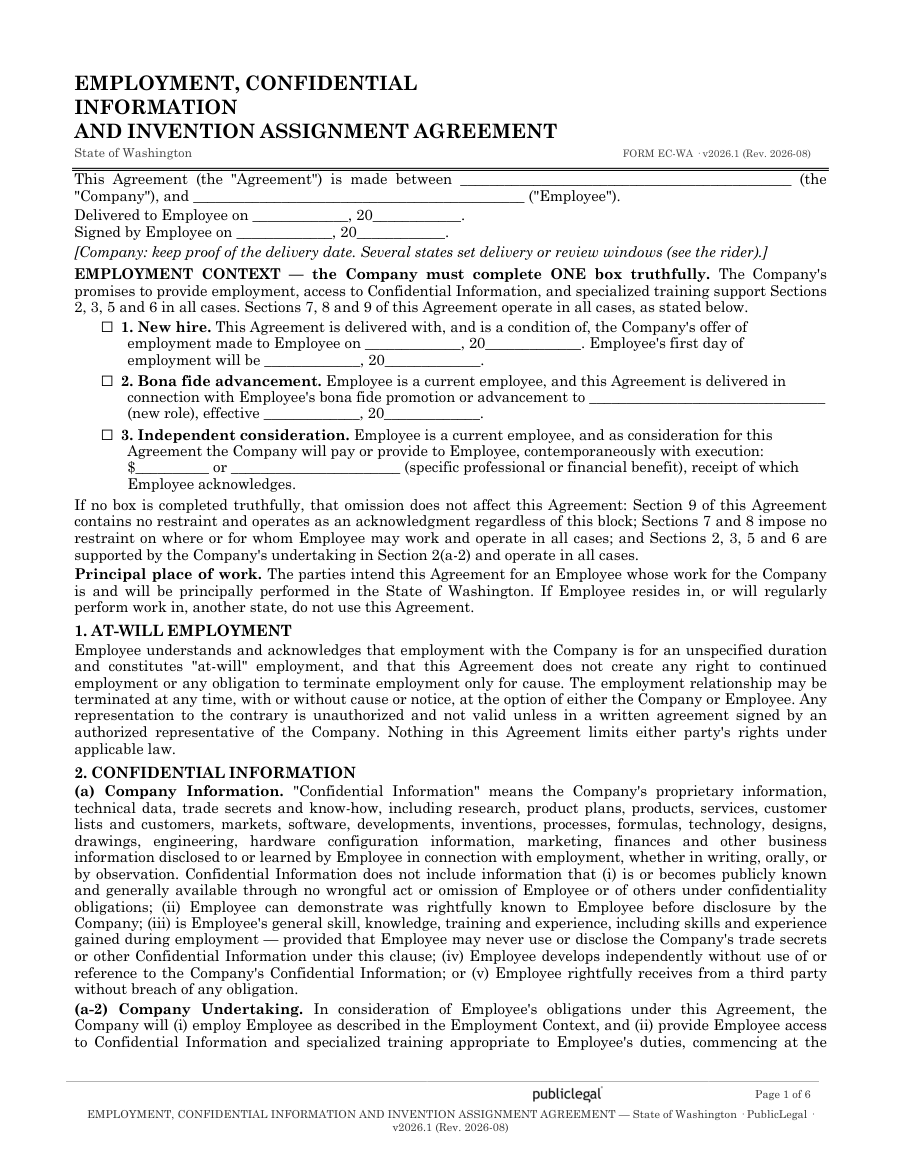
The real document — not a mockup. Page 1 of the form included in your download.
Every part of the instrument, in order — thirteen sections, the exhibits, and the signature page.
About this form
An employment confidentiality agreement is the employer's first line of defense for its most valuable assets: trade secrets, proprietary data, customer relationships, and employee-created inventions. Signed at the start of employment, it defines what information is confidential, assigns work-related inventions to the company, and sets the employee's obligations during and after employment.
Washington voids or severely restricts employee non-competes, so this agreement contains none — by design, not by omission. It protects what Washington law does protect: confidential information, inventions, and (where lawful) relationships, without asking a court to blue-pencil an illegal covenant.
Your Washington Instructions & Rider covers the state specifics: the governing statute or rule in one paragraph, any earnings thresholds, delivery and timing requirements, and step-by-step completion guidance, with a delivery log for your records.
Both parties sign in two originals — one for each side. No notarization is required. Give the employee a copy of the signed agreement (some states require it — the rider flags them) and keep the signed original with the completed exhibits.
ILRG provides self-help legal forms and download support. PublicLegal employment forms are provided for you to complete with your own business information. Restrictive-covenant rules vary by state and change frequently — the Instructions & Rider explains the rules in your state and the certifications this agreement uses to stay within them. If you are not 100 percent satisfied after purchasing from us, contact us for a refund.
The Washington employment confidentiality agreement in fillable Word (.docx) with a fillable PDF, plus the Washington Instructions & Rider (covenant rules, thresholds, timing, and step-by-step completion guidance). A completed sample is available as an optional add-on.
It protects the employer’s confidential information and trade secrets, assigns employee-created inventions to the company, confirms at-will employment, requires the return of company property at termination, and — where state law allows — adds non-solicitation and non-competition covenants. It is signed at the start of employment and its core obligations survive the end of employment.
Yes — and that is precisely why this Washington version contains no non-compete: Washington law voids or severely restricts employee non-competes, so a form that included one would hand you an unenforceable (and in some states unlawful) clause. The confidentiality, invention-assignment, and lawful solicitation protections remain fully enforceable.
No. Section 1 expressly preserves at-will employment — either party may end the employment at any time, with or without cause. The agreement adds confidentiality, invention, and (where lawful) covenant obligations; it does not create a term contract or a promise of continued employment.
Exhibit A is the employee’s prior-inventions list — anything the employee created before this employment stays the employee’s, and listing it there prevents later ownership disputes (a “No Prior Inventions” checkbox covers the common case). Exhibit B is the termination certification: at the end of employment the employee confirms that company property, devices, and confidential materials have been returned.
Present it with the offer or at onboarding, before the employee starts work — consideration and timing rules matter, and several states impose delivery or waiting periods (the Washington Instructions & Rider lists yours). Both parties sign two originals and each keeps one; some states require the employee to receive a copy, which the rider flags.