
Find legal forms, law schools, and legal resources
Try “residential lease” — forms for your state are shown first.
Try “Yale” or “University of Texas” — the full ABA directory is searchable as you type.
Maryland residential lease agreement
Download the September 2026 Maryland Residential Lease Agreement packet for houses, apartments, condos, and other residential rentals. The packet includes a complete editable DOCX, a true fillable PDF, landlord instructions, a utility-billing addendum, the Maryland Tenants’ Bill of Rights, and mold and lead disclosure materials.
Bundle & save $19.97
Handle tenant screening, the lease, move-in condition records, and a Maryland nonpayment notice workflow if you need it.
Use each document only when appropriate. The notice packet is not a move-in document and should be used only when the facts and current law support it.
A practical Maryland lease packet built to document the rental relationship, current Real Property Article terms, disclosure obligations, and clean completion in your own PDF reader or on paper.
The lease addresses the two-month security-deposit cap (Md. Code, Real Prop. § 8-203(b)), the five-day grace period and 5% late-charge cap (§ 8-208(d)(3)), the Tenants’ Bill of Rights delivery duty (§ 8-208(c)(4)), mold-disclosure obligations (§ 8-220), utility-apportionment rules (§ 8-212.4), and the move-in cost cap (§ 8-208(d)(11)).
Download the files, customize the lease in Word or type directly into the fillable PDF fields in your own PDF reader, and keep a signed copy for your records.
Use the editable DOCX with click-to-fill controls, or open the true fillable PDF in your own PDF reader and type directly into the form fields — no online interview or ILRG account required; both print cleanly for signing.
Your $9.99 purchase includes 7 document groups and 12 delivered files in the Word and PDF formats shown below. The completed sample PDF is an optional $4.99 add-on and is not included in the 12-file count.
Self-help lease overview
A written Maryland residential lease helps document the landlord, tenant, premises, county, term, rent, security deposit, utilities, repairs, disclosures, rules, and signatures for a rental property. This agreement captures the key deal terms in a front Data Schedule before the detailed provisions.
This packet includes the Maryland Residential Lease Agreement in editable DOCX and true fillable PDF, landlord instructions, the utility-billing addendum, the Maryland Tenants’ Bill of Rights, the EPA mold guide, and the lead-based paint materials listed below for pre-1978 housing and affected property.
Review the completed lease and any local, subsidized-housing, association, or property-specific requirements before signing; Maryland counties and cities such as Montgomery County, Prince George’s County, and Baltimore City add their own overlays. ILRG provides self-help legal forms and information, not legal advice.
This page highlights the current downloadable Maryland residential lease packet: a complete editable DOCX, a true fillable PDF, landlord instructions, a utility-billing addendum, the Maryland Tenants’ Bill of Rights, and mold and lead disclosure materials. The lease uses a front Data Schedule, a lease-for-term or month-to-month election, and a § 33(g) checklist that records delivered addenda and pamphlets. A completed sample lease is available as an add-on.
Review the operative agreement terms below before you buy. This preview is not the full download package: checkout delivers the complete agreement layout, completion fields, signature pages, and the companion files listed above. The completed sample PDF remains optional.
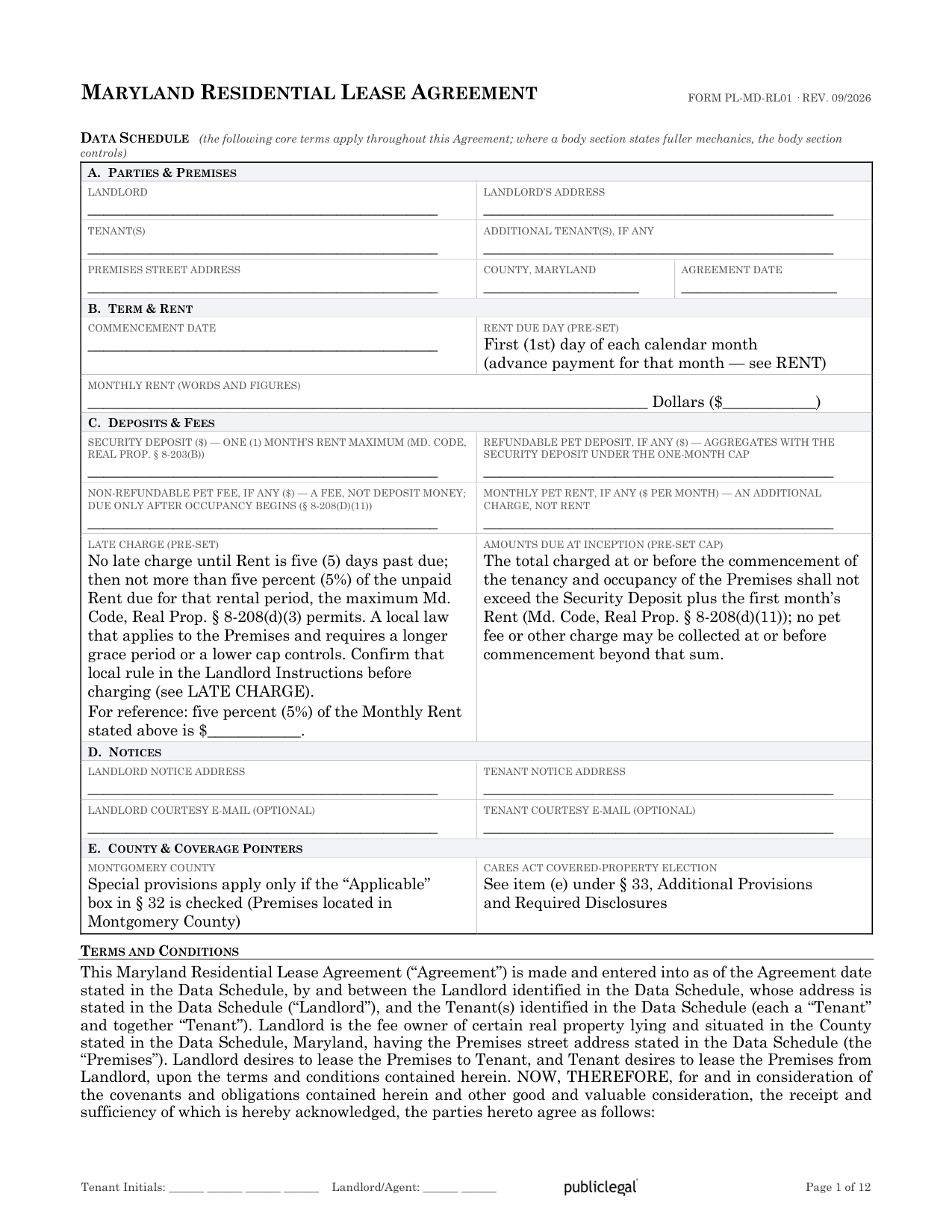
Maryland Residential Lease Agreement
(Lease for Term or Month-to-Month)
Terms and Conditions
This Maryland Residential Lease Agreement (“Agreement”) is made and entered into as of the Agreement date stated in the Data Schedule, by and between the Landlord identified in the Data Schedule, whose address is stated in the Data Schedule (“Landlord”), and the Tenant(s) identified in the Data Schedule (each a “Tenant” and together “Tenant”). Landlord is the fee owner of certain real property lying and situated in the County stated in the Data Schedule, Maryland, having the Premises street address stated in the Data Schedule (the “Premises”). Landlord desires to lease the Premises to Tenant, and Tenant desires to lease the Premises from Landlord, upon the terms and conditions contained herein. NOW, THEREFORE, for and in consideration of the covenants and obligations contained herein and other good and valuable consideration, the receipt and sufficiency of which is hereby acknowledged, the parties hereto agree as follows:
Each person executing this Agreement as Tenant is an adult and is jointly and severally liable for all of Tenant’s obligations under this Agreement. Minors may be listed as occupants only and are never parties to this Agreement. Adult occupants who are not Tenants are listed in the USE OF PREMISES section and have no rights as Tenants.
1. TERM. This Agreement shall commence on the Commencement Date stated in the Data Schedule (“Commencement Date”). Check either A or B:
☐ A. Lease for Term: This Agreement shall continue as a lease for a fixed term. The termination date of this lease shall be _____, at 11:59 p.m. Unless this Agreement is extended or renewed in writing by both parties, the tenancy expires on the termination date; to recover possession at the expiration of the stated term, Landlord shall give Tenant written notice of Landlord’s intent to terminate the tenancy at least sixty (60) days before the termination date (Md. Code, Real Prop. § 8-402(c)(2)(i)), or such longer period as applicable local law requires, and Tenant shall give Landlord written notice of Tenant’s intention to vacate at the end of the term at least sixty (60) days before the termination date. Acceptance of any payment after a termination notice does not waive the notice or any judgment for possession unless the parties specifically agree in writing (Md. Code, Real Prop. § 8-402(c)(5)(i)). Upon the termination date, Tenant shall vacate the Premises unless one of the following occurs: (i) Landlord and Tenant extend this Agreement in writing or execute a new written Agreement; (ii) local rent-control law mandates extension of the tenancy; or (iii) Landlord willingly accepts new rent from Tenant, which does not constitute past-due rent. If Landlord accepts new rent from Tenant, a month-to-month tenancy shall be created, subject to the notice provisions below. Rent shall continue at the rate specified in this Agreement, or as otherwise allowed by law. All other terms and conditions of this Agreement remain in full force and effect.
Tenant(s) initial the holdover-conversion provision above (Md. Code, Real Prop. § 8-402(d)): Tenant initials:
☐ B. Month-to-Month: This Agreement shall continue as a month-to-month tenancy. If at any time Tenant desires to terminate the tenancy, Tenant may do so by providing written notice of intention to terminate to Landlord at least thirty (30) days prior to the desired termination date. If at any time Landlord desires to terminate the tenancy, Landlord must provide written notice of intention to terminate to Tenant at least sixty (60) days prior to the desired termination date for a month-to-month tenancy or ninety (90) days for a year-to-year tenancy. Where local law provides greater tenant protections, those protections apply. Notices to terminate may be given on any calendar day and shall comply with the notice periods and any end-of-period requirements of Md. Code, Real Prop. § 8-402(c) and other applicable law.
Early Termination — Victims of Abuse (Md. Code, Real Prop. §§ 8-5A-01 through 8-5A-04). If Tenant or a legal occupant (an occupant residing on the Premises with Landlord’s actual knowledge and permission) is a victim of abuse within the meaning of Md. Code, Real Prop. § 8-5A-01, Tenant may terminate Tenant’s future liability under this Agreement by giving Landlord written notice of intent to vacate by first-class mail or hand delivery, stating Tenant’s or the legal occupant’s status as a victim of abuse and including a copy of: (i) a final protective order issued for the benefit of Tenant or the legal occupant; (ii) a final peace order issued for the benefit of Tenant or the legal occupant where the underlying act was abuse; or (iii) a report by a qualified third party as described in § 8-5A-01(h), with perpetrator identifying information redacted, signed within the preceding sixty (60) days. Tenant is responsible for Rent only for the period from the notice until Tenant vacates, up to a maximum of thirty (30) days; if Tenant vacates earlier, Tenant shall give Landlord the notarized written notice of vacating required by § 8-5A-02(c)(2), and Landlord shall inspect the Premises and provide the written confirmation and rent statement that section requires. If Tenant does not vacate within thirty (30) days after the notice of intent to vacate, Landlord may, at Landlord’s option and on written notice to Tenant, pursue the holdover remedies of § 8-402 or deem the notice of intent to vacate rescinded (§ 8-5A-02(d)). Termination under this section does not release any other Tenant, including a Tenant who is the respondent in the protective-order or peace-order action (§ 8-5A-02(e)).
2. RENT. “Rent” means the Monthly Rent stated in the Data Schedule — the fixed, periodic payment for use and occupancy of the Premises. Late charges, utility charges, pet fees and pet rent, damages, costs, and all other sums payable by Tenant under this Agreement are “Additional Charges”; Additional Charges are not Rent, may not be treated as unpaid rent in an action for failure to pay rent, and are recoverable as this Agreement and applicable law otherwise provide (including from the Security Deposit as Md. Code, Real Prop. § 8-203 permits). The Security Deposit is neither Rent nor an Additional Charge. Tenant shall pay to Landlord the Monthly Rent stated in the Data Schedule per month as Rent for the Term of the Agreement. Rent shall be due on the first (1st) day of each calendar month and shall be considered advance payment for that month. If not remitted on the 1st, Rent shall be considered overdue and delinquent on the 2nd day of each calendar month. If the Commencement Date is not the first (1st) day of a calendar month, Rent paid on the Commencement Date shall be prorated based on a thirty (30)-day period. Unless otherwise required by law, each payment received from Tenant shall be applied first to unpaid Rent, oldest rental period first, and then to Additional Charges in the order incurred; during any holdover, the payment-ordering rules of Md. Code, Real Prop. § 8-402(c)(5) govern.
Rent Adjustments. Landlord may increase Rent effective at the expiration of the fixed term under branch A of the TERM section, or, under branch B, effective at the start of a monthly period, by written notice given at least ninety (90) days before the effective date of the increase for a tenancy with a term of more than one (1) month, or at least sixty (60) days before the effective date for a month-to-month tenancy (Md. Code, Real Prop. § 8-209(b)(3)). The notice shall state the new Rent amount and its effective date and shall be sent by first-class mail with a certificate of mailing or, if Tenant has elected electronic delivery under the NOTICE section, by electronic delivery with proof of transmission (§ 8-209(b)(2)). No rent increase takes effect during the initial fixed term of this Agreement, and any stricter applicable local law controls.
Acceptable Forms of Payment. The only permitted forms of payment of Rent to Landlord shall be as checked below.
☐ Personal check
☐ Money order
☐ Cashier’s check
☐ Other: _____
Payment shall be made to Landlord under the following name and address: _____. If any payment by Tenant is returned for insufficient funds (“NSF”) or if Tenant stops payment, Landlord may require in writing that Tenant pay Rent in cash for three (3) consecutive months, and that all future Rent payments be remitted by money order or cashier’s check. Landlord shall give Tenant a written receipt for any payment made in cash and, upon Tenant’s request, for any other payment (Md. Code, Real Prop. § 8-205).
3. SECURITY DEPOSIT. In accordance with the Code of Maryland, Real Property § 8-203, Tenant has deposited with Landlord the Security Deposit stated in the Data Schedule, receipt of which is hereby acknowledged. This amount shall not exceed one (1) month’s rent. The deposit shall be held as collateral security and may be applied toward unpaid rent, damage due to Tenant’s breach of this Lease, or damage to the Premises, common areas, major appliances, or furnishings beyond ordinary wear and tear caused by Tenant or Tenant’s family, agents, employees, guests, or invitees (Md. Code, Real Prop. § 8-203(f)(1)(i)). This Agreement shall serve as Tenant’s receipt for such deposit, and Landlord shall retain a copy of this Agreement for at least two (2) years after termination of the tenancy, abandonment of the Premises, or eviction of Tenant. Tenant may not use or apply the security deposit as rent, including the last month’s rent.
(a) The security deposit shall be deposited and maintained in an escrow account in a federally insured financial institution that does business in the State of Maryland, devoted exclusively to security deposits, within thirty (30) days after receipt. The deposit may be held in insured certificates of deposit at such institutions or in securities issued by the federal government or the State of Maryland.
(b) Return of Deposit and Interest. Within forty-five (45) days after the tenancy ends, Landlord shall return the deposit, less lawful deductions, together with simple interest at the greater of one-and-one-half percent (1.5 %) per year or the daily U.S. Treasury yield curve rate for one (1) year, as of the first business day of each year in which interest accrues (Md. Code, Real Prop. § 8-203(e)(1)), subject to the accrual thresholds stated in the Withholding and Interest Accumulation paragraph below. Any prior language inconsistent with this paragraph is superseded.
(c) Withholding and Interest Accumulation. Interest shall accrue monthly from the date Tenant’s deposit is received, provided the deposit equals or exceeds Fifty Dollars ($50.00). No interest is due for any period less than a full month or for deposits held fewer than six months. For a Tenant who has been evicted or ejected for breach of this Lease, or who has abandoned the Premises, before the end of the tenancy, the return, interest, and itemization duties of this section apply only if Tenant demands return of the deposit by written notice sent by first-class mail within forty-five (45) days after being evicted or ejected or after abandoning the Premises, specifying Tenant’s new address (Md. Code, Real Prop. § 8-203(h)(2)).
(d) Itemization of Charges. If any portion of the Security Deposit is withheld, Landlord shall send Tenant, by first-class mail to Tenant’s last known address within forty-five (45) days after the termination of the tenancy, a written list of the damages claimed together with an itemized statement of the costs incurred, including supporting documentation that identifies the materials or services provided (Md. Code, Real Prop. § 8-203(g)(1), (j)(1)). Landlord may provide an estimate of costs, in which case Landlord shall notify Tenant in writing when the repairs are completed, include a copy of the final invoice, and, if actual costs are less than the estimate, return the excess within thirty (30) days after completing the repairs (§ 8-203(j)(2), (k)). Failure to comply forfeits Landlord’s right to withhold any part of the deposit for damages (§ 8-203(g)(2)). If Tenant claims charges for repair of damage caused by Landlord or Landlord’s agents, Tenant shall provide an itemization of such charges and, upon written request, substantiate them.
(e) Repairs and Transfer of Deposit. Tenant’s obligations under this Lease may not end merely because Tenant ceases to occupy the Premises. Repairs required may be so substantial or of such a nature that work will not be completed within the forty-five (45)-day period following termination of the tenancy. In such event, the estimate procedure of Md. Code, Real Prop. § 8-203(j)–(k) governs, and Landlord reserves the right to pursue Tenant for reimbursement of costs incurred for damages; nothing in this paragraph extends the forty-five (45)-day itemization and return deadlines of § 8-203(g) and (e).
(f) In the event of a sale or transfer of the property, Landlord shall deliver the Security Deposit to the transferee together with the accounting required by Md. Code, Real Prop. § 8-203(d)(3), and shall notify Tenant in writing of the transferee’s name and address. Landlord remains liable to Tenant and the transferee for maintenance and return of the Security Deposit as to all or any portion Landlord fails so to deliver (§ 8-203(d)(3)(i)), and each successor in interest is liable to Tenant for return of the deposit, together with interest, as § 8-203 provides (§ 8-203(d)(4)). The foregoing shall apply to each successive transfer or assignment. If Landlord consents to an assignment or sublease, the written consent shall state the disposition of the Security Deposit; absent such a statement, Landlord shall continue to hold and return the deposit as § 8-203 requires.
(g) Required Disclosures for Security Deposit Receipt. Pursuant to § 8-203.1 of the Maryland Real Property Code, Tenant is advised of the following rights regarding the security deposit:
(1) The right to request an inspection by Landlord, in Tenant’s presence, for the purpose of making a written list of existing damages at the commencement of the tenancy if requested by certified mail within 15 days after occupancy;
(2) The right to be present when Landlord inspects the Premises at the end of the tenancy to determine damages if Tenant notifies Landlord by certified mail at least 15 days before Tenant’s intended move, stating the date of moving and Tenant’s new address;
(3) Landlord’s obligation to conduct that inspection within five (5) days before or after Tenant’s stated move date;
(4) Landlord’s obligation to notify Tenant in writing of the inspection date;
(5) Tenant’s right to receive, by first-class mail to Tenant’s last known address, a written list of any charges claimed against the deposit and the actual costs, within 45 days after termination of the tenancy;
(6) Landlord’s obligation to return any unused portion of the deposit by first-class mail within 45 days after termination of the tenancy; and
(7) Landlord’s failure to comply with Maryland’s security-deposit law may result in liability to Tenant for up to three (3) times the amount withheld, plus reasonable attorney’s fees.
4. USE OF PREMISES. The Premises shall be used and occupied by Tenant and Tenant’s immediate family and other authorized occupants (including minors and adult occupants who are not Tenants), consisting of the persons listed in the occupancy roster below, exclusively, as a private single family dwelling, and no part of the Premises shall be used at any time during the term of this Agreement by Tenant for the purpose of carrying on any business, profession, or trade of any kind, or for any purpose other than as a private single family dwelling. Tenant shall not allow any other person, other than Tenant’s immediate family or transient relatives and friends who are guests of Tenant, to use or occupy the Premises without first obtaining Landlord’s written consent to such use. Tenant shall comply with any and all laws, ordinances, rules and orders of any and all governmental or quasi-governmental authorities affecting the cleanliness, use, occupancy and preservation of the Premises.
Occupancy roster (occupants only — not parties to this Agreement): _____
_____
5. CONDITION OF PREMISES. Landlord shall deliver the Premises and all common areas in a clean, habitable, and sanitary condition, free of rodents and vermin, and in compliance with all applicable laws. If the Premises are part of a condominium or cooperative housing structure, Landlord is required to deliver the dwelling unit itself in such condition. Tenant acknowledges that Tenant has examined the Premises and agrees that they are, at the commencement of this Lease, in good order and repair and in a safe, clean, habitable, and sanitary condition. If Tenant claims any pre-existing damage or defect, Tenant shall attach to this Lease a written list of such pre-existing conditions, labeled Exhibit “A”, which shall be signed by both parties and incorporated herein by reference.
6. ASSIGNMENT AND SUBLEASING. Tenant shall not assign this Agreement, or sublease or grant any license or other right to use the Premises or any part thereof, without Landlord’s prior written consent, which Landlord shall not unreasonably withhold. A consent by Landlord to one assignment, sublease, or license shall not be deemed consent to any subsequent assignment, sublease, or license. Any assignment, sublease, or license made without Landlord’s prior written consent, or by operation of law, shall be null and void and shall, at Landlord’s option, constitute a default and terminate this Agreement. Any proposed assignee, subtenant, or licensee must meet the same qualifications as required of prospective tenants, including, but not limited to, satisfactory credit, rental, and employment references. Tenant shall pay a processing fee of $_____, which shall be fair and reasonable and intended solely to offset Landlord’s actual expenses in reviewing the proposed assignment or sub-tenancy.
7. ALTERATIONS AND IMPROVEMENTS. Tenant shall make no alterations, additions, or improvements to the buildings or other structures on the Premises, nor construct or install any new building, fixture, or improvement, without the prior written consent of Landlord. Any alterations, additions, or improvements made to the Premises by Tenant shall, unless otherwise agreed in writing by Landlord and Tenant, become the property of Landlord and shall remain upon the Premises at the expiration or earlier termination of this Agreement.
8. NON-DELIVERY OF POSSESSION. Landlord shall assure that Tenant may peaceably and quietly enter on the Premises at the beginning of the term (Md. Code, Real Prop. § 8-204(b)). If Landlord fails to provide Tenant with possession of the Premises at the beginning of the term, the Rent abates until possession is delivered, and, on written notice to Landlord before possession is delivered, Tenant may terminate, cancel, and rescind this Agreement, whereupon Landlord is liable to Tenant for all money or property given as prepaid rent, deposit, or security (§ 8-204(c)–(d)). This section does not limit any right or remedy of Tenant under Md. Code, Real Prop. § 8-204, including consequential damages actually suffered after notice as provided in § 8-204(e); Landlord’s liability is limited only to the extent that section permits. Landlord may bring an action of eviction and damages against any tenant holding over after the end of that tenant’s term even though Landlord has entered into this Lease with Tenant, and may join Tenant as a party to the action (§ 8-204(f)).
9. HAZARDOUS MATERIALS. Tenant shall not keep on the Premises any item of a dangerous, flammable or explosive character that might unreasonably increase the danger of fire or explosion on the Premises or that might be considered hazardous or extra hazardous by any responsible insurance company. If the Premises were constructed prior to 1978, Landlord is required to disclose lead-based paint hazards, and Tenant hereby acknowledges receipt of the pamphlet ("Lead Poisoning Prevention: Notice of Tenant's Rights" and "Protect Your Family From Lead in Your Home") on this subject.
10. UTILITIES. Responsibility for each utility service is as marked below (check the Landlord or Tenant box for each service):
Heat — ☐ Landlord ☐ Tenant
Gas — ☐ Landlord ☐ Tenant
Electricity — ☐ Landlord ☐ Tenant
Water — ☐ Landlord ☐ Tenant
Sewer — ☐ Landlord ☐ Tenant
Trash removal — ☐ Landlord ☐ Tenant
Other: _____ — ☐ Landlord ☐ Tenant
Each service checked “Tenant” shall be arranged in Tenant’s name and paid directly to the provider. Any service checked “Landlord” for which Landlord separately bills Tenant (pass-through billing, submetering, ratio-utility billing (RUBS), or third-party water/sewer billing) is governed by the Utility Billing Addendum, which Landlord shall complete and attach before this Agreement is signed; utility charges billed under that Addendum are Additional Charges, not Rent. Landlord shall provide and maintain in working order the systems that supply heat, electricity, gas (if supplied), and hot and cold running water to the Premises, and shall make all repairs required of a landlord by Maryland law and applicable housing codes; Tenant’s repair and maintenance duties are those stated in MAINTENANCE AND REPAIR; RULES. This section states the parties’ specific obligations as to heat, gas, electricity, water, and repair of the Premises (Md. Code, Real Prop. § 8-208(c)(2)).
11. MAINTENANCE AND REPAIR; RULES. Tenant shall, at Tenant’s sole expense, keep and maintain the Premises and all appurtenances in good and sanitary condition and repair throughout the term of this Agreement and any renewal thereof. Nothing in this section shifts or waives any non-delegable duty of Landlord under Maryland law, including the warranty of habitability (Md. Code, Real Prop. § 8-212), the serious-and-dangerous-condition rent-escrow provisions (§ 8-211), or the mold duties (§ 8-220). Without limiting the generality of the foregoing, Tenant shall comply with the Tenant Maintenance Responsibilities set out below.
Utilities and Billing Disclosure. If Landlord bills Tenant for any utility service (pass-through billing, submetering, ratio-utility billing (RUBS), or third-party water/sewer billing), the Utility Billing Addendum shall be completed and attached before this Agreement is signed, and a utility-billing or RUBS charge is collectible only as that Addendum and Md. Code, Real Prop. §§ 8-205.1, 8-205.2, 8-205.3 (effective October 1, 2026), and 8-212.4 permit. This paragraph is not the disclosure required by § 8-212.4(c); the Addendum provides it.
Mold Notification and Remediation. If Tenant believes that mold exists in the Premises, Tenant shall promptly provide written notice to Landlord describing the condition. Within fifteen (15) days after receiving such notice, Landlord shall perform an assessment of the Premises and, if mold is confirmed, shall remediate within forty-five (45) days after the assessment is completed or, if remediation within that time frame is not feasible, within a reasonable time after the assessment is completed (Md. Code, Real Prop. § 8-220(c)). Landlord shall communicate the progress and completion of the remediation in writing.
Tenant Maintenance Responsibilities. Tenant’s maintenance obligations shall include, without limitation, the following duties:
(a) Not obstruct the driveways, sidewalks, courts, entryways, stairs, and halls, which shall be used for ingress and egress only;
(b) Keep all windows, glass, window coverings, doors, locks, and hardware in good, clean order and repair;
(c) Not obstruct or cover the windows or doors;
(d) Not leave windows or doors open during inclement weather;
(e) Not hang laundry, clothing, sheets, or similar items from any window, rail, porch, or balcony, nor air-dry any such items in any yard area or space;
(f) Not install any locks or hooks upon any door or window without Landlord’s prior written consent;
(g) Keep all air-conditioning filters clean and free from dirt;
(h) Keep all lavatories, sinks, toilets, and other plumbing fixtures in good order and repair, using them only for their intended purposes. Tenant shall not allow any sweepings, rubbish, sand, rags, ashes, or other substances to be thrown or deposited therein. Any damage or cost of clearing stopped plumbing resulting from misuse shall be borne by Tenant;
(i) Ensure that Tenant, Tenant’s family, and guests maintain order in and about the Premises and refrain from loud or improper noises or conduct disturbing other residents;
(j) Keep all radios, television sets, stereos, and similar devices turned to a level that does not annoy or interfere with other residents;
(k) Deposit all trash, garbage, and refuse in the designated receptacles and not allow the same to accumulate outside any building or within common areas; and
(l) Abide by all rules and regulations affecting the Premises or common areas that may be adopted by the applicable Condominium or Homeowners’ Association having control over them.
12. INSURANCE. Landlord, Landlord’s agent or manager, or, if applicable, the Condominium or Homeowners’ Association, are not responsible for insuring Tenant’s or Tenant’s permitted visitors’ personal property and vehicles against loss or damage due to theft, vandalism, fire, water, rain, criminal or negligent acts of others, or any other cause. Landlord has advised Tenant to carry Tenant’s own insurance (renter’s insurance) to protect Tenant from any such loss or damage. The parties agree that, upon notification by Landlord, Tenant shall take all actions necessary to avoid: (i) an increase in Landlord’s insurance premium (or Tenant shall pay for the increase in premium); or (ii) loss of insurance.
13. DAMAGE TO PREMISES. In the event the Premises are destroyed or rendered wholly uninhabitable by fire, storm, earthquake, or other casualty not caused by the negligence of Tenant, this Agreement shall terminate from such time except for the purpose of enforcing rights that may have then accrued hereunder. The rental provided for herein shall then be accounted for by and between Landlord and Tenant up to the time of such injury or destruction of the Premises, Tenant paying rentals up to such date and Landlord refunding rentals collected beyond such date. Should a portion of the Premises thereby be rendered uninhabitable, the Landlord shall have the option of either repairing such injured or damaged portion or terminating this Lease. In the event that Landlord exercises its right to repair such uninhabitable portion, the rental shall abate in the proportion that the injured parts bears to the whole Premises, and such part so injured shall be restored by Landlord as speedily as practicable, after which the full rent shall recommence and the Agreement continue according to its terms.
14. RIGHT OF ENTRY TO PREMISES. Except in emergencies or as otherwise required by law, Landlord shall provide Tenant with at least twenty-four (24) hours’ prior written notice before entering the Premises and shall enter only Monday through Saturday, between 7:00 a.m. and 7:00 p.m., or at another time Tenant agrees to in writing (Md. Code, Real Prop. § 8-221(b)(1)(ii)), for lawful purposes including inspections, repairs, maintenance, or showings. Tenant shall not unreasonably withhold consent to entry during such hours. Any prior conflicting entry language is superseded by this provision. Each entry notice shall state the date, the approximate time, and the specific purpose of the intended entry, and shall be delivered by first-class mail with a certificate of mailing, by a paper notice affixed to the door of the Premises, or — only if Tenant has elected electronic delivery under the NOTICE section — by e-mail message, text message, or electronic tenant portal with proof of transmission (Md. Code, Real Prop. § 8-221(c)). Landlord and Tenant may agree in writing to a specific entry on less than twenty-four (24) hours’ notice (§ 8-221(c)(5)). If Tenant alleges a housing-code violation, Tenant shall provide Landlord access to the Premises within twenty-four (24) hours after notifying Landlord of the alleged violation (§ 8-221(f)).
15. SUBORDINATION OF LEASE. This Lease and Tenant’s rights and interest hereunder are and shall remain subordinate, junior, and inferior to any and all mortgages, deeds of trust, liens, or other encumbrances now or hereafter placed upon the Premises by Landlord, including all renewals, extensions, modifications, and future advances thereunder. Tenant shall, upon Landlord’s request, execute any reasonable documentation required to evidence or confirm such subordination, provided Tenant’s quiet enjoyment of the Premises is not materially disturbed so long as Tenant is not in default.
16. SURRENDER OF PREMISES. Upon the expiration of the term hereof, Tenant shall surrender the Premises in as good a state and condition as they were at the commencement of this Agreement, reasonable use and wear and tear thereof and damages by the elements excepted.
17. ANIMALS. ☐ Permitted ☐ Not Permitted. If the “Permitted” box is checked, Tenant may keep no more than _____ approved domestic pets, subject to Landlord’s prior written consent and Landlord’s written pet policy (Md. Code, Real Prop. § 8-210(c)), including any applicable breed or weight restrictions, vaccination requirements, liability-insurance requirements, and additional fees. If the “Not Permitted” box is checked, Tenant shall not keep or permit any animals on the Premises. If pets are permitted, Tenant shall pay the pet deposit, pet fee, and/or monthly pet rent stated in the Data Schedule; any non-refundable pet fee is due only after occupancy of the Premises begins (Md. Code, Real Prop. § 8-208(d)(11)). Any pet deposit is security-deposit money under Md. Code, Real Prop. § 8-203: it counts toward the one (1) month’s rent cap, is refundable, and shall be returned within forty-five (45) days after the tenancy ends, less lawful itemized deductions including the cost of repairing any damage caused by any animal. Any non-refundable amount shall be charged only as a disclosed pet fee and never as deposit money. Assistance animals required by a person with a disability are not considered pets and are not subject to pet deposits, pet rent, or additional fees. Tenant remains responsible for any actual damage caused by any animal and for maintaining it in compliance with all applicable health, safety, and noise ordinances.
18. QUIET ENJOYMENT. Tenant, upon timely payment of all sums due under this Lease and upon performance of all Tenant obligations herein, shall peaceably and quietly have, hold, and enjoy the Premises for the term of this Lease without disturbance from Landlord or anyone lawfully claiming under Landlord, subject to the terms and conditions of this Lease and to any mortgages or encumbrances of record.
19. INDEMNIFICATION. To the maximum extent permitted by law, Tenant shall indemnify, defend, and hold Landlord harmless from and against claims, damages, losses, and expenses (including reasonable attorney’s fees) to the extent arising out of or caused by the negligence, willful misconduct, or breach of this Agreement by Tenant or by Tenant’s family, guests, invitees, agents, or employees. This section does not apply to, and nothing in this Agreement limits, waives, or shifts: (i) any liability arising from the negligence or willful misconduct of Landlord or Landlord’s agents or employees; or (ii) any non-waivable right or duty under Maryland law, including Md. Code, Real Prop. §§ 8-105, 8-203, 8-207, 8-208, 8-211, 8-212, and 8-220. Any provision of this Agreement that applicable law voids as against public policy (including § 8-105) is of no force or effect and shall not be enforced.
20. DEFAULT. (1) Breach Other Than Nonpayment. If Tenant fails to comply with any of the material provisions of this Agreement, other than the covenant to pay rent, or of any rules and regulations prescribed by Landlord, or materially fails to comply with any duties imposed on Tenant by statute, Landlord may terminate this Agreement by written notice specifying the non-compliance, stating Landlord’s intention to terminate this Lease by reason thereof, and stating the termination date, given at least thirty (30) days before the termination date; provided that if the breach involves behavior by Tenant, a member of Tenant’s household, or a guest that demonstrates a clear and imminent danger of serious harm to persons or property, the notice period shall be fourteen (14) days (Md. Code, Real Prop. § 8-402.1). Landlord may repossess the Premises before the expiration of the stated term if Tenant breaches this Agreement and fails to vacate after such notice, by the procedure of § 8-402.1. (2) Nonpayment of Rent. If Tenant fails to pay rent when due, Landlord may exercise any and all rights and remedies available at law or in equity, including an action for failure to pay rent, but only after first providing Tenant the ten (10) days’ written notice required by Md. Code, Real Prop. § 8-401(c)(1) before filing, stating Landlord’s intent to file if Tenant does not cure within that period. Tenant’s right to redeem the Premises before actual execution of the eviction order — by tendering, in cash, certified check, or money order, all past-due amounts determined by the court under Md. Code, Real Prop. § 8-401(e) (rent and late fees), plus all court-awarded costs and fees — is preserved as provided by § 8-401(h); that right does not apply if three (3) judgments of possession for unpaid rent have been entered against Tenant in the twelve (12) months before initiation of the action (§ 8-401(h)(3)). Attorney’s fees are not rent. (3) No Acceleration. No provision of this Agreement accelerates rent or declares rent for future periods immediately due; Landlord’s remedies for accrued rent, damages, and mitigation are preserved as provided by law.
21. LATE CHARGE. If Tenant fails to pay rent when due, no late fee shall be charged until the rent is at least five (5) days past due. Any late fee shall not exceed five percent (5 %) of the amount of unpaid rent due for the applicable rental period. A late charge is an Additional Charge, not Rent, and is inclusive of all costs of collecting the late payment other than court costs actually awarded by a court. This provision complies with Maryland law; where applicable local law provides a lower cap or a longer grace period, local law controls. Landlord shall not assess a late charge sooner, or in a greater amount, than a local law applicable to the Premises allows. The Landlord Instructions list the local grace periods and caps verified for this form. If the Premises are in a locality that is not listed, Landlord shall confirm the local rule before charging a late fee. The Data Schedule states the dollar amount equal to five percent (5%) of the Monthly Rent.
22. ABANDONMENT. If Tenant abandons the Premises before the end of the term, Landlord may re-enter and take possession only after this Agreement has been terminated by act of the parties or by operation of law and Tenant’s personal property has been abandoned, or by court process (Md. Code, Real Prop. § 8-208(d)(6)). Landlord shall make the reasonable efforts to relet the Premises that Md. Code, Real Prop. § 8-207 requires — the steps Landlord would take to rent the Premises had they been vacated in due course — and need not show or lease the Premises in preference to other available units (§ 8-207(b)); Landlord may sublet the Premises without prior notice to Tenant, and Tenant in default is secondarily liable for Rent for the remainder of the term, in addition to liability for consequential damages resulting from Tenant’s breach, if Landlord gives Tenant prompt notice of any default by a sublessee (§ 8-207(c)). Net rent received shall be applied to amounts due under this Agreement, and Tenant shall remain liable for any deficiency between the Rent that would have been payable during the remainder of the term and the net rent actually realized through reletting.
Personal Property After Eviction. When a warrant of restitution is to be executed, Landlord shall give the written notice required by Md. Code, Real Prop. § 8-407 — at least six (6) days before the scheduled date of repossession (or the period of not less than four (4) or more than fourteen (14) days that applicable local law establishes), by first-class mail with a certificate of mailing, by posting on the front door of the Premises with a date-stamped photograph, and, if Landlord knows or has on file Tenant’s e-mail address or cellphone number, by e-mail message or text message — containing the content § 8-407(b)(2) prescribes, including the statement that Tenant could lose all personal belongings left inside the home when the eviction occurs and that local laws and practices about disposal vary. Landlord may charge Tenant the expenses actually incurred in providing that notice, not to exceed five dollars ($5) (§ 8-407(b)(3)). Personal property remaining on the Premises when the warrant is executed shall be handled as applicable State and local law provide; Landlord has no duty to store, move, or safeguard such property except as required by law. Personal Property After Voluntary Abandonment. Before disposing of personal property left on the Premises following Tenant’s voluntary abandonment, Landlord shall send written notice by first-class mail to Tenant’s last known address and shall allow at least fourteen (14) days for Tenant to reclaim the property; if it is not reclaimed within that period, Landlord may dispose of it in any lawful manner and shall have no further liability to Tenant. This paragraph is a lease-granted procedure for voluntary-abandonment property only and does not apply to an eviction under a warrant of restitution. Nothing in this section authorizes Landlord to take possession of Tenant’s personal property unless this Agreement has been terminated by action of the parties or by operation of law and the property has been abandoned (§ 8-208(d)(6)).
23. ATTORNEYS’ FEES. Any provision for attorney’s fees under this Lease shall be reciprocal: if one party is entitled to recover attorney’s fees, so is the other, under the same terms. Any attorney’s fees must be determined and awarded by a court as reasonable under the circumstances. Attorney’s fees are not additional rent and need not be paid to redeem the Premises in a failure-to-pay-rent action. If Tenant is the prevailing party, or if the court awards costs or attorney’s fees to Tenant, Landlord shall promptly pay those amounts. Any prior conflicting attorney’s-fee language in this Lease is superseded by this section.
24. RECORDING OF AGREEMENT. Tenant shall not record this Agreement on the Public Records of any public office. In the event that Tenant shall record this Agreement, this Agreement shall, at Landlord’s option, terminate immediately and Landlord shall be entitled to all rights and remedies that it has at law or in equity.
25. SEVERABILITY. If any provision of this Agreement or the application thereof shall, for any reason and to any extent, be invalid or unenforceable, neither the remainder of this Agreement nor the application of the provision to other persons, entities or circumstances shall be affected thereby but instead shall be enforced to the maximum extent permitted by law.
26. BINDING EFFECT. The covenants, obligations and conditions herein contained shall be binding on and inure to the benefit of the heirs, legal representatives, and assigns of the parties hereto.
27. DESCRIPTIVE HEADINGS. The descriptive headings used herein are for convenience of reference only and they are not intended to have any effect whatsoever in determining the rights or obligations of the Landlord or Tenant.
28. CONSTRUCTION. The pronouns used herein shall include, where appropriate, either gender or both, singular and plural.
29. NON-WAIVER. No indulgence, waiver, election, or non-election by either party under this Agreement shall operate as or be deemed a waiver of any subsequent breach or default, nor shall it affect the other party’s duties, obligations, or liabilities hereunder. Any waiver must be in writing and signed by the party granting it.
30. ENTIRE AGREEMENT; MODIFICATION; GOVERNING LAW. This Agreement constitutes the entire understanding between the parties and supersedes all prior negotiations, representations, or agreements, whether written or oral. This Agreement may not be modified, changed, or amended except by a written instrument signed by both Landlord and Tenant. No provision of this Lease waives or limits any right or remedy available to either party under applicable Maryland landlord-tenant law. If any term of this Lease conflicts with Maryland law, Maryland law shall control and govern. This Agreement and any related documents may be executed by electronic signature, which shall be valid and binding on the parties to the same extent as a handwritten signature under the federal Electronic Signatures in Global and National Commerce Act and the Maryland Uniform Electronic Transactions Act.
31. NOTICE. Any notice required or permitted under this Lease shall be in writing and shall be sent by United States first-class or certified mail (with a certificate of mailing or return receipt where Maryland law requires one), or delivered by personal delivery, addressed to the applicable notice address stated in the Data Schedule; provided that where Maryland law prescribes the method for giving a particular notice — including security-deposit itemizations and returns (first-class mail), entry notices (Md. Code, Real Prop. § 8-221(c)), rent-increase notices (§ 8-209(b)(2)), the ten-day pre-filing notice (§ 8-401(c)(1)), and eviction, quit, and other court-process notices — the statutory method controls and this paragraph does not modify it. A courtesy copy of any notice may also be sent by e-mail but is not required. Landlord and Tenant may each change their notice address from time to time by written notice to the other. In the event of a change in any of the names or addresses stated in the Data Schedule, Landlord shall advise Tenant of the change within thirty (30) days after it occurs, either in writing or by posting a notice in a conspicuous place on the Premises. The Landlord identified in the Data Schedule is either the owner of record or an authorized agent empowered to receive legal notices, demands, and service of process on the owner’s behalf. Landlord’s telephone number: _____ (Md. Code, Real Prop. § 8-210).
Electronic Delivery of Certain Notices — Tenant Election Only.
☐ Tenant elects electronic delivery: Tenant elects to receive the following notices, and only these notices, by electronic delivery (e-mail message, text message, or electronic tenant portal, in each case providing Landlord with proof of transmission): (i) notice of a rent increase (Md. Code, Real Prop. § 8-209); (ii) notice of entry (§ 8-221); and (iii) the ten-day notice preceding a failure-to-pay-rent action (§ 8-401(c)(1)).
☐ No election — all notices will be given by the physical or statutory methods.
An electronic election applies only to the three notice types listed above; Tenant may withdraw the election at any time by written notice to Landlord. Landlord may not condition acceptance of Tenant’s application or of this Lease on an electronic-delivery election (Md. Code, Real Prop. § 8-208(d)(9) as to rent-increase and pre-filing notices; electronic delivery of entry notices is tenant-elected under § 8-221(c)(3)(iii)). Electronic delivery does not alter or shorten any statutory notice period under Maryland law. Security-deposit itemizations and returns are sent by first-class mail; eviction, quit, and other statutory process notices are served as Maryland law provides.
32. SPECIAL PROVISIONS APPLICABLE ONLY TO MONTGOMERY COUNTY.
☐ Applicable
☐ Not Applicable – Property Not Located in Montgomery County
If the “Applicable” box is checked, the following provisions apply:
(a) Two-Year Lease Offer. Montgomery County law requires each landlord to offer each prospective tenant a lease for an initial term of 2 years unless the landlord has reasonable cause to do otherwise. The tenant may accept or reject this offer. Before signing this lease, the tenant confirms that (initial and date one option):
☐ (1) The landlord offered me a 2-year lease term and I accepted it.
☐ (2) The landlord offered me a 2-year lease term but I rejected it.
☐ (3) The landlord gave me a statement: (i) explaining why the landlord had reasonable cause not to offer me a 2-year lease term; and (ii) telling me that I can challenge the landlord’s action by filing a complaint with the Montgomery County Department of Housing and Community Affairs.
(b) Acknowledgment of Landlord’s Responsibility for Maintenance. In accordance with Montgomery County Code Section 29-27(c), Landlord acknowledges its responsibility for maintenance of the Premises. As an express warranty of habitability and covenant to repair, the following provisions from the Montgomery County Code are incorporated by reference into this Agreement: Chapter 8, “Building;” Chapter 22, “Fire Prevention;” Chapter 26, “Housing and Building Standards,” and Chapter 59, “Zoning.”
(c) Notification of Location of Rental Housing License. The Premises is licensed as required under Montgomery County law. Tenant may inspect a copy of the rental housing license at the Montgomery County Department of Housing and Community Affairs, Office of Landlord-Tenant Affairs, or online at www.montgomerycountymd.gov/dhcalicensing.
(d) Tenant’s Right to Terminate Lease. (i) Tenant may terminate this Lease by providing Landlord with thirty (30) days’ written notice of Tenant’s involuntary change of employment from the Washington metropolitan area, death of major wage earner, unemployment, or other reasonable cause beyond Tenant’s control. (ii) If Tenant claims an involuntary change in employment, Tenant must provide Landlord with written evidence of the employment change and demonstrate that the distance is greater than 25 miles beyond the perimeter of the Washington metropolitan area, which for purposes of this Agreement is defined as the area also known as the Washington–Arlington–Alexandria (DC–VA–MD–WV) metropolitan statistical area as classified by the U.S. Office of Management and Budget. (iii) If Tenant claims a death of major wage earner, unemployment, or other reasonable cause beyond Tenant’s control, Tenant must provide Landlord with written evidence in support of the claim. (iv) The written evidence owed to Landlord under this paragraph is due on the same date that Tenant provides Landlord with the thirty (30) day notice. (v) If Tenant’s claim is not appropriately substantiated and verifiable, or if the claim fails to meet the standard of reasonable cause, Landlord may reject Tenant’s claim. (vi) In the event of termination under this paragraph, Tenant is liable for a reasonable termination charge not to exceed the lower of one month’s Rent or actual damages sustained by Landlord. (vii) If it is determined by a court of proper jurisdiction that Tenant has materially misrepresented a claim under this paragraph and has acted in bad faith, Tenant is not entitled to the limitation of charges in paragraph (vi) and is liable for Landlord’s actual damages resulting from the misrepresentation.
(e) Evictions. Landlord hereby notifies Tenant that general information and assistance regarding evictions are available from the Montgomery County Department of Housing and Community Affairs.
33. ADDITIONAL PROVISIONS AND REQUIRED DISCLOSURES. The following additional provisions and disclosures apply to this Lease:
(a) Lead-Based Paint Disclosure (Pre-1978 Housing). If the Premises were built before 1978, Landlord shall provide Tenant with a completed Disclosure of Information on Lead-Based Paint and/or Lead-Based Paint Hazards form and a copy of the EPA pamphlet “Protect Your Family from Lead in Your Home.” Tenant shall acknowledge receipt of both prior to signing this Lease.
(b) Environmental and Safety Disclosures. Landlord shall disclose any known material environmental or safety hazards on the Premises, including but not limited to the presence of asbestos, mold, radon, or other hazardous conditions known to Landlord that may materially affect health or safety.
(c) Other Required Disclosures. Landlord shall disclose any other matters required under federal, state, or local law, including but not limited to utility billing arrangements (RUBS or sub-metering), pending code violations, or notices of condemnation.
(d) Additional Provisions.
_____
(e) CARES Act Covered-Property Election. ☐ The Premises ARE ☐ The Premises ARE NOT a “covered dwelling” under Section 4024 of the CARES Act (15 U.S.C. § 9058) (generally, a dwelling on a property that participates in a covered federal housing program or that secures a federally backed mortgage loan). If the Premises are a covered dwelling — including where that status is unknown at signing and is later determined to apply — then notwithstanding any other provision of this Agreement, Landlord shall not require Tenant to vacate before the date that is thirty (30) days after the date Landlord provides Tenant a notice to vacate, and any shorter period in this Agreement is extended accordingly.
(f) Servicemembers Civil Relief Act. Nothing in this Agreement limits or conditions the rights of a servicemember or a servicemember’s dependents under the Servicemembers Civil Relief Act, including the right to terminate this Lease under 50 U.S.C. § 3955 (written notice with a copy of military orders; no early-termination charge; refund of prepaid rent; for a lease providing for monthly payment of rent, termination is effective thirty (30) days after the first date on which the next rental payment is due after the notice is delivered; for any other lease, on the last day of the month following the month in which the notice is delivered) and the eviction protections of 50 U.S.C. § 3951 (court order required within the statutory rent ceiling, as adjusted annually).
(g) Addenda and Attachments Checklist. Check each item delivered with this Agreement. A blank box does not excuse a legally required attachment. Each checked item is made part of this Agreement:
☐ Maryland Tenants’ Bill of Rights (required for every tenancy — Md. Code, Real Prop. § 8-208(c)(4))
☐ EPA pamphlet “A Brief Guide to Mold, Moisture and Your Home” (required — Md. Code, Real Prop. § 8-220(b))
☐ Federal lead-based paint disclosure form and EPA pamphlet (for Premises built before 1978)
☐ Maryland lead-poisoning prevention Notice of Tenant’s Rights (for affected property)
☐ Utility Billing Addendum (for any Landlord billing for utilities — Md. Code, Real Prop. § 8-212.4)
☐ Written pet policy (if pets are permitted — Md. Code, Real Prop. § 8-210(c))
☐ Landlord rules and regulations
☐ Condominium or homeowners’ association rules
☐ Housing Choice Voucher (HAP/HUD) tenancy addendum
☐ Municipal or local addendum (registration, rent stabilization, or similar local requirements)
☐ Other: _____
Required Attachments and Pamphlet Receipt. The following are attached to and made part of this Lease: (1) the current Maryland Tenants’ Bill of Rights published by the Maryland Department of Housing and Community Development, attached unmodified as required by Md. Code, Real Prop. § 8-208(c)(4); (2) for Premises built before 1978, the federal lead-based paint disclosure form and pamphlet set (and, for affected properties, the Maryland lead-poisoning-prevention materials); and (3) the pamphlet “A Brief Guide to Mold, Moisture and Your Home” (EPA-402-K-02-003), delivered at signing and again on request as provided by Md. Code, Real Prop. § 8-220(b). Tenant acknowledges receipt of the items applicable to the Premises, and Landlord requests Tenant’s signed acknowledgment of receipt of the mold pamphlet. Tenant initials:
34. RIGHT OF FIRST REFUSAL TO PURCHASE. Nothing in this Agreement waives, limits, or places conditions on any right of first refusal to purchase the property that Tenant may have under Md. Code, Real Prop. § 8-119 (which applies to residential rental property with three (3) or fewer individual dwelling units, to a tenant who has occupied the property for at least six (6) months and who is a named lessee in the written lease).
If you are not satisfied with your PublicLegal form purchase, contact support for help. We keep the purchase path simple: secure checkout, immediate access, and no subscription.
The purchase includes 7 document groups and 12 delivered files in the Word and PDF formats shown in the included-documents list. A completed sample lease is available as a separate $4.99 add-on and is not part of that count.
This is PL-MD-RL01, Rev. 09/2026, last revised September 23, 2026. Addresses the two-month security-deposit cap (Md. Code, Real Prop. § 8-203(b)), the five-day grace period and 5% late-charge cap (§ 8-208(d)(3)), the Tenants’ Bill of Rights delivery duty (§ 8-208(c)(4)), mold-disclosure obligations (§ 8-220), utility-apportionment rules (§ 8-212.4), and the move-in cost cap (§ 8-208(d)(11)).
The packet delivers the Maryland Tenants’ Bill of Rights (delivery required by Md. Code, Real Prop. § 8-208(c)(4)), the EPA “Brief Guide to Mold, Moisture and Your Home” (§ 8-220(b)), and the MDE Notice of Tenant’s Rights — Reduction of Lead Risk in Housing (for affected property), plus the federal lead disclosure form and EPA pamphlet for pre-1978 housing. Official pamphlets are government publications included for convenience; the lease’s § 33(g) checklist records which were delivered.
Use the Word version when you want to edit the agreement in Microsoft Word or a compatible editor. The fillable fields are in the PDF itself — this is not an online interview or document-building wizard, and no ILRG account is required. Open the PDF in a compatible PDF reader (Adobe Acrobat Reader is one free option), type in the fields, save, and print — or print a blank copy and complete it by hand. This is a one-time purchase, not a subscription; save your downloaded copies to your device.
Yes. Once purchased, you can reuse the lease and companion forms for additional properties, tenants, or transactions. Update the property, parties, dates, terms, disclosures, and other facts for each use, and confirm the law and local requirements are still current.
The packet is built for ordinary private Maryland residential rentals. Montgomery County, Prince George’s County, Baltimore City, and other localities add licensing, notice, rent-regulation, and disclosure overlays, and subsidized or federally regulated housing and association rules can add requirements. Confirm those overlays before signing.
No. You can check out as a guest, and the purchase is a one-time charge. There is no subscription or recurring membership fee.
Contact PublicLegal support for help with the download or delivered files. Keep your order email so the support team can locate the purchase quickly.
No. PublicLegal provides self-help legal forms and information, not legal advice. You are responsible for reviewing the completed lease and confirming state, local, federal, subsidized-housing, and property-specific requirements before signing.