
Find legal forms, law schools, and legal resources
Try “residential lease” — forms for your state are shown first.
Try “Yale” or “University of Texas” — the full ABA directory is searchable as you type.
Missouri residential lease agreement
Download the October 2026 Missouri Residential Lease Agreement for houses, apartments, condos, and other residential rentals. The packet includes a complete editable DOCX, a true fillable PDF, a landlord notice companion, and federal lead-based paint materials.
Bundle & save $19.97
Handle tenant screening, the lease, move-in condition records, and a Missouri nonpayment notice workflow if you need it.
Use each document only when appropriate. The notice packet is not a move-in document and should be used only when the facts and current law support it.
A practical Missouri lease packet built to document the rental relationship, current deposit and notice rules, disclosure obligations, and clean completion in your own PDF reader or on paper.
The lease addresses the two-month security-deposit cap, insured-account holding, and 30-day itemized return (RSMo § 535.300), manager and owner disclosure (§ 535.185), month-to-month notice of one month (§ 441.060.4(1)), protections for victims of domestic violence, sexual assault, or stalking (§ 441.920), and methamphetamine and contamination disclosures when they apply (§ 441.236 and § 442.055).
Download the files, customize the lease in Word or type directly into the fillable PDF fields in your own PDF reader, and keep a signed copy for your records.
Use the editable DOCX with click-to-fill controls, or open the true fillable PDF in your own PDF reader and type directly into the form fields — no online interview or ILRG account required; both print cleanly for signing.
Your $9.99 purchase includes 4 document groups and 7 delivered files in the Word and PDF formats shown below. The completed sample PDF is an optional $4.99 add-on and is not included in the 7-file count.
Self-help lease overview
A written Missouri residential lease helps document the landlord, tenant, premises, county, term, rent, security deposit, utilities, repairs, disclosures, rules, and signatures for a rental property. This agreement captures the key deal terms in a front Data Schedule before the detailed provisions.
This packet includes the Missouri Residential Lease Agreement in editable DOCX and true fillable PDF, the Missouri landlord notice companion, and the federal lead-based paint materials listed below for pre-1978 housing.
Review the completed lease and any municipal, subsidized-housing, association, or property-specific requirements before signing. Cities and counties can add notice, registration, inspection, and counsel-program rules. Section 441.043, RSMo, bars local rent-control and local security-deposit caps for private housing. ILRG provides self-help legal forms and information, not legal advice.
This page highlights the current downloadable Missouri residential lease packet: a complete editable DOCX, a true fillable PDF, the Missouri landlord notice companion, and federal lead-based paint materials. The lease uses a front Data Schedule and a lease-for-term or month-to-month election. A completed sample lease is available as an add-on.
Review the operative agreement terms below before you buy. This preview is not the full download package: checkout delivers the complete agreement layout, completion fields, signature pages, and the companion files listed above. The completed sample PDF remains optional.
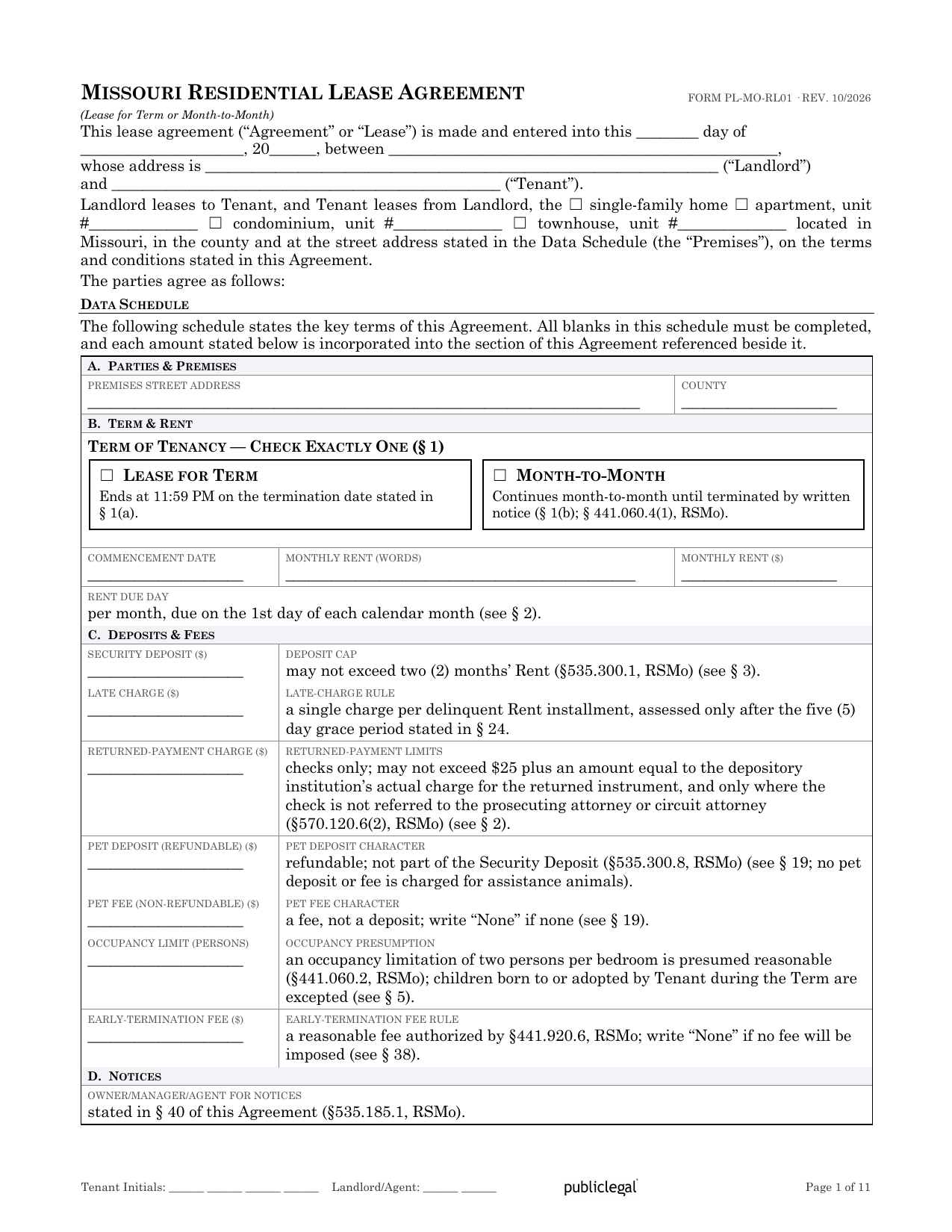
Missouri Residential Lease Agreement
(Lease for Term or Month-to-Month)
This lease agreement (“Agreement” or “Lease”) is made and entered into this _____ day of
_____, 20_____, between _____,
whose address is _____ (“Landlord”)
and _____ (“Tenant”).
Landlord leases to Tenant, and Tenant leases from Landlord, the ☐ single-family home ☐ apartment, unit #_____ ☐ condominium, unit #_____ ☐ townhouse, unit #_____ located in Missouri, in the county and at the street address stated in the Data Schedule (the “Premises”), on the terms and conditions stated in this Agreement.
The parties agree as follows:
Terms and Conditions
1. TERM. This Agreement shall commence on the commencement date stated in the Data Schedule (“Commencement Date”). (CHECK EXACTLY ONE):
☐ (a) Lease: This Agreement shall continue as a lease for term. The termination date shall be on _____ (date) at 11:59 PM. Upon termination date, Tenant shall be required to vacate the Premises unless one of the following circumstances occur: (i) Landlord and Tenant formally extend this Agreement in writing or create and execute a new, written, and signed agreement; or (ii) Landlord willingly accepts new Rent from Tenant, which does not constitute past due Rent. If Landlord accepts from Tenant new Rent, a month-to-month tenancy shall be created. Either party may terminate this month-to-month tenancy by following the procedures specified in paragraph (b) of this TERM section. Rent shall continue at the rate specified in this Agreement, or as allowed by law. All other terms and conditions as outlined in this Agreement shall remain in full force and effect.
☐ (b) Month-to-Month: This Agreement shall continue as a month-to-month tenancy. Either Landlord or Tenant may terminate this month-to-month tenancy by a written notice given to the other party stating that the tenancy shall terminate upon a periodic rent-paying date not less than one (1) month after receipt of the notice by the other party (§441.060.4(1), RSMo). If this tenancy is or becomes a week-to-week tenancy, either party may terminate it by one (1) month’s written notice to the other party given as a matter of contract under this Agreement; Landlord may also terminate any tenancy at will or by sufferance as provided by §441.060.1, RSMo.
2. RENT. Under the terms of this Agreement, “Rent” shall consist of all monetary obligations owed to Landlord by Tenant in accordance with this Agreement including any Late Charge. However, the Security Deposit shall not be considered Rent. Tenant shall pay to Landlord the Monthly Rent stated in the Data Schedule as Rent for the Term of the Agreement. Due date for Rent payment shall be the 1st day of each calendar month and shall be considered advance payment for that month. If not remitted on the 1st, Rent shall be considered overdue and delinquent on the 2nd day of each calendar month. In the event that the Commencement Date is not the 1st of the calendar month, Rent payment remitted on the Commencement Date shall be prorated based on a thirty (30) day period.
Landlord will accept personal checks, cashier’s checks, or money orders for Rent, except if Tenant has had a personal check returned for non-sufficient funds or account closure. If Tenant makes any payment under this Agreement by check and the check is dishonored or returned unpaid by a financial institution and the check is not referred to the prosecuting attorney or circuit attorney for any action under §570.120, RSMo, Tenant shall pay the Returned-Payment Charge stated in the Data Schedule, which shall not exceed $25 plus an amount equal to the actual charge by the depository institution for the return of each unpaid or dishonored instrument (§570.120.6(2), RSMo). No returned-payment charge applies to electronic or ACH payments; if an electronic, ACH, or other non-check payment is returned or dishonored, Tenant shall pay, as damages, an amount equal to the actual charge imposed on Landlord by the depository institution for the returned payment. Landlord may choose not to accept cash. Payment shall be made to Landlord under the following name and address:
_____
3. SECURITY DEPOSIT. Upon execution of this Agreement, Tenant shall deliver a sum of money not exceeding two (2) months of monthly Rent, in the amount stated in the Data Schedule (the “Security Deposit”), to either Landlord or Landlord’s property manager, as specified by Landlord. As required by §535.300, RSMo, Landlord shall hold the Security Deposit in a bank, credit union, or depository institution account insured by an agency of the federal government, as security for Tenant’s performance of Tenant’s obligations under this Agreement.
(a) Use of Security Deposit. Landlord may withhold from the Security Deposit such amounts as are reasonably necessary to: (1) remedy any default by Tenant in the payment of Rent; (2) restore the Premises to its condition at the commencement of the Term, excluding ordinary wear and tear; or (3) compensate Landlord for actual damages sustained as a result of Tenant’s failure to provide adequate notice to terminate this Agreement in accordance with law or the terms of this Agreement, provided Landlord makes reasonable efforts to mitigate damages (§535.300.4(3), RSMo); and as may be permitted by applicable law.
(b) Carpet Cleaning Costs. An amount up to $_____ may be withheld from the Security Deposit for actual carpet cleaning costs incurred. However, Tenant may still be liable for actual costs for carpet cleaning or other repairs or replacements of damage that exceed ordinary wear and tear, which may also be withheld from the Security Deposit.
(c) Return of Security Deposit. Within thirty (30) days after the date of termination of the tenancy, Landlord shall either (1) return the full amount of the Security Deposit, or (2) furnish Tenant a written itemized list of the damages for which the Security Deposit or any portion thereof is withheld, along with the balance of the Security Deposit, plus any receipt for actual carpet cleaning costs as provided in this Agreement (§535.300.3, RSMo). Landlord complies with this paragraph by mailing the statement and any payment to Tenant’s last known address. The refund may be made in one check, payable jointly to all known individuals and entities that comprise Tenant as defined under the Lease. Landlord may mail the check only to one Tenant.
(d) Move-Out Inspection. Landlord shall give Tenant (or Tenant’s representative) reasonable notice in writing at Tenant’s last known address, or in person, of the date and time when Landlord will inspect the Premises following the termination of this Agreement to determine the amount of the Security Deposit to be withheld; the inspection shall be held at a reasonable time, and Tenant has the right to be present at the inspection (§535.300.5, RSMo).
(e) Security Deposit Not Considered Liquidated Damages. The Security Deposit does not constitute liquidated damages, and nothing in this Agreement shall limit Landlord’s right to recover actual damages in excess of the Security Deposit, or permit Tenant to apply any portion of it in lieu of payment of any Rent due under this Agreement.
(f) Interest-Bearing Account. The Security Deposit, along with any prepaid rent or other deposit under this Agreement, may be held in an interest-bearing account. Any interest earned shall be paid to Landlord (or its property manager, if one has been designated).
(g) Transfer of Interest. If Landlord conveys Landlord’s interest under this Agreement and actually transfers the Security Deposit to Landlord’s grantee or assignee, and that grantee or assignee assumes Landlord’s obligations with respect to the Security Deposit, then Tenant shall look solely to such grantee or assignee for the return of the Security Deposit. Nothing in this paragraph waives any right or remedy of Tenant under §535.300, RSMo, including §535.300.6, RSMo.
4. CONDITION OF PREMISES. With the exception of the items listed in this section and identified as “Maintenance Work,” Tenant stipulates, represents and warrants that Tenant has examined the Premises, and that they are at the time of the execution of this Agreement in good order, repair, and in a safe, clean and habitable condition. If Landlord is unable to deliver possession of the Premises to Tenant within ten (10) days of the scheduled Commencement Date, Tenant shall have two options as Tenant’s sole and exclusive remedies for such failure: (a) to terminate this Agreement by providing notice to Landlord before possession is delivered, in which case Landlord shall promptly return all prepaid Rent and the Security Deposit; or (b) to receive a prorated abatement in Rent until the date possession is delivered. A delay in completing any listed Maintenance Work does not constitute a failure to deliver possession unless the incomplete Maintenance Work prevents occupancy of the Premises. The foregoing remedies are exclusive as to Landlord’s failure to deliver possession, but they do not limit any right or remedy that cannot lawfully be waived under applicable law, including the implied warranty of habitability.
Tenant is solely responsible for any repairs that need to be made due to Tenant’s negligence, intentional misconduct, or neglect (or that of others as outlined in the JOINT AND SEVERAL LIABILITY section of this Agreement). Landlord may opt to perform these repairs, and Tenant must reimburse Landlord for the cost, along with interest at a rate of three percent (3%) above the publicly announced prime rate of Bank of America, N.A. (or its successors), but not exceeding the maximum rate permitted by law (the “Default Rate”), from the date Landlord incurs the expense until the date of reimbursement by Tenant. Except as required by applicable law, Landlord is not obligated to make any other improvements or repairs to the Premises. Landlord and Tenant agree that: (for each item, check either Landlord or Tenant):
LANDLORD
TENANT
Landlord or Tenant is responsible for lawn maintenance and routine landscaping, if any, or arranging for its maintenance.
☐
☐
Landlord or Tenant is responsible for clearing snow and ice from the Premises, or arranging for its removal.
☐
☐
Landlord or Tenant is responsible for extermination of rodents and insects, with the exception of treatment for wood-destroying insects, for which Landlord remains responsible.
☐
☐
The scope of the Maintenance Work is restricted to the items listed below (if applicable). These items must be completed before the scheduled start date of the lease term, unless otherwise indicated:
_____
5. USE OF PREMISES. The Premises shall be used and occupied by Tenant and Tenant’s immediate family,
consisting of _____, exclusively,
as a private single family dwelling, and no part of the Premises shall be used at any time during the term of this Agreement by Tenant for the purpose of carrying on any business, profession, or trade of any kind, or for any purpose other than as a private single family dwelling. Tenant shall not allow any other person, other than Tenant’s immediate family or transient relatives and friends who are guests of Tenant, to use or occupy the Premises without first obtaining Landlord’s written consent to such use. A guest who stays on the Premises for more than _____ consecutive days, or more than _____ days in any twelve (12) month period, without Landlord’s prior written consent, is an unauthorized occupant, and such stay is a default under this Agreement. Tenant shall comply with any and all laws, ordinances, rules and orders of any and all governmental or quasi-governmental authorities affecting the cleanliness, use, occupancy and preservation of the Premises. Occupancy of the Premises is limited to Tenant and the persons listed above, subject to the Occupancy Limit stated in the Data Schedule; children born to or adopted by Tenant during the Term may also reside in the Premises. An occupancy limitation of two persons per bedroom is presumed reasonable under §441.060.2, RSMo.
6. ASSIGNMENT AND SUBLEASING. Tenant may not assign Tenant’s interests under this Agreement, sublease any portion of the Premises, or grant any license to use any portion of the Premises without the prior written consent of Landlord. Any unapproved attempt by Tenant to assign, sublease, or license all or any portion of Tenant’s interest under this Agreement shall qualify as a material breach of this Agreement. Such actions (whether through voluntary act, operation of law, or otherwise) shall be deemed null and void regarding the transfer of such interest to any third party. The prohibited activities described in this paragraph shall include but are not limited to subleasing through short-term rental or sharing services such as Airbnb®, Craigslist®, Vrbo®, or any rental, sharing, exchanging, or hosting platform. A consent by Landlord to one such assignment, subleasing, or license is not consent to any subsequent assignment, subleasing, or license. In addition, as provided by §534.347, RSMo, if Tenant allows another person or persons to come into sole possession of the Premises under or by collusion with Tenant and without Landlord’s permission, then in any action under Chapter 534 or 535, RSMo the court may, in addition to the Rent due, award damages not to exceed twice the amount of the Rent due, together with attorneys’ fees, other expenses, and other remedies provided in this Agreement.
7. ALTERATIONS AND IMPROVEMENTS. Tenant shall make no alterations to the buildings or improvements on the Premises or construct any building or make any other improvements on the Premises without the prior written consent of Landlord. Any and all alterations, changes, and/or improvements built, constructed or placed on the Premises by Tenant shall, unless otherwise provided by written agreement between Landlord and Tenant, be and become the property of Landlord and remain on the Premises at the expiration or earlier termination of this Agreement. Notwithstanding the foregoing, Landlord shall not refuse to permit a modification, at the expense of a person with a disability, that is reasonable and may be necessary to afford that person full enjoyment of the Premises, as required by §213.040, RSMo, and the federal Fair Housing Act; where reasonable, Landlord may condition permission on the renter’s agreement to restore the interior of the Premises to the condition that existed before the modification, reasonable wear and tear excepted.
8. HAZARDOUS MATERIALS. Tenant shall not keep on the Premises any item of a dangerous, flammable or explosive character that might unreasonably increase the danger of fire or explosion on the Premises or that might be considered hazardous or extra hazardous by any responsible insurance company.
9. METHAMPHETAMINE PRODUCTION DISCLOSURE. Missouri law (§441.236, RSMo) requires a landlord who has knowledge that the Premises is or was used as a site for methamphetamine production to disclose that fact in writing to a prospective lessee, including any prior knowledge of methamphetamine production regardless of whether the persons involved in the production were convicted.
(CHECK EXACTLY ONE):
☐ Landlord has no knowledge that the Premises is or was used as a site for methamphetamine production.
☐ Landlord discloses that the Premises is or was used as a site for methamphetamine production; details:
_____
10. HAZARDOUS OR RADIOACTIVE CONTAMINATION DISCLOSURE. Missouri law (§442.055, RSMo) requires a landlord to disclose in writing to a prospective lessee the fact that the Premises is or was previously contaminated with radioactive material or other hazardous material if Landlord has knowledge of such contamination; knowledge requires receipt of a report stating affirmatively that the Premises is or was previously contaminated. Knowing non-disclosure is a class A misdemeanor.
(CHECK EXACTLY ONE):
☐ Landlord has no knowledge that the Premises is or was previously contaminated with radioactive material or other hazardous material.
☐ Landlord discloses that the Premises is or was previously contaminated with radioactive material or other hazardous material; details:
_____
11. UTILITIES AND SERVICES. Tenant agrees to cover all expenses associated with connecting utilities, including electricity, natural gas, sewer, and water, as well as services such as sanitation, cable or satellite television, internet service, security alarm service, and telephone service. Tenant will also be responsible for any deposits required for these services and any costs incurred during the Term. Tenant must arrange for all accounts to be put in Tenant’s name no later than the first day of the Term. If Tenant fails to have all utilities placed in Tenant’s name within three (3) days of occupying the Premises, such failure shall constitute a default under this Agreement, and Landlord may pay any amounts necessary to maintain or restore utility service and recover the amounts paid from Tenant as additional Rent. Tenant may install a satellite dish or antenna within Tenant’s exclusive-use area as permitted by federal law (47 C.F.R. § 1.4000), subject to Landlord’s reasonable safety and installation conditions; Landlord’s written approval is required before installing any satellite dish or antenna on any common or non-exclusive-use area of the Premises.
12. MAINTENANCE AND REPAIR; RULES. Subject to Landlord’s duties under applicable law, Tenant will, at its sole expense, keep and maintain the Premises and appurtenances in good and sanitary condition and repair during the term of this Agreement and any renewal of it. Nothing in this Agreement waives any right or remedy, or relieves Landlord of any duty, that cannot lawfully be waived under applicable statutory or common law, including §441.234, RSMo. Without limiting the generality of the foregoing, unless otherwise agreed in writing Tenant shall:
(a) Not obstruct the driveways, sidewalks, courts, entry ways, stairs and/or halls, which shall be used for the purposes of ingress and egress only;
(b) Not place boats, trailers, recreational vehicles (RVs), or campers on the Premises.
(c) Keep all windows, glass, window coverings, doors, locks and hardware in good, clean order and repair;
(d) Not obstruct or cover the windows or doors;
(e) Not leave windows or doors in an open position during any inclement weather;
(f) Take necessary and appropriate measures to prevent pipes from freezing during freezing temperatures.
(g) Not hang any laundry, clothing, sheets, etc. from any window, rail, porch or balcony nor air or dry any of same within any yard area or space;
(h) Not change, replace, or add locks to any doors or windows without Landlord’s prior written consent. Upon termination or expiration of the Agreement, Tenant must return all keys, fobs, passcards, and garage openers to Landlord. If Tenant requests Landlord to change the locks, Tenant must pay in advance for all related locksmith or contractor fees, and Landlord may, but is not obligated to except as required by law, change the locks in accordance with this request;
(i) Comply with all rules related to vehicles and parking. Vehicles belonging to Tenant, their family members, guests, invitees, agents, or employees, including automobiles and motorcycles, must be in operating condition, licensed, and insured. If provided, they must be parked in designated parking areas and not elsewhere. The Premises may not be used for any vehicle repairs;
(j) Not drill into the walls, woodwork or any part of the Premises with nails, screws or adhesive hangers, with the exception of standard picture hooks, shade brackets and curtain rods;
(k) Not place any objects or personal property in a manner that exceeds the load limits of the Premises. Furniture or equipment such as waterbeds, pianos, aquariums, and similar heavy items may only be placed on the Premises with the Landlord’s written consent.
(l) Not leave the Premises unoccupied for more than _____ consecutive days without prior written notice to Landlord;
(m) Keep all air conditioning filters clean and free from dirt, and replace the filters regularly (no less than every three months);
(n) Ensure that all bathroom fixtures, plumbing, and water systems are in good condition and functioning properly; use these systems only for their intended purposes; and not allow any debris, waste, or substances to be disposed of in them. Tenant is responsible for any damage or repair costs caused by improper usage;
(o) Maintain order at all times, both within the Premises and in all places on the Premises, including among family and guests, and avoid making or permitting any loud or improper noises that might disturb other residents;
(p) Maintain the volume of all audio devices, such as radios, televisions, stereos, and entertainment equipment, at a level that does not disturb other residents;
(q) Store and dispose of garbage, trash, waste, and debris in containers designated by Landlord, placed in designated areas, and prepared for collection according to the Landlord’s specifications. If Landlord designates a pickup service, Tenant must use it at Tenant’s own expense. Tenant may be required by Landlord to contract directly with a designated service provider. Food items and other waste must be stored and removed from the property in leak-proof containers. Tenant must clean and remove any evidence of leaks at Tenant’s own expense. Tenant assumes all costs of extermination and fumigation for infestation caused by Tenant;
(r) Properly use and operate all electrical, gas, heating, plumbing and other fixtures and appliances supplied by Landlord;
(s) Not engage in smoking or the use of vapor-generating electronic devices, including, but not limited to, tobacco, marijuana, or cannabis (THC, CBD), within the interior or exterior boundaries of the Premises. Should Tenant breach this provision, Tenant shall be liable for all costs associated with the cleaning, restoration, deodorizing, abatement, repainting, or replacement of any affected ductwork, carpeting, vinyl flooring, or curtains that may be required as a result of such breach;
(t) Regularly inspect all smoke detectors, fire extinguishers, and other safety devices to ensure they are functioning correctly, including replacing batteries as needed to maintain their good working order;
(u) Comply with and follow all rules and regulations that pertain to the Premises or the related common areas, as established and communicated by the Owners’ Association having control over them;
(v) Upon termination and vacation, restore the Premises to their initial condition except for reasonable wear and tear.
13. INSURANCE. Tenant shall obtain adequate insurance for Tenant’s personal property and liability insurance in the amount of $_____ during the Term and any extensions of this Agreement, shall deliver proof of such insurance to Landlord before taking possession of the Premises, shall keep such insurance in force for the entire Term (any lapse constitutes a default under this Agreement), and shall demonstrate the same to Landlord upon request. Landlord shall not be liable for damage to Tenant’s property caused by negligence or any other cause, except to the extent such damage is the result of Landlord’s gross negligence or intentional misconduct. Landlord, Landlord’s agent or manager, or, if applicable, the Owners’ Association, are not responsible for insuring Tenant’s or Tenant’s permitted visitors’ personal property and vehicles against loss or damage due to theft, vandalism, fire, water, rain, criminal or negligent acts of others, or any other cause. The parties agree that, upon notification by Landlord, Tenant shall take all actions necessary to avoid: (i) an increase in Landlord’s insurance premium (or Tenant shall pay for the increase in premium); or (ii) loss of insurance. Landlord and Tenant waive any rights they may have against each other for any loss or damage to the person or property of Landlord or Tenant, the Premises or its contents, which is covered by insurance held by either Landlord or Tenant (up to the amount of insurance proceeds, including the deductible). Additionally, both parties, on behalf of their respective insurance companies that insure their property, waive any right of subrogation they may have against the other party.
14. FIRE OR CASUALTY DAMAGE. If the Premises is damaged by fire or other casualty not caused by Tenant but is not destroyed, Landlord may, at Landlord’s option and subject to Landlord’s duties under applicable law, either (a) restore the Premises to a habitable condition within a reasonable time, or (b) terminate this Agreement by written notice to Tenant, in which case Landlord shall refund any prepaid Rent applicable to the period after Tenant vacates and return the unexpended balance of the Security Deposit as provided by law. If the Premises is destroyed by an act of God, fire, or other natural or man-made disaster not caused by Tenant, Tenant shall not be liable for Rent for the remainder of the Term (§441.645, RSMo), and either party may terminate this Agreement by written notice to the other party, in which case Landlord shall refund any prepaid Rent applicable to the period after the casualty and return the unexpended balance of the Security Deposit as provided by law. Nothing in this section waives any right or remedy that cannot lawfully be waived under applicable law, including §§441.010 and 441.645, RSMo.
15. QUIET ENJOYMENT AND ACCESS. Landlord shall allow Tenant to occupy and use the Premises peacefully during the Term without unreasonable interference from Landlord, as long as Tenant complies with this Agreement. Landlord or its designated agent(s) have the right, but not the obligation, to inspect the Premises’ condition and ensure Tenant’s compliance with this Agreement, make necessary or desired repairs, and show the property to prospective tenants or buyers. For these purposes, Landlord may enter at reasonable times upon reasonable advance notice to Tenant given by any reasonable method (a formal Notice under the NOTICE section is not required); twenty-four (24) hours’ advance notice is deemed reasonable, except in cases of emergency, which require no notice. Notwithstanding the preceding sentences, during the last sixty (60) days of the Term or of any renewal, twelve (12) hours’ advance notice is deemed reasonable for entries to show the Premises to prospective tenants or buyers. Landlord shall have the right to display “for sale,” “for rent,” or similar signs on the Premises at any time before the expiration of this Agreement.
16. SUBORDINATION OF LEASE. This Agreement and Tenant’s interest under this Agreement are and shall be subordinate, junior and inferior to any and all mortgages, liens or encumbrances now or hereafter placed on the Premises by Landlord, all advances made under any such mortgages, liens or encumbrances (including, but not limited to, future advances), the interest payable on such mortgages, liens or encumbrances and any and all renewals, extensions or modifications of such mortgages, liens or encumbrances.
17. TENANT’S HOLDOVER AND RENEWAL. Tenant shall provide written notice to Landlord at least _____ days prior to the expiration of the Term indicating Tenant’s intention to either renew or terminate this Agreement. If Tenant desires to renew this Agreement, Landlord may, at Landlord’s sole discretion, enter into a new Agreement with Tenant. If Tenant remains in possession of the Premises after the expiration or termination of this Agreement without Landlord’s written consent, such holdover shall constitute a default under this Agreement and shall create a tenancy at sufferance, which Landlord may terminate as provided by law; no notice to quit beyond that required by law is a precondition to an action under Chapter 534 or 535, RSMo. A holdover does not renew or extend this Agreement. Tenant shall be liable for all damages resulting from the holdover, including the liability imposed by §441.080, RSMo: a tenant who willfully holds over after the termination of the term, after demand has been made and written notice requiring possession has been given, shall pay to the person kept out of possession double the yearly value of the Premises for the entire period of the detention, as provided by law; this liability also applies to any person who comes into possession of the Premises under or by collusion with Tenant, as provided by §441.080, RSMo. Landlord’s acceptance of past-due Rent does not create or extend a tenancy. If Landlord willingly accepts new Rent (which does not constitute past-due Rent) for a period after expiration, a month-to-month tenancy is created under paragraph (b) of the TERM section, terminable as provided there, and the statutory holdover liability described in this section does not apply to any period of such accepted month-to-month tenancy.
18. SURRENDER OF PREMISES. Upon the expiration of the term of this Agreement, Tenant shall surrender the Premises in as good a state and condition as they were at the commencement of this Agreement, reasonable use and wear and tear thereof and damages by the elements excepted.
19. ANIMALS. Tenant shall be entitled to keep no more than _____ domestic dogs, cats or birds; however, at such time as Tenant shall actually keep any such animal on the Premises, Tenant shall pay to Landlord the refundable Pet Deposit and, if stated in the Data Schedule, the non-refundable Pet Fee. The Pet Fee is a fee, not a deposit; it does not secure performance of any obligation under this Agreement and is earned by Landlord upon payment. Neither the Pet Deposit nor the Pet Fee is part of the Security Deposit for purposes of §535.300, RSMo (§535.300.8, RSMo). This section does not apply to assistance animals required as a reasonable accommodation under applicable fair-housing law, including §213.040, RSMo, and the federal Fair Housing Act: an assistance animal is not a pet, no pet deposit or pet fee shall be charged for an assistance animal, and, where the law permits, Landlord may request reliable verification of the disability-related need for the accommodation. Tenant remains responsible for all damage caused by any animal kept on the Premises.
20. QUIET ENJOYMENT. Tenant, upon payment of all sums payable by Tenant under this Agreement, upon performance of Tenant’s agreements in this Agreement, and upon observance of all rules and regulations, may peacefully and quietly hold and enjoy the Premises for the term of this Agreement.
21. INDEMNIFICATION. Except for damage or injury caused by Landlord’s gross negligence or intentional misconduct, or arising from Landlord’s breach of a duty imposed by applicable law, Landlord shall not be liable for any damage or injury of or to the Tenant, Tenant’s family, guests, invitees, agents or employees or to any person entering the Premises or the building of which the Premises are a part or to goods or equipment, or in the structure or equipment of the structure of which the Premises are a part, and Tenant hereby agrees to indemnify, defend and hold Landlord harmless from any and all claims or assertions of every kind and nature arising out of the acts or omissions of Tenant or Tenant’s family, guests, invitees, agents or employees. Nothing in this section limits any right, remedy, or duty that cannot lawfully be waived or disclaimed under applicable law, including §535.300, RSMo, and the implied warranty of habitability.
22. DEFAULT. If Tenant fails to make a Rent payment by the due date, Landlord shall make demand for the Rent due, as required by §535.020, RSMo (which demand shall be deemed good whenever made after the Rent accrues, §535.060, RSMo), and may thereafter proceed to recover possession and unpaid Rent as provided by Chapter 535, RSMo. If Tenant violates any other term of this Agreement, Landlord may declare Tenant in default and exercise any of the rights or remedies established within this Agreement or at law, subject to any notice required by law; for violations covered by §441.020 or §441.030, RSMo, Landlord may serve on Tenant ten (10) days’ written notice to vacate the Premises, as provided by §441.040, RSMo, and any notice to vacate under §441.040, RSMo, shall so state. In the event of a material default by Tenant, Landlord may terminate this Agreement and Tenant’s right of possession by written notice to Tenant, without prejudice to Landlord’s right to recover Rent and damages as provided by law. These rights and remedies are in addition to, and not in place of, any other rights and remedies available under law or equity, including those outlined in §441.065 RSMo in the event of Tenant’s abandonment of the Premises. Landlord’s failure to exercise or delay in exercising any right or remedy does not constitute a waiver of that right. A single or partial exercise of a right or remedy does not prevent further exercise of that right or any other right. Any payment received by Landlord does not constitute an accord and satisfaction. Landlord may accept such payment without waiving Landlord’s right to recover any remaining balance or exercise any other right or remedy in the event of Tenant’s default. Any payment received by Landlord will first be applied to the costs and expenses incurred by Landlord in re-letting the premises following a Tenant default, including but not limited to advertising fees, court-awarded attorneys’ fees, brokerage fees, and cleaning and repair costs; second, to any additional charges or other debts (other than monthly rent) owed by Tenant under this Agreement; and third, to the payment of any Rent owed. If a deficiency remains after these payments are applied, Tenant must immediately pay the deficiency, along with interest at the Default Rate, until it is fully paid.
23. DAMAGES. Tenant shall be responsible for compensating Landlord for any damages incurred due to the Tenant’s breach of this Agreement, which may include, but is not limited to, lost rent, the costs of preparing the Property for re-rental and a real estate broker’s commission for finding a new tenant due to eviction or early termination of the tenancy.
24. LATE CHARGE. If any installment of Rent is not received within five (5) days after its due date, Tenant shall pay Landlord a single late charge in the amount stated in the Data Schedule for that delinquency. Only one (1) late charge shall be assessed per delinquent installment; a late charge shall not accrue daily, shall not compound, and shall not be assessed again for the same delinquency.
Any late fees owed by Tenant under this provision are in addition to any other rights and remedies provided in this Agreement and will not limit Landlord’s ability to declare Tenant in default for failure to pay Landlord any sum when due.
25. ABANDONMENT. If at any time during the term of this Agreement Tenant abandons the Premises or any part thereof, Landlord may, at Landlord’s option, obtain possession of the Premises in the manner provided by law. In addition, Landlord may, at Landlord’s discretion, as agent for Tenant, relet the Premises, or any part thereof, for the whole or any part thereof, for the whole or any part of the then unexpired term, and may receive and collect all Rent payable by virtue of such reletting, and, at Landlord’s option, hold Tenant liable for any difference between the Rent that would have been payable under this Agreement during the balance of the unexpired term, if this Agreement had continued in force, and the net Rent for such period realized by Landlord by means of such reletting.
26. ATTORNEYS’ FEES. If Landlord successfully enforces a valid obligation of Tenant under this Agreement through a court action, Tenant shall pay Landlord’s reasonable attorneys’ fees and court costs actually incurred in that successful enforcement, as awarded by the court, in addition to any damages or other relief awarded. This section does not entitle Landlord to any fee or cost for an unsuccessful claim, and nothing in this section limits any right or remedy of Tenant under applicable law, including any statutory fee provision. This provision shall survive this Agreement’s termination.
27. SEVERABILITY. If any provision of this Agreement or its application is found to be invalid or unenforceable for any reason, it shall not impact the enforceability of the remaining provisions of this Agreement or the enforceability of the invalid provision when applied to other individuals, entities, or circumstances, and such provision will instead be enforced to the maximum extent permitted by law.
28. JOINT AND SEVERAL LIABILITY. The undersigned Tenants shall be jointly and severally liable for all covenants and obligations under this Agreement, including but not limited to payment of Rent and other charges, compliance with all covenants and conditions, and proper use and maintenance of the Premises. Each Tenant is responsible for the full performance of all obligations under this Agreement, and any one Tenant may be required to perform all such obligations in the event of a default by any other Tenant.
29. SUCCESSORS AND ASSIGNS. The covenants, obligations, and conditions set forth in this agreement shall be binding upon and inure to the benefit of the parties hereto and their respective heirs, executors, administrators, successors, and assigns.
30. DESCRIPTIVE HEADINGS. The descriptive headings in this Agreement are for convenience of reference only and they are not intended to have any effect whatsoever in determining the rights or obligations of Landlord or Tenant.
31. CONSTRUCTION. The language used in this Agreement shall include, where appropriate, either gender or both, singular and plural forms.
32. GOVERNING LAW. This Agreement shall be governed by, construed and interpreted in accordance with the laws of the State of Missouri. Any action arising out of or relating to this Agreement or the Premises shall be brought and maintained only in the circuit court (including an associate circuit court) of the county in which the Premises are located, and each party consents to venue and personal jurisdiction there.
33. TIME OF ESSENCE. Time is of the essence with respect to all obligations under this Agreement, including but not limited to the payment of Rent, compliance with the terms of this Agreement, and the delivery of possession of the Premises upon termination of this Agreement. Tenant’s failure to perform timely any obligation under this Agreement shall qualify as a material breach. A “day” under this Agreement refers to a 24-hour calendar day, seven days a week, unless otherwise specified.
34. WAIVER OF LEASE PROVISIONS AND FUTURE ENFORCEMENT. The failure of Landlord to insist on the exact and immediate fulfillment of any obligations or conditions under this Agreement, or any of the regulations specified, shall not qualify as a waiver of these provisions. This failure to insist will not restrict Landlord from demanding prompt compliance in the future and shall not prevent Landlord from taking legal action in case of future violations. Landlord can only waive a provision, obligation, or condition under this Agreement if the waiver is in writing and signed by Landlord.
35. MODIFICATION. This Agreement constitutes the full and complete understanding between the parties and may not be altered or amended in any manner except through a written agreement signed by both Landlord and Tenant.
36. SECURITY CAMERA USAGE DURING TENANCY. Landlord shall not install or operate any camera, microphone, or other recording or surveillance device inside the dwelling unit of the Premises during the tenancy, and no exterior or common-area camera shall be positioned or used to view or record the interior of the Premises or to intercept private communications. Exterior security cameras (including doorbell cameras) and cameras located in common areas of multi-family housing, such as entranceways, hallways, building exteriors, exercise areas, front desk or concierge areas, elevators, refuse rooms, athletic courts or fields, laundry rooms, or parking areas, may remain installed and in use, subject to the preceding sentence. Tenant may install and operate Tenant’s own camera or recording devices inside the Premises, provided they do not damage the Premises, are not positioned to capture common areas, building exteriors, or other dwelling units, and are not used to intercept any wire, oral, or electronic communication in violation of §542.402, RSMo; Tenant shall remove all such devices at the end of the tenancy and repair any damage caused by installation or removal.
37. LEAD-BASED PAINT DISCLOSURE. This disclosure is applicable if the Premises was constructed prior to 1978. Tenant acknowledges receiving the EPA publication, “Protect Your Family From Lead In Your Home.” In addition, a fully executed copy of the document “Disclosure of Information on Lead-Based Paint and Lead-Based Paint Hazards” has been signed by both Tenant and Landlord, as well as any applicable real estate broker, and is attached to and incorporated as a part of this Agreement.
38. VICTIMS OF DOMESTIC VIOLENCE, SEXUAL ASSAULT, OR STALKING. As provided by §441.920, RSMo, which applies to residential properties: Landlord shall not deny tenancy to, evict, or find in violation of this Agreement any applicant or Tenant on the basis of, or as a direct result of, the fact that the person is, has been, or is in imminent danger of becoming a victim of domestic violence, sexual assault, or stalking, if the person otherwise qualifies for tenancy or occupancy. This protection does not apply if (1) the applicant or Tenant allowed into the Premises a person named in any documentation described in §441.920.4, RSMo, or (2) Landlord reasonably believes that a person named in any such documentation poses a threat to the safety of the other occupants or the property. In any action under Chapter 441, 534, or 535, RSMo, a Tenant who establishes the conditions stated in §441.920 (including notice to Landlord and, on request, the documentation described in §441.920.4, RSMo) has an affirmative defense and is not liable for Rent for the period after vacating the Premises, as provided by §441.920.3, RSMo. Submitting false information under §441.920 may be a basis for denial of tenancy, eviction, or a finding of lease violation. If a Tenant desires to terminate this Agreement before its expiration under §441.920, Landlord may impose the reasonable early-termination fee, if any, stated in the Data Schedule (§441.920.6, RSMo); no fee is imposed if none is stated.
39. RETURN OF KEYS. Tenant must return the keys to the Premises to Landlord when Tenant vacates the Premises.
40. NOTICE. Any notice or demand required or necessary under this Agreement or under state law (“Notice”) shall be considered validly given or served if it is sent in writing to the individual named below and delivered through one of the following methods: (1) personal delivery, (2) courier or messenger service, (3) posting or legal publication, (4) registered or certified mail through the United States Postal Service, and (5) electronic mail to the e-mail address stated in this Agreement, which is a valid method of service only for a notice or demand for which no statute prescribes a method of service; an emailed copy never satisfies a statutory service requirement. Notice is considered delivered when it is actually received by the intended recipient, or as otherwise specified under applicable law or this Agreement. Refusal to accept a Notice shall qualify as delivery of the Notice.
If to Landlord to:
If to Tenant to:
LANDLORD’S NAME _____ TENANT’S NAME _____
LANDLORD’S ADDRESS _____ TENANT’S ADDRESS _____
LANDLORD’S CITY, STATE, AND ZIP CODE _____ TENANT’S CITY, STATE, AND ZIP CODE _____
LANDLORD’S E-MAIL ADDRESS _____ TENANT’S E-MAIL ADDRESS _____
Person authorized to manage the Premises (§535.185.1(1), RSMo):
_____ (name),
_____ (address).
Owner of the Premises, or person authorized to act for and on behalf of the owner for purposes of service of process and of receiving and receipting for notices and demands (§535.185.1(2), RSMo):
☐ Same as the person authorized to manage, above.
_____ (name),
_____ (address).
Either Landlord or Tenant may modify the address for payment of Rent or delivery of Notices (or designate a new person to receive them) by providing at least fifteen (15) days’ written notice to the other party in the manner specified above.
41. PARKING. If parking spaces are included as part of this Agreement, the following information must be indicated:
Type of Parking Space: ☐ Attached Garage or ☐ Offsite (specify location):
_____
Number of Spaces: _____
Designation: ☐ Reserved, ☐ Unreserved, or ☐ Other (describe):_____
Note: Any additional charges or fees for parking (beyond the monthly Rent outlined in this Agreement) are as follows: _____
_____
42. ADDENDA. The terms set forth in the attached addenda or riders are made a part of this Agreement. (list titles of addenda:)
☐ Lead-Based Paint Disclosure (housing built before 1978 — see § 37).
☐ Other:
_____
43. ADDITIONAL PROVISIONS; DISCLOSURES.
_____
44. EXECUTION. Each person signing this Agreement as Tenant is an adult and is jointly and severally liable as provided in this Agreement. Only persons who sign this Agreement are parties to it; occupants who do not sign are not parties and acquire no rights under this Agreement except as provided by applicable law. The parties have executed this Agreement and agree to be bound by its terms as of the date first written above.
45. WAIVER OF JURY TRIAL. EACH PARTY, TO THE FULLEST EXTENT PERMITTED BY LAW, KNOWINGLY, VOLUNTARILY, AND INTENTIONALLY WAIVES ANY RIGHT TO A TRIAL BY JURY IN ANY ACTION, PROCEEDING, OR COUNTERCLAIM ARISING OUT OF OR RELATING TO THIS AGREEMENT, THE PREMISES, OR THE TENANCY, INCLUDING ANY ACTION FOR POSSESSION, RENT, OR DAMAGES.
If you are not satisfied with your PublicLegal form purchase, contact support for help. We keep the purchase path simple: secure checkout, immediate access, and no subscription.
The purchase includes 4 document groups and 7 delivered files in the Word and PDF formats shown in the included-documents list. A completed sample lease is available as a separate $4.99 add-on and is not part of that count.
This is PL-MO-RL01, Rev. 10/2026, last revised October 9, 2026. Addresses the two-month security-deposit cap, insured-account holding, and 30-day itemized return (RSMo § 535.300), manager and owner disclosure (§ 535.185), month-to-month notice of one month (§ 441.060.4(1)), protections for victims of domestic violence, sexual assault, or stalking (§ 441.920), and methamphetamine and contamination disclosures when they apply (§ 441.236 and § 442.055).
Use the Word version when you want to edit the agreement in Microsoft Word or a compatible editor. The fillable fields are in the PDF itself — this is not an online interview or document-building wizard, and no ILRG account is required. Open the PDF in a compatible PDF reader (Adobe Acrobat Reader is one free option), type in the fields, save, and print — or print a blank copy and complete it by hand. This is a one-time purchase, not a subscription; save your downloaded copies to your device.
Yes. Once purchased, you can reuse the lease and companion forms for additional properties, tenants, or transactions. Update the property, parties, dates, terms, disclosures, and other facts for each use, and confirm the law and local requirements are still current.
The packet is built for ordinary private Missouri residential rentals. Cities and counties can add notice, registration, inspection, and counsel-program rules, including in Kansas City and St. Louis. Section 441.043, RSMo, bars local rent-control, local security-deposit caps, and certain screening ordinances for private housing. Subsidized or federally regulated housing and association rules can add requirements. Confirm those overlays before signing.
No. You can check out as a guest, and the purchase is a one-time charge. There is no subscription or recurring membership fee.
Contact PublicLegal support for help with the download or delivered files. Keep your order email so the support team can locate the purchase quickly.
No. PublicLegal provides self-help legal forms and information, not legal advice. You are responsible for reviewing the completed lease and confirming state, local, federal, subsidized-housing, and property-specific requirements before signing.