
Find legal forms, law schools, and legal resources
Try “residential lease” — forms for your state are shown first.
Try “Yale” or “University of Texas” — the full ABA directory is searchable as you type.
New York City residential lease agreement — five boroughs, free-market units
Download the August 2026 New York City Residential Lease Agreement for free-market apartments, condos, and other residential rentals in the Bronx, Brooklyn, Manhattan, Queens, and Staten Island. The packet includes a complete editable DOCX, a true fillable PDF, the official NYC and HCR disclosure forms (window-guard notice, bedbug history, Local Law 1 lead notices), federal lead-based paint materials, an optional RPL § 227-a senior addendum, and an optional completed sample lease.
New York property location
New York City has separate residential lease requirements, so choose based on the rental property's location.
Rent-stabilized, rent-controlled, public-housing, and Section 8 / HAP tenancies follow different lease rules and are not covered by either form. Confirm the unit’s regulatory status before signing.
A practical New York City lease packet built to document the rental relationship: capture the deal in the front Data Schedule, work through the deposit, Good Cause Eviction, and New York City disclosure provisions, and finish in your own PDF reader or on paper.
Good Cause Eviction applies by default in the five boroughs, and this lease handles it: Schedule A carries the RPL § 231-c notice with the New York City exemption rules. Schedule B covers the city-required window-guard, stove-knob, Local Law 1 lead, tenant-data-privacy, smoking-policy, and bedbug provisions, and the packet delivers the matching official forms.
Receive the official window-guard lease notice in English and Spanish, the HCR bedbug disclosure (Form DBB-N), the HPD Local Law 1 lead notices in English and Spanish, the federal lead disclosure in Word and PDF, and the EPA lead-safety pamphlet.
Use the editable DOCX with click-to-fill controls, or open the true fillable PDF in your own PDF reader and type directly into the form fields — no online interview or ILRG account required; both print cleanly for signing.
Your $14.99 purchase includes 9 document groups and 12 delivered files in the Word and PDF formats shown below. The completed sample PDF is an optional $4.99 add-on and is not included in the 12-file count.
Self-help lease overview
A written New York City residential lease documents the landlord, tenant, premises, term, rent, security deposit, utilities, repairs, disclosures, rules, and signatures for a rental property. This agreement captures the key deal terms in a front Data Schedule before the detailed provisions.
This packet includes the New York City Residential Lease Agreement in editable DOCX and fillable PDF formats, the official window-guard, bedbug, and lead-paint notices issued by the City and State, the federal lead-based paint disclosure and EPA pamphlet for pre-1978 housing, and an optional RPL § 227-a senior-termination addendum. A completed sample lease is available as an add-on.
Scope: this form is for free-market residential rentals inside the five boroughs. It is not for rent-stabilized, rent-controlled, public-housing, Section 8/HAP, or other rent-regulated units, and not for rentals outside New York City — use the New York State lease for those. Confirm building-specific registration, annual-notice, and association requirements before signing. PublicLegal provides self-help legal forms and information, not legal advice.
This page highlights the current downloadable New York City lease packet for free-market rentals in the five boroughs: a complete editable DOCX, a true fillable PDF, official NYC and HCR disclosure forms, federal lead-based paint materials, an optional senior-termination addendum, and an optional completed sample lease. The lease uses a front Data Schedule, fixed-term or month-to-month election, a Schedule A Good Cause Eviction notice, a Schedule B of New York City notices and elections, and a move-in/move-out inspection exhibit.
Review the operative agreement terms below before you buy. This preview is not the full download package: checkout delivers the complete agreement layout, completion fields, signature pages, and the companion files listed above. The completed sample PDF remains optional.
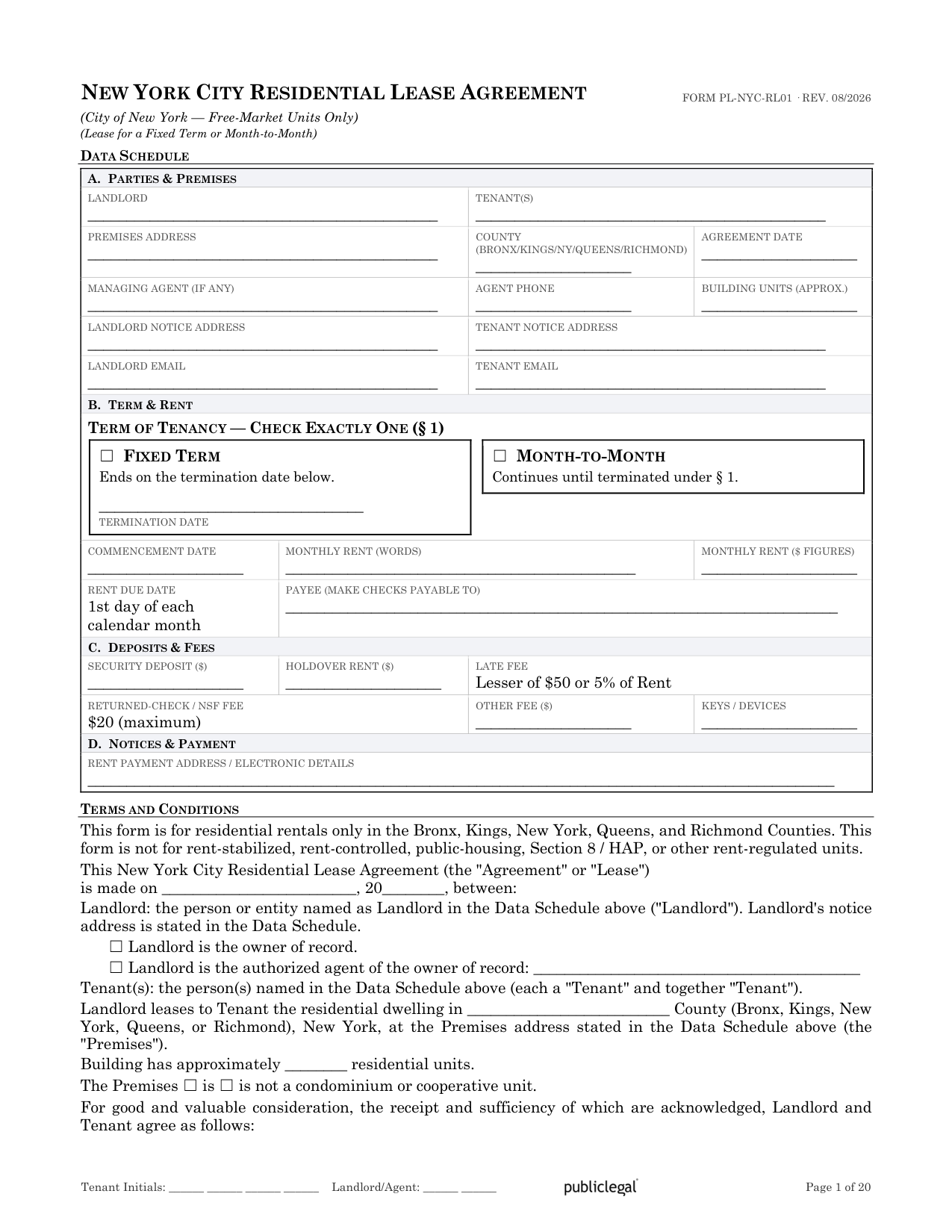
New York City Residential Lease Agreement
(City of New York — Free-Market Units Only)
(Lease for a Fixed Term or Month-to-Month)
Terms and Conditions
This form is for residential rentals only in the Bronx, Kings, New York, Queens, and Richmond Counties. This form is not for rent-stabilized, rent-controlled, public-housing, Section 8 / HAP, or other rent-regulated units.
This New York City Residential Lease Agreement (the "Agreement" or "Lease") is made on _____, 20_____, between:
Landlord: the person or entity named as Landlord in the Data Schedule above ("Landlord"). Landlord's notice address is stated in the Data Schedule.
Landlord is the owner of record.
Landlord is the authorized agent of the owner of record: _____
Tenant(s): the person(s) named in the Data Schedule above (each a "Tenant" and together "Tenant").
Landlord leases to Tenant the residential dwelling in _____ County (Bronx, Kings, New York, Queens, or Richmond), New York, at the Premises address stated in the Data Schedule above (the "Premises").
Building has approximately _____ residential units.
The Premises is / is not a condominium or cooperative unit.
For good and valuable consideration, the receipt and sufficiency of which are acknowledged, Landlord and Tenant agree as follows:
1. TERM. This Agreement begins on _____, 20_____ ("Commencement Date"). CHECK EXACTLY ONE:
A. Fixed Term. This Agreement is a lease for a term ending on _____, 20_____, at 11:59 p.m. (the "Expiration Date"). Tenant shall vacate on the Expiration Date unless (i) Landlord and Tenant sign a written extension or a new agreement, or (ii) Landlord accepts Rent for a period after the Expiration Date that is not past-due Rent, in which case a month-to-month tenancy is created under Real Property Law § 232-c on the same terms except as this Agreement or law provides. This form is not used for rent-regulated tenancies; no rent-regulation law is relied on to extend this tenancy. Any Landlord notice not to renew, or to renew at a Rent increase of 5% or more, will be given at least 30, 60, or 90 days before the Expiration Date as required by RPL § 226-c (60 days for a one-year term; 90 days for a term of two years or more), and will append the Good Cause Eviction Law notice required by RPL § 231-c.
B. Month-to-Month. This Agreement is a month-to-month tenancy beginning on the Commencement Date.
Ending a month-to-month tenancy (Option B, or a month-to-month created after a fixed term). Tenant may terminate a month-to-month tenancy by giving Landlord written notice at least one full calendar month before the last day of a monthly rental period; the tenancy then ends on that last day. Landlord may end a residential month-to-month tenancy, or may refuse to renew a fixed term, or may increase Rent by 5% or more, only by giving the written notice required by Real Property Law § 226-c. That notice period is the longer of Tenant's occupancy or the current lease term: at least 30 days if Tenant has occupied less than one year and has no lease term of at least one year; at least 60 days if Tenant has occupied more than one year but less than two years, or has a lease term of at least one year but less than two years; at least 90 days if Tenant has occupied more than two years or has a lease term of at least two years. A one-year lease always requires at least 60 days' notice. The notice shall append or contain the Real Property Law § 231-c Good Cause Eviction notice. If Landlord's notice is late, the existing tenancy continues on its existing terms until the full notice period runs.
Because the Premises are in New York City, the Premises are subject to Real Property Law Article 6-A (Good Cause Eviction) unless an exemption stated on Schedule A applies. If the Premises is subject to Article 6-A, Landlord may refuse to renew, or may recover possession, only on a ground listed in Real Property Law § 216. Any Real Property Law § 226-c notice for a covered unit shall state that lawful basis, as Real Property Law § 226-c(1)(a) requires, and shall append the Real Property Law § 231-c notice. Coverage and any exemption are disclosed on Schedule A.
If neither box is checked, this Agreement is not complete.
2. RENT. "Rent" means the monthly installment stated below. The Security Deposit is not Rent. Late fees, dishonored-check fees, attorneys' fees, utility charges, and other sums due under this Agreement are "Additional Charges," not Rent, and are not a basis for a nonpayment summary proceeding (RPAPL § 702). Additional Charges are due within 10 days after Landlord's written statement.
Monthly Rent: $_____, due on the 1st day of each calendar month in advance. Rent not received on the due date is unpaid and may be demanded. A late fee may be charged only as stated in Section 25 and Real Property Law § 238-a(2).
If the Commencement Date is not the 1st, the first installment is prorated on a 30-day month.
Any Rent increase during a month-to-month tenancy takes effect only after the notice required by Section 1B and RPL § 226-c (if the increase is 5% or more).
Payment. Tenant will pay Rent by (check all that apply):
Personal check
Money order
Cashier's or certified check
Electronic transfer to an account Landlord designates in writing
Other: _____
Payments are made payable and delivered as stated in the Data Schedule, or as Landlord later directs in writing.
Landlord shall not require electronic billing or electronic payment as the only method of paying Rent, and shall not charge a fee because Tenant pays by a permitted non-electronic method (Real Property Law § 235-g). At least one of personal check, money order, or cashier's or certified check must remain available, except that after a dishonored or stopped payment Landlord may require certified funds as this Agreement provides.
Receipts. If Tenant pays in cash or by any instrument other than Tenant's personal check, Landlord shall give Tenant a written receipt stating the date, amount, Premises, period paid, and the signature and title of the person receiving the payment (RPL § 235-e). If Tenant requests in writing a receipt for personal-check payments, Landlord shall give that receipt for the rest of the tenancy unless Tenant withdraws the request. A receipt for an in-person payment is due immediately; a receipt for an indirect payment is due within 15 days. Landlord shall keep a record of cash rent receipts for at least three years.
Dishonored Payments. If any check, draft, or like instrument given for Rent is dishonored or returned unpaid by Tenant's bank for insufficient funds or any other cause not attributable to Landlord, Tenant will pay, as an Additional Charge, a dishonored-payment charge of $20.00 (RPL § 238-a(2-a); GOL § 5-328(3)). After any dishonored or stopped payment, Landlord may require in writing that all further payments be made by money order, cashier's or certified check, or electronic transfer for the rest of the term.
3. SECURITY DEPOSIT.
A. Amount. On signing, Tenant will deposit with Landlord $_____ as a security deposit ("Security Deposit"), receipt of which Landlord acknowledges. The Security Deposit, together with any other deposit or advance of any kind, will not exceed one month's Rent (GOL § 7-108(1-a)(a)). The Security Deposit is Tenant's money, held in trust, and shall not be commingled with Landlord's personal funds (GOL § 7-103(1)). Landlord is not required to place the deposit in a bank unless the Building has six or more dwelling units or Landlord chooses to bank it. Whenever Landlord deposits the funds in a bank, the account shall be in a New York banking organization and Landlord shall give Tenant written notice of the bank's name, the bank's address, and the amount deposited (GOL § 7-103(2)). If the bank changes, Landlord will give Tenant written notice of the new bank's name and address.
B. Interest — CHECK AND INITIAL EXACTLY ONE:
The Building has five or fewer dwelling units. Landlord is not required to hold the Security Deposit in an interest-bearing account, and no interest is payable to Tenant unless Landlord elects to deposit it in an interest-bearing account, in which case the balance of interest after Landlord's 1% annual administration fee will be held in trust and paid to Tenant when the Security Deposit is returned.
Tenant initials: _____ Landlord initials: _____
The Building has six or more dwelling units. Landlord will hold the Security Deposit in an interest-bearing account at the prevailing rate for such deposits in the area (GOL § 7-103(2-a)), will retain 1% per year of the Security Deposit as administration expenses in lieu of all other administrative and custodial expenses, and will hold the balance of the interest in trust and pay it to Tenant when the Security Deposit is returned or applied. If this Agreement ends other than on a regular interest-payment date, Landlord shall pay Tenant the interest Landlord is able to collect as of that date (GOL § 7-103(2-b)).
Bank name: _____
Bank address: _____
Amount deposited: $_____
Tenant initials: _____ Landlord initials: _____
C. Use. Landlord may apply the Security Deposit, to the extent permitted by GOL § 7-108, to unpaid Rent, damage caused by Tenant or Tenant's occupants, guests, or pets beyond normal wear and tear, unpaid utility charges payable directly to Landlord under this Agreement, and the cost of moving and storing property Tenant leaves behind. If Landlord applies any part of the Security Deposit during the term, Tenant will restore the amount applied within 10 days after Landlord's written demand so that the full Security Deposit is on hand. Tenant may not treat the Security Deposit as payment of the last month's Rent.
D. Return. The Security Deposit is refundable except for reasonable, itemized amounts for the deductions stated in Section 3C. Landlord may not retain any amount for ordinary wear and tear or for damage caused by a prior tenant. Within 14 days after Tenant vacates, Landlord will give Tenant an itemized statement of the basis for any amount retained and return the balance (GOL § 7-108(1-a)(e)). If Landlord fails to give the statement and the balance within 14 days, Landlord forfeits any right to retain any portion of the Security Deposit. In any dispute, Landlord has the burden of proving the reasonableness of any amount retained (GOL § 7-108(1-a)(f)). A willful violation may result in punitive damages of up to twice the Security Deposit (GOL § 7-108(1-a)(g)). Any waiver of these rights is void (GOL § 7-108(3)). Tenant will give Landlord a written forwarding address on or before vacating; if none is given, Landlord may send the statement and balance to Tenant's last known address.
E. inspection. Before Tenant takes occupancy, Landlord offers Tenant the opportunity to inspect the Premises with Landlord or Landlord's agent to record its condition (GOL § 7-108(1-a)(c)). Tenant requests / declines this inspection (Tenant initials _____). If requested, the parties will sign a Move-In Condition Statement (the inspection exhibit) before occupancy noting any existing defects or damage; Landlord will not retain any part of the Security Deposit for a condition noted on the inspection exhibit.
F. Move-Out Inspection. After either party gives notice ending the tenancy (unless Tenant gives less than two weeks' notice), Landlord will notify Tenant in writing that Tenant may request an inspection before vacating and may be present (GOL § 7-108(1-a)(d)). If Tenant requests one, the inspection will occur no earlier than two weeks and no later than one week before the end of the tenancy; Landlord will give at least 48 hours' written notice of its date and time; after the inspection Landlord will give Tenant an itemized statement of repairs or cleaning proposed as the basis for deductions, and Tenant may cure those conditions before the tenancy ends.
4. USE AND OCCUPANCY. Tenant will use the Premises only as a private residence and Tenant's primary residence, and for no business, profession, or trade, except a lawful home occupation that has no employees, customers, or clients on the Premises and causes no additional traffic, noise, or nuisance.
Occupancy. The Premises will be occupied only by Tenant and the following persons: _____.
In addition, as permitted by RPL § 235-f: if this Agreement is signed by one Tenant, occupancy is permitted by that Tenant, the Tenant's immediate family, one additional occupant, and that occupant's dependent children, provided Tenant or Tenant's spouse occupies the Premises as a primary residence. If this Agreement is signed by two or more Tenants, occupancy is permitted by those Tenants, their immediate families, occupants, and occupants' dependent children, provided the total number of Tenants and occupants, excluding occupants' dependent children, does not exceed the number of Tenants named in this Agreement, and provided at least one Tenant or a Tenant's spouse occupies as a primary residence (RPL § 235-f(4)). Tenant will give Landlord the name of any occupant within 30 days after that occupant moves in or within 30 days after Landlord's request. No occupant or occupant's child acquires any right to continued occupancy or any tenancy right without Landlord's express written permission (RPL § 235-f(6)). Landlord may enforce any federal, state, or local occupancy, fire, or housing-code limit (RPL § 235-f(8)). Guests may stay no more than 14 consecutive days or 30 days in any 12-month period without Landlord's written consent. Tenant will comply with all laws, ordinances, rules, and orders of governmental authorities affecting the cleanliness, use, occupancy, and preservation of the Premises.
Occupancy affidavit (NYC Admin. Code § 27-2075(c)). On Landlord's written demand when Landlord rents the Premises or at any time thereafter, Tenant shall submit an affidavit setting forth the names and relationships of all occupants residing in the Premises and the ages of all minors. If the number of occupants increases, Tenant shall advise Landlord and, upon Landlord's written demand, shall submit an affidavit setting forth the pertinent information regarding that increase.
5. CONDITION OF PREMISES. Tenant has examined the Premises and accepts them in their present condition, which Tenant acknowledges is good, clean, safe, and tenantable, except for any conditions noted on the Move-In Condition Statement (the inspection exhibit), if any. Landlord makes no promise to decorate, alter, or improve the Premises unless stated in this Agreement. Nothing in this Section waives any right that cannot be waived under RPL § 235-b.
6. ASSIGNMENT AND SUBLETTING.
A. Assignment. Tenant will not assign this Agreement without Landlord's prior written consent, which Landlord may withhold in its sole discretion. If Landlord unreasonably withholds consent, Tenant's sole remedy is to be released from this Agreement on 30 days' written notice to Landlord as provided in RPL § 226-b(1); if Landlord reasonably withholds consent, there is no assignment and Tenant is not released.
B. Subletting. Tenant will not sublet all or part of the Premises, or permit any short-term, transient, or license occupancy (including through any online rental platform), without Landlord's prior written consent.
If the Building has four or more residential units, Landlord will not unreasonably withhold consent to a sublease requested as follows (RPL § 226-b(2)): Tenant must send the request by certified mail, return receipt requested, stating (i) the sublease term, (ii) the proposed subtenant's name, (iii) the subtenant's business and permanent home addresses, (iv) Tenant's reason for subletting, (v) Tenant's address during the sublease, (vi) the written consent of every co-Tenant and guarantor, and (vii) a copy of the proposed sublease acknowledged by Tenant and the subtenant as a true copy, with a copy of this Agreement attached. Landlord may request reasonable additional information within 10 days after the request is mailed and will respond within 30 days after the request or the additional information, whichever is later. Landlord's failure to respond within that time is deemed consent.
If the Building has three or fewer residential units, Landlord may withhold consent to any sublease in its sole discretion.
C. General. Consent to one assignment or sublease is not consent to another. Tenant remains fully liable under this Agreement after any assignment or sublease. Any assignment, sublease, or occupancy in violation of this Section, or by operation of law, is void as against Landlord, is a substantial breach of this Agreement, and entitles Landlord to the remedies in Section 24.
7. ALTERATIONS AND TENANT-INSTALLED EQUIPMENT. Tenant will make no alterations, additions, or improvements to the Premises (including painting, wallpaper, fixtures, locks, and telecommunications or satellite equipment) without Landlord's prior written consent. Any alteration or improvement Tenant makes becomes Landlord's property and remains with the Premises when this Agreement ends, unless Landlord elects by written notice to require Tenant to remove it and restore the Premises to their original condition at Tenant's expense before vacating. Tenant will keep the Premises free of any lien arising from work done for Tenant. Requests for reasonable modifications for a person with a disability are handled as required by applicable fair-housing law.
Tenant-installed equipment (including air conditioners). Tenant may install a window or portable air-conditioning unit or other equipment only with Landlord's prior written consent, at Tenant's expense, by a qualified installer, using brackets and supports that comply with applicable codes and the New York City window-fall-prevention rules (24 RCNY Chapter 12). Where 24 RCNY § 12-09(i) applies, a window air conditioner must be permanently secured with tamper-resistant one-way screws, leave no opening greater than 4½ inches, have the required sash stops or brackets, and be inspected and approved by Landlord after installation; Landlord's advance consent is not final approval until that inspection is completed. Tenant will remove any unit that fails inspection or is unsafe immediately on Landlord's notice, and is responsible for resulting damage.
8. DELAYED POSSESSION. If Landlord cannot deliver possession on the Commencement Date for reasons beyond Landlord's control (including a holdover by a prior occupant), Landlord is not liable for the delay, Rent abates until possession is delivered, and the term is not extended. If possession is delivered within 30 days after the Commencement Date, Tenant will accept it and Rent begins on delivery. If possession is not delivered within 30 days, either party may terminate this Agreement by written notice, and Landlord will refund any Rent and Security Deposit paid; that refund is Tenant's sole remedy. This Section is an express provision contrary to the implied delivery condition in Real Property Law § 223-a.
9. HAZARDOUS MATERIALS. Tenant will not keep on the Premises anything dangerous, flammable, or explosive that could unreasonably increase the risk of fire or explosion or that a responsible insurer would consider hazardous.
10. UTILITIES AND SERVICES. Tenant will arrange and pay for the utilities and services checked "Tenant" below; Landlord will provide those checked "Landlord." Check exactly one per row:
Electricity: Tenant / Landlord
Gas/Oil/Propane: Tenant / Landlord
Heat: Tenant / Landlord
Hot water: Tenant / Landlord
Water/Sewer: Tenant / Landlord
Trash/Recycling: Tenant / Landlord
Internet/Cable: Tenant / Landlord
Other: _____ — Tenant / Landlord
Checking "Tenant" for Heat or Hot water does not waive Real Property Law § 235-b and does not shift to Tenant any heat or hot-water duty that law places on the owner of the building. If law requires Landlord to supply heat or hot water, those rows are deemed checked "Landlord" even if marked otherwise.
Tenant will keep Tenant-paid utilities in service throughout the term and will not allow them to be shut off. An interruption of any utility or service not caused by Landlord's negligence does not abate Rent or constitute an eviction, except as required by law. Landlord shall not unlawfully interrupt or cause the interruption of heat, hot water, water, gas, electricity, or other essential service (RPL § 235). Utility charges payable directly to Landlord under this Section are Additional Charges.
11. MAINTENANCE, REPAIRS, AND RULES.
A. Tenant's Duties. Tenant will keep the Premises and its fixtures, appliances, and equipment clean, sanitary, and in good order; will use them only for their intended purposes; will promptly notify Landlord in writing of any condition needing repair; and will pay, as an Additional Charge, the cost of repairing any damage to the Premises or Building caused by Tenant or Tenant's occupants, guests, or pets, including clearing plumbing stoppages caused by misuse. Tenant will replace light bulbs, smoke/CO-detector batteries (Section 21), and HVAC filters at Tenant's expense. Landlord will make repairs required of Landlord by law. Nothing in this Section shifts to Tenant any obligation that RPL § 235-b places on Landlord.
B. Rules. Tenant and Tenant's occupants and guests will:
(1) not obstruct driveways, sidewalks, entries, stairs, halls, fire escapes, or building exits, which are for entry and exit only;
(2) keep windows, glass, doors, locks, and hardware in good, clean order;
(3) not obstruct or cover windows or doors, and not leave them open in inclement weather;
(4) not hang laundry or other items from any window, rail, porch, fire escape, or balcony or in yard areas;
(5) not change or add any lock without Landlord's prior written consent, and in every case give Landlord a duplicate key to any lock on request;
(6) not put sweepings, rubbish, sand, rags, grease, or other improper substances into plumbing fixtures;
(7) not make or permit loud or improper noise or otherwise disturb other residents, and keep audio and video devices at levels that do not disturb others; musical instruments and amplified sound may be played only between _____ a.m. and _____ p.m. and only at levels that do not disturb others;
(8) place trash, recycling, and refuse only in the containers and locations provided;
(9) if the Premises is in a condominium, cooperative, or homeowners' association, comply with all rules of that association;
(10) not remove or render inoperative any required self-closing device, cause or permit a required self-closing door to be held open, or place any encumbrance on or obstruct access to a fire escape, public hall, or required means of egress (NYC Admin. Code § 27-2007(a), (c); §§ 27-2041.1, 28-315.10);
(11) not possess, store, repair, or charge any e-bike, e-scooter, or other lithium-ion mobility device or battery that is not certified to applicable safety standards (including UL 2849, UL 2272, and UL 2271), or that has been reassembled, refurbished, or damaged, anywhere in the Premises or Building; not store or charge any mobility device or battery in any common area or where it obstructs egress; and, even for certified devices, not charge any such battery unattended or overnight, and store or charge it only in areas Landlord designates in writing if Landlord has designated such areas; provided that Landlord will consider a reasonable accommodation required by applicable disability law for a medically necessary mobility aid; and
(12) comply with any reasonable written rule covering use of common areas, trash, noise, or similar day-to-day matters that Landlord adopts on written notice, provided the rule does not change Rent, the term, occupancy rights, or any other substantial obligation of this Agreement. A rule adopted after this Agreement is signed is not, by itself, a default under Section 24 and is not a Real Property Law § 216(1)(b) ground. Only a rule that is part of this Agreement at signing, or that Tenant later accepts in a signed writing, may be enforced as a substantial obligation.
A material or repeated violation of these Rules is a default under Section 24.
12. INSURANCE. Landlord does not insure, and is not responsible for loss of or damage to, Tenant's or Tenant's guests' personal property or vehicles from theft, vandalism, fire, water, weather, the acts of others, or any other cause, except to the extent caused by Landlord's negligence. Tenant will, at Tenant's expense, maintain throughout the term a renter's insurance policy covering Tenant's personal property and providing personal liability coverage of at least $100,000 per occurrence, naming Landlord as an additional interest (interested party) entitled to notice of cancellation, and will deliver a certificate of insurance to Landlord before taking possession and on each renewal. To the extent a loss is covered by Tenant's insurance, Tenant releases Landlord from claims for that loss. Failure to maintain the insurance required by this Section is a material default. Flood damage is not covered by a standard renter's policy — see Section 40 (Flood Notice).
13. DAMAGE OR DESTRUCTION. If the Premises are damaged by fire or other casualty so as to be wholly or partly uninhabitable, Landlord will notify Tenant within 30 days whether Landlord elects to repair or to terminate this Agreement. If Landlord elects to repair, Rent abates in proportion to the part of the Premises that is uninhabitable until repairs are substantially complete, and this Agreement otherwise continues. If Landlord elects to terminate, or if the Premises are wholly destroyed, this Agreement ends as of the date of the casualty, Rent is apportioned to that date, and Landlord will refund any prepaid Rent for the period after that date. If the casualty was caused by the negligence or willful act of Tenant or Tenant's occupants, guests, or pets, Rent does not abate and Tenant is liable for the loss to the extent not covered by insurance proceeds actually received by Landlord. This Section is the express agreement contemplated by RPL § 227.
14. LANDLORD'S ACCESS. Except as provided below for a Building with three or more dwelling units, Landlord and Landlord's agents may enter the Premises at reasonable times on reasonable notice (ordinarily at least 24 hours, which may be given by any method in Section 35 or by text message or e-mail to Tenant) to inspect the condition of the Premises; to show the Premises to prospective tenants, purchasers, lenders, insurers, or contractors; and to remove signs, fixtures, alterations, or additions that do not conform to this Agreement. Landlord may enter without notice in an emergency or if Tenant has abandoned the Premises. During the last 60 days of the term Landlord may post "For Rent" or "For Sale" signs on the Premises. Tenant will not unreasonably withhold access and will not change or add locks so as to defeat Landlord's access (see Section 11B(5)).
For a Building with three or more dwelling units, this paragraph controls repairs, improvements, and code-compliance inspections (NYC Admin. Code § 27-2008; 28 RCNY § 25-101): Landlord shall give at least 24 hours' advance written notice for a code-compliance inspection and at least one week's advance written notice for improvements required by law or ordinary repairs; the notice shall be dated and shall state the nature of the work. Except for urgent or emergency work, access shall occur between 9:00 a.m. and 5:00 p.m., and access is not required on Saturdays, Sundays, or legal holidays unless Tenant agrees otherwise. No advance written notice is required for urgently needed repairs described in 28 RCNY § 25-101(a)(3) or an emergency requiring immediate repair, but Landlord shall notify Tenant by telephone, e-mail, or knocking at a reasonable time. A written repair request from Tenant is consent to entry at a reasonable time between 9:00 a.m. and 5:00 p.m. on a weekday that is not a legal holiday, unless Tenant specifies otherwise or 28 RCNY § 25-101(a)(3) applies. An owner's representative shall exhibit the owner's written authorization when requesting access.
15. SUBORDINATION. This Agreement and Tenant's rights are subordinate to all present and future mortgages, liens, and encumbrances on the Premises or Building, all advances under them, and all renewals, modifications, and extensions. Tenant will sign, within 10 days after request, any certificate reasonably requested to confirm this subordination or the status of this Agreement. Landlord may not sign a certificate in Tenant's name. If the Premises is a condominium or cooperative unit, this Agreement is also subject to the declaration, by-laws, proprietary lease (if any), and rules of the condominium or cooperative and its board, copies or summaries of which Landlord has furnished or will furnish to Tenant; Tenant will comply with them, and will not do or omit anything that would be a violation or default under them.
16. HOLDOVER. If Tenant remains in possession after the Expiration Date with Landlord's written consent (or Landlord accepts Rent for a later period), a month-to-month tenancy arises on the terms of this Agreement, except that monthly Rent will be $_____ ("Holdover Rent"; if left blank, the Rent then in effect), and the tenancy may be ended by Tenant on at least one full calendar month's written notice effective at the end of a monthly period, or by Landlord on the notice required by RPL § 226-c as described in Section 1B. If Tenant remains in possession without Landlord's consent, Tenant is a holdover, no new tenancy is created, and Tenant will pay use and occupancy at the Holdover Rent rate (prorated daily) plus Landlord's damages caused by the holdover, without waiving Landlord's right to recover possession; Landlord's acceptance of use and occupancy does not create a tenancy unless Landlord so states in writing. If Holdover Rent exceeds the Rent then in effect by 5% or more, Landlord will give the notice required by RPL § 226-c before the Expiration Date.
17. SURRENDER. When this Agreement ends, Tenant will vacate, remove all of Tenant's property, leave the Premises clean and in the same condition as at the Commencement Date except for normal wear and tear and damage by casualty not caused by Tenant, and return all keys, access devices, and garage/mail keys to Landlord. Property left on the Premises after Tenant vacates is handled under Section 26C.
18. PETS. Check one. This Section does not prohibit a trained service animal or an assistance animal that Tenant is entitled to keep as a reasonable accommodation under the Fair Housing Act or the New York Human Rights Law. No pet deposit above the one-month security-deposit cap is permitted.
A. No pets. Tenant will keep no animal on the Premises (other than an assistance animal permitted as required by law) without Landlord's prior written consent.
B. Pets permitted. Tenant may keep only the following: _____ dog(s), _____ cat(s), _____ other: _____ (describe breed/size if limited: _____). Pets must be leashed or carried in common areas, kept off lawns and garden areas designated by Landlord, and never left unattended outdoors; Tenant will immediately clean up pet waste and will prevent noise, odor, or nuisance to others. Tenant is liable for all damage and injury caused by any animal Tenant keeps or permits. Keeping an unauthorized animal, or a material or repeated violation of this Section, is a default under Section 24. If the building has a service elevator, Tenant shall use it when reasonably possible. Animals are not permitted on grass, garden plots, the roof, a fitness room, or a laundry room if those areas exist, except as an assistance-animal accommodation requires.
19. QUIET ENJOYMENT. So long as Tenant pays Rent and performs this Agreement, Tenant may peacefully and quietly occupy the Premises for the term, subject to this Agreement.
20. SMOKING POLICY (NYC Admin. Code § 17-506.1). For a Building with three or more dwelling units, New York City law requires a written smoking policy that states where smoking (including vaping, and cannabis where prohibited) is permitted or prohibited in all indoor and outdoor areas, and this Section is that policy and is incorporated into this Agreement.
CHECK EXACTLY ONE:
A. Smoking (including vaping and cannabis) is prohibited everywhere on the property, including the Premises, all common areas, and all outdoor areas of the Building.
B. Smoking, vaping, and cannabis smoking are prohibited in the Premises and every indoor common area and are prohibited in all outdoor areas except only the following lawful outdoor location(s): _____ (if none, check A). No exception permits conduct prohibited by law.
This policy applies to Tenant, all occupants, and Tenant's guests and invitees. Tenant will comply, and will cause occupants and guests to comply. A material or repeated violation is a default under Section 24. Landlord may materially change this policy by the written notice or prominent posting permitted by NYC Admin. Code § 17-506.1(c); to the extent § 17-506.1(a)(4) permits, Tenant agrees that such change is binding on its stated effective date. For a Building with fewer than three dwelling units, the policy above applies to the Premises and Building as a term of this Agreement.
21. SMOKE, CARBON MONOXIDE, AND NATURAL GAS DETECTORS. Landlord shall provide, install, and periodically replace every smoke detecting, carbon monoxide detecting, and natural-gas detecting device required by law (natural-gas alarms being required by January 1, 2027, or such later date as the commissioner of buildings sets under NYC Admin. Code § 28-315.2.4.1, where the Building has gas piping or gas service, under Local Law 157 of 2016, as amended), including a sealed 10-year battery unit or a hard-wired unit where a battery-operated device is used. Tenant acknowledges that, at move-in, the required detectors were present and appeared to work. Tenant shall not disable, remove, or tamper with any detector, shall test detectors as the manufacturer's instructions provide, and shall give Landlord prompt written notice if any detector is missing, expired, or not working.
Tenant shall keep and maintain each required device in good repair and shall replace any device stolen, removed, missing, or rendered inoperable during Tenant's occupancy, except that Landlord shall make replacements required because of expiration of useful life, a qualifying manufacturing defect, turnover, or other applicable law. To the extent NYC Administrative Code § 27-2045(e) permits, Tenant shall reimburse Landlord for providing and installing a newly required device, a useful-life replacement, or a replacement necessitated by Tenant's failure, loss, or damage, in each case only for a battery-operated device described in that subdivision and not exceeding $25 for each single-function device, $50 for each two-function device, or $75 for each three-function device. Such reimbursement is an Additional Charge, but notwithstanding Section 2, Tenant has one year from installation to pay it. Nothing in this Section waives Real Property Law § 235-b or makes Tenant the installer of required devices. Landlord is not liable for a detector failure except to the extent caused by Landlord's negligence or willful misconduct.
22. KEYS, LOCKS, AND ACCESS DEVICES. Landlord will give Tenant _____ key(s) or access device(s). If Tenant requires reproduction of a key to a single dwelling, the fee shall not exceed 110% of Landlord's actual reproduction cost, unless Tenant has already required reproduction more than three times in the same calendar year (RPL § 235-i). The cost of re-keying because Tenant failed to return keys or devices at move-out is an Additional Charge and is not a key-reproduction fee.
Landlord shall provide a key-operated lock in the entrance door to the Premises and at least one key. If the Premises are in a Class A multiple dwelling, the entrance door shall also have the heavy-duty latch set, outside-key/inside-thumb-turn deadbolt (no double-cylinder key-both-sides deadbolt), and chain door guard required by NYC Administrative Code § 27-2043. Where Multiple Dwelling Law § 50-a applies, required building entrances shall be self-closing and self-locking and any required intercommunication system shall be maintained, and Landlord will provide Tenant the means of entry.
23. LIABILITY AND INDEMNITY. Except to the extent caused by the negligence or willful misconduct of Landlord or Landlord's agents or employees, Landlord is not liable to Tenant or to Tenant's occupants, guests, or invitees for injury to persons or damage to property occurring in the Premises or Building, including damage from water, steam, fire, weather, utility interruption, or the acts of other tenants or third parties. Tenant will indemnify, defend, and hold Landlord harmless from all claims, damages, costs, and reasonable attorneys' fees (as permitted by law) arising from Tenant's use or occupancy of the Premises or from any act, omission, or negligence of Tenant or Tenant's occupants, guests, invitees, or pets, except to the extent caused by Landlord's negligence or willful misconduct.
24. DEFAULT AND REMEDIES.
A. Nonpayment of Rent. If Tenant fails to pay Rent when due, Landlord may serve the written 14-day rent demand required by RPAPL § 711(2) (which will append the notice required by RPL § 231-c) and, if the Rent is not paid within 14 days, commence a summary proceeding to recover possession and the unpaid Rent. In addition or instead, Landlord may treat any Rent unpaid 14 days after written demand as a default under Section 24C.
B. Other Defaults. If Tenant fails to perform any other obligation of this Agreement or the Rules, or violates any law affecting the Premises, Landlord may give Tenant written notice specifying the default and requiring cure within 10 days. No cure period applies, and Landlord may proceed directly under Section 24C, if the default is (i) not reasonably curable, (ii) a repeat of a default noticed within the prior 12 months, (iii) illegal activity, or a nuisance, or objectionable conduct that threatens the health, safety, or peaceful enjoyment of others, or (iv) an unauthorized assignment, sublease, or occupancy under Section 6.
C. Termination. If a default is not cured within the applicable period, Landlord may end this Agreement by written notice stating a termination date not less than 5 days after service of the notice. Tenant will vacate and return all keys by that date. Tenant's obligations under this Agreement, including payment of Rent through the original term (subject to Section 24D), survive termination. Landlord will recover possession only through a lawful court proceeding.
D. Damages; Mitigation. If this Agreement ends because of Tenant's default, or Tenant vacates before the end of the term without Landlord's written consent, Tenant remains liable for Rent as it comes due for the rest of the term, less any Rent Landlord actually receives from re-letting the Premises for that period, plus Landlord's reasonable costs of re-letting (advertising, cleaning, and repairs beyond normal wear and tear). Landlord will, in good faith and according to Landlord's resources and abilities, take reasonable and customary steps to re-let the Premises at fair market value or at the Rent under this Agreement, whichever is lower, as required by RPL § 227-e; when a new tenant's lease takes effect, Tenant's obligation for Rent accruing after that date ends. Landlord may sue for damages as they accrue and need not wait until the term ends.
E. GCE-covered units. If the Premises is subject to Real Property Law Article 6-A, the termination and no-cure provisions of this Section apply only as permitted by RPL § 216. For a covered unit, a substantial-obligation or house-rule ground requires the 10-day written cure notice in RPL § 216(1)(b), and the rule must have been accepted in writing by Tenant or made part of this Agreement at the beginning of the term. A rule adopted after signing is not, by itself, a default under this Section and is not a § 216(1)(b) ground.
F. Remedies Cumulative. Landlord's remedies are cumulative and in addition to any available at law or in equity. Any Rent Landlord accepts after a default is applied to the oldest amounts due and does not waive the default or any notice served, unless Landlord so states in writing.
25. LATE CHARGE. If any monthly Rent payment is not received within 5 days after it is due, Tenant will pay a late charge, as an Additional Charge, of the lesser of $50 or 5% of the monthly Rent (RPL § 238-a(2)). No larger amount may be inserted or collected. The late fee applies only to late Rent, not to other charges, and is not itself Rent. If Landlord has not received Rent within 5 days after the due date, Landlord will send Tenant, by certified mail, a written notice that the Rent has not been received (RPL § 235-e(d)). Failure to send that notice may be used as an affirmative defense in a nonpayment proceeding. Any waiver of RPL § 238-a is void.
26. ABANDONMENT; PROPERTY LEFT BEHIND.
A. Abandonment. The Premises are abandoned if Tenant is absent for 15 or more consecutive days while Rent is unpaid, has removed substantially all of Tenant's belongings, and has not notified Landlord in writing of an intended return, or if Tenant so states in writing. Landlord may then recover possession as permitted by law.
B. Liability. If Tenant abandons or otherwise vacates before the end of the term without Landlord's written consent, Tenant remains liable as provided in Section 24D, and Landlord will re-let as required by RPL § 227-e; Rent received from a new tenant for the balance of the term is credited to Tenant's obligation.
C. Property Left Behind. Property Tenant leaves on the Premises after Tenant has vacated, abandoned, or been lawfully removed from the Premises may, after Landlord gives Tenant 10 days' written notice at Tenant's last known address (or, if unknown, at the Premises), be treated as abandoned; Landlord may store it at Tenant's expense, and may sell, donate, or dispose of it, applying any proceeds to amounts Tenant owes. Landlord is not liable for such property except to the extent of Landlord's negligence or willful misconduct. Costs of removal and storage are Additional Charges and may be deducted from the Security Deposit as permitted by GOL § 7-108.
27. ATTORNEYS' FEES. In any action or summary proceeding arising out of this Agreement in which Landlord prevails, Tenant will pay Landlord's reasonable attorneys' fees and costs as awarded by the court. Fees and costs are collectible only pursuant to a court judgment or order and are not Rent. Landlord may not recover attorneys' fees upon a default judgment (RPL § 234).
28. RECORDING. Tenant will not record this Agreement or any memorandum of it. If Tenant records it, Tenant shall immediately execute any discharge Landlord requests, and the recording is a substantial breach. Recording is not a self-executing termination of Tenant's obligations.
29. GOVERNING LAW; VENUE. New York law governs this Agreement. Any action or proceeding concerning this Agreement or the Premises will be brought in the courts of the county in which the Premises are located, including, where it has jurisdiction, the Housing Part of the Civil Court of the City of New York.
30. SEVERABILITY. If any provision of this Agreement is invalid or unenforceable, the rest of this Agreement remains in effect and the provision is enforced to the fullest extent the law permits.
31. BINDING EFFECT; JOINT AND SEVERAL LIABILITY. This Agreement binds and benefits the parties and their heirs, executors, administrators, successors, and permitted assigns. If more than one person signs as Tenant, each is jointly and severally liable for all obligations, whether or not in possession; notice to or from any one Tenant is notice to or from all; and no Tenant is released by moving out or by Landlord's acceptance of Rent from fewer than all Tenants. No assignee of Tenant has any rights unless Landlord approved the assignment in writing.
32. INTERPRETATION. Headings are for convenience only. Words in the singular include the plural and vice versa; "including" means "including without limitation." This Agreement will not be construed against either party as its drafter.
33. NO WAIVER. Landlord's failure or delay in enforcing any provision, or acceptance of Rent or any other payment with knowledge of a default, is not a waiver of that provision or default and does not bar later enforcement. No waiver by Landlord is effective unless in writing and signed by Landlord. Nothing in this Agreement waives a right that a statute says cannot be waived, including Real Property Law §§ 227-e, 234, 235-b, 235-f, 226-b, 227-c, 238-a, and General Obligations Law §§ 7-103 and 7-108.
34. ENTIRE AGREEMENT; AMENDMENTS. This Agreement, together with the attachments checked in Section 38, is the entire agreement between the parties about the Premises and supersedes all prior discussions. It may be changed only by a written amendment signed by Landlord and Tenant, except that Landlord may adopt reasonable Rules under Section 11B.
35. NOTICES. Any notice under this Agreement must be in writing and is properly given if (a) delivered personally, (b) sent by U.S. certified mail, return receipt requested, or (c) sent by a nationally recognized overnight courier, addressed to Landlord or Tenant at the notice addresses stated in the Data Schedule (if no Tenant notice address is stated, Tenant's notice address is the Premises). Notice is effective on personal delivery, on the date of the return receipt or refusal for certified mail, or one business day after deposit with an overnight courier. A courtesy copy may also be sent by e-mail to the e-mail address stated in the Data Schedule, but e-mail alone is not notice under this Agreement. Where New York law requires a particular method or content of service for a notice (including a rent demand or notice under RPAPL Article 7, a notice under RPL § 226-c or § 231-c, a certified-mail late-payment notice under RPL § 235-e(d), or the security-deposit statement under GOL § 7-108), that law controls and this Section does not replace it. Either party may change its notice address by notice given under this Section; Tenant will keep Landlord informed in writing of a current e-mail address and telephone number.
36. ADDITIONAL TERMS.
_____
_____
_____
(Attach additional pages if needed; if none, write "None." Do not use this blank to waive a non-waivable statute, to impose a fee that RPL § 238-a bars, or to replace the federal lead-based paint form or the flood notice.)
37. SPRINKLER SYSTEM NOTICE (RPL § 231-a). Check one:
A. There is NO maintained and operative sprinkler system in the Premises.
B. There IS a maintained and operative sprinkler system in the Premises. Date of last maintenance and inspection: _____.
("Sprinkler system" has the meaning in Executive Law § 155-a.)
38. DISCLOSURES AND ATTACHMENTS. The following are part of this Agreement (check all that apply; items marked * are required in every lease):
* Good Cause Eviction Law Notice (RPL § 231-c) — Schedule A
* Flood History and Risk Notice (RPL § 231-b) — Section 40
* Warranty of Habitability (RPL § 235-b) — Section 39
* Domestic Violence Termination Rights (RPL § 227-c) — Section 42
* Military Rights (50 U.S.C. §§ 3951, 3955) — Section 43
* Smoking Policy (NYC Admin. Code § 17-506.1) — Section 20
Certificate of Occupancy Notice (RPL § 235-bb) — Section 41 (required if the Building has three or fewer rental units)
* Notice of Tenants' Rights to Reasonable Accommodations (Exec. Law § 170-d; DHR form) — delivered with this Agreement / to be delivered within 30 days after the Commencement Date
Lead-Based Paint Disclosure and EPA pamphlet (required if the Building was built before 1978) — separate federal form, attached
Bedbug Infestation History Notice (NYC Admin. Code § 27-2018.1; HCR Form DBB-N) — separate form, delivered with this Agreement (required if the Building has three or more dwelling units)
DOHMH Window Falls Prevention Lease Notice — Appendix A (NYC Admin. Code §§ 17-123, 27-2043.1; 24 RCNY Ch. 12) — separately completed and delivered with this Agreement; see Schedule B, Part 1 (required if the Building has three or more dwelling units)
Stove Knob Cover Notice (NYC Admin. Code § 27-2046.4; 28 RCNY § 55-02) — Schedule B, Part 2 (required if the Building has three or more dwelling units and a gas stove)
Indoor Allergen Hazards Notice and DOHMH fact sheet (NYC Admin. Code § 27-2017.2) — Section 46 and fact sheet delivered (required if the Building has three or more dwelling units)
NYC Lead-Based Paint (Local Law 1) Lease/Commencement Notice and pamphlet (NYC Admin. Code § 27-2056.4; 28 RCNY Ch. 11) — separately completed and delivered; see Schedule B, Part 3 (required for applicable pre-1960 Buildings, and 1960–1978 Buildings with known lead-based paint)
Steam Radiator Notice (NYC Admin. Code § 27-2056.24) — Section 47 (required for steam-heated Buildings with three or more dwelling units)
* Suspected Gas Leak notice (Local Law 153 of 2016) — delivered with this Agreement
Housing Information Guide availability notice (NYC Admin. Code § 26-1103) — posted by Landlord in the Building's mail area as required (Buildings with three or more dwelling units; provided in another language on request)
Fire and Emergency Preparedness guide acknowledgment (3 RCNY § 401-06) — delivered (multiple dwellings)
Tenant Data Privacy Act consent (NYC Admin. Code §§ 26-3001–26-3007) — Schedule B, Part 4 (required if the Building uses keyless/smart access with data collection)
FARE Act itemized fee disclosure (NYC Admin. Code § 20-699.22(b)) — separate form, signed before this Agreement
the inspection exhibit — Move-In Condition Statement (if Tenant requested the inspection)
Rules / Pet Addendum / Parking / Other: _____
Senior or Disabled Tenant Early-Termination Addendum (RPL § 227-a) (optional)
39. WARRANTY OF HABITABILITY (RPL § 235-b). Landlord is deemed to covenant that the Premises and common areas are fit for human habitation and for the uses reasonably intended, and that occupants will not be subjected to conditions that are dangerous, hazardous, or detrimental to life, health, or safety, except conditions caused by the misconduct of Tenant or persons under Tenant's direction or control. Any waiver or modification of this warranty is void.
40. FLOOD HISTORY AND RISK NOTICE (RPL § 231-b). Landlord discloses:
(a) The Premises IS / IS NOT located wholly or partially in a FEMA-designated floodplain.
(b) The Premises IS / IS NOT located wholly or partially in a Special Flood Hazard Area ("100-year floodplain") according to FEMA's current Flood Insurance Rate Maps.
(c) The Premises IS / IS NOT located wholly or partially in a Moderate Risk Flood Hazard Area ("500-year floodplain") according to FEMA's current Flood Insurance Rate Maps.
(d) Prior flood damage to the Premises from a natural flood event (such as heavy rainfall, coastal storm surge, tidal inundation, or river overflow) that Landlord knows or reasonably should know has occurred: None known / Yes — nature of damage: _____.
Flood insurance is available to renters through the Federal Emergency Management Agency's (FEMA's) National Flood Insurance Program (NFIP) to cover your personal property and contents in the event of a flood. A standard renter's insurance policy does not typically cover flood damage. You are encouraged to examine your policy to determine whether you are covered.
41. CERTIFICATE OF OCCUPANCY NOTICE (RPL § 235-bb). Applies if the Building has three or fewer rental units. Check one:
/ A certificate of occupancy required by law IS currently valid for the Premises ( / copy provided to Tenant).
/ A certificate of occupancy required by law IS NOT currently valid for the Premises.
/ No certificate of occupancy is required by law for the Premises.
/ Not applicable — the Building has more than three rental units.
Any waiver of this section is void.
42. DOMESTIC VIOLENCE (RPL § 227-c). A Tenant who is, or whose household member is, a victim of domestic violence as defined in Social Services Law § 459-a and who reasonably fears remaining because of potential further domestic violence may terminate that Tenant's obligations under this Agreement by the written notice and documentation Real Property Law § 227-c requires, effective on a date no earlier than 30 days after delivery. The terminating Tenant shall also give that notice to every co-Tenant other than the perpetrator. The terminating Tenant shall pay pro-rata Rent through the termination date. If that Tenant has vacated, Landlord shall refund prepaid Rent covering the period after the termination date within 10 days after the notice is delivered. Exercise of this right is not a default and is not a ground to retain the Security Deposit. If any other Tenant remains on this Agreement, Landlord shall not terminate or sever that co-tenancy except with that remaining Tenant's consent, and shall give each remaining Tenant at least 30 days from the termination date to decide whether to consent. Landlord shall keep the fact of termination and the supporting documents confidential as § 227-c(5) requires. Any waiver of § 227-c is void. A knowing violation may result in liquidated damages of up to $1,000, plus actual damages, costs, and attorneys' fees.
43. MILITARY RIGHTS. A servicemember entitled to the protections of 50 U.S.C. §§ 3951 and 3955 may terminate this Agreement as those sections provide. That right cannot be waived in advance except as federal law allows.
44. JURY WAIVER.
Jury-waiver election (check to apply): To the extent permitted by law, Landlord and Tenant each waive trial by jury in any action, proceeding, or counterclaim arising out of this Agreement or Tenant's occupancy of the Premises, including any summary proceeding for nonpayment or possession. This waiver does not apply to any action for personal injury or property damage (RPL § 259-c).
45. STATUTORY RIGHTS SAVINGS. Nothing in this Agreement waives any right of Tenant that New York law provides may not be waived.
46. INDOOR ALLERGEN HAZARDS NOTICE (NYC Admin. Code §§ 27-2017.1–27-2017.5). Applies if the Building has three or more dwelling units. The following notice is given as required by NYC Administrative Code § 27-2017.2(c):
1. The owner of this building is required, under New York City Administrative Code section 27-2017.1 et seq., to make an annual inspection for indoor allergen hazards (such as mold, mice, rats, and cockroaches) in your apartment and the common areas of the building. The owner must also inspect if you inform him or her that there is a condition in your apartment that is likely to cause an indoor allergen hazard, or you request an inspection, or the Department has issued a violation requiring correction of an indoor allergen hazard for your apartment. If there is an indoor allergen hazard in your apartment, the owner is required to fix it, using the safe work practices that are provided in the law. The owner must also provide new tenants with a pamphlet containing information about indoor allergen hazards.
2. The owner of this building is also required, prior to your occupancy as a new tenant, to fix all visible mold and pest infestations in the apartment, as well as any underlying defects, like leaks, using the safe work practices provided in the law. If the owner provides carpeting or furniture, he or she must thoroughly clean and vacuum it prior to occupancy. This notice must be signed by the owner or his or her representative, and state that he or she has complied with these requirements.
I, _____ (owner or representative name in print), certify that I have complied with the requirements of the New York City Administrative Code section 27-2017.5 by removing all visible mold and pest infestations and any underlying defects, and where applicable, cleaning and vacuuming any carpeting and furniture that I have provided to the tenant. I have performed the required work using the safe work practices provided in the law.
Signed: _____ Print Name: _____ Date: _____
Tenant will keep the Premises clean and free of conditions that attract pests; will store food and dispose of garbage so as not to attract pests; will promptly notify Landlord of any evidence of pests, mold, leaks, or moisture; and will provide access for inspection and remediation as stated in Section 14.
47. STEAM RADIATOR NOTICE (NYC Admin. Code § 27-2056.24). Applies if the Building has three or more dwelling units and is heated by a steam heating system. NOTICE — STEAM RADIATOR INSPECTIONS: The owner of this building is required, at least once every two years, to inspect all steam radiators in dwelling units where a child under the age of six resides and all steam radiators in the common areas of the building. Tenant shall timely answer any child-residency inquiry required by law, promptly notify Landlord if a child under the age of six comes to reside in the Premises, and provide access for required inspections and repairs as stated in Section 14. Tenant will not tamper with, damage, remove, or obstruct any steam radiator, its valves, or any protective covering.
If you are not satisfied with your PublicLegal form purchase, contact support for help. We keep the purchase path simple: secure checkout, immediate access, and no subscription.
The purchase includes 9 document groups and 12 delivered files in the Word and PDF formats shown in the included-documents list. A completed sample lease is available as a separate $4.99 add-on and is not part of that count.
This is PL-NYC-RL01, Rev. 08/2026, last revised August 25, 2026. Addresses Good Cause Eviction coverage by default in the five boroughs (RPL Art. 6-A), the city-required smoking-policy clause (Admin. Code § 17-506.1), bedbug-history disclosure (§ 27-2018.1, HCR Form DBB-N), window-guard and stove-knob elections (24 RCNY Ch. 12; § 27-2046.4), Local Law 1 lead-paint notices, indoor-allergen and steam-radiator notices, and the statewide deposit, notice, and late-fee limits.
It is designed for landlords. The form includes a late fee set at the lesser of $50 or 5% of monthly rent (RPL § 238-a(2)), a holdover use-and-occupancy clause with a landlord-set Holdover Rent rate, pet and smoking-policy restrictions, and an optional jury-waiver election. "Landlord-friendly" describes these drafting choices; it is not a promise of enforcement or a particular result.
The packet delivers the current official companions the lease references: the DOHMH window-guard lease notice (Appendix A) in English and Spanish, the HCR bedbug-infestation history disclosure (Form DBB-N), and the HPD Local Law 1 lead-paint lease/commencement notice in English and Spanish, plus the federal lead disclosure form and EPA pamphlet for pre-1978 housing. Official forms are government publications included for convenience; use the version in effect when you sign.
Use the Word version when you want to edit the agreement in Microsoft Word or a compatible editor. The fillable fields are in the PDF itself — this is not an online interview or document-building wizard, and no ILRG account is required. Open the PDF in a compatible PDF reader (Adobe Acrobat Reader is one free option), type in the fields, save, and print — or print a blank copy and complete it by hand. This is a one-time purchase, not a subscription; save your downloaded copies to your device.
Yes. Once purchased, you can reuse the lease and companion forms for additional properties, tenants, or transactions. Update the property, parties, dates, terms, disclosures, and other facts for each use, and confirm the law and local requirements are still current.
This packet is drafted for free-market residential rentals inside the five boroughs (Bronx, Kings, New York, Queens, and Richmond Counties). It is not for rent-stabilized, rent-controlled, public-housing, Section 8/HAP, or other rent-regulated units. Building-specific overlays (registration, annual bedbug reports, lead and window-guard annual notices, condominium or cooperative rules) can add requirements; confirm them before signing. For rentals outside the five boroughs, use the New York State lease.
No. You can check out as a guest, and the purchase is a one-time charge. There is no subscription or recurring membership fee.
Contact PublicLegal support for help with the download or delivered files. Keep your order email so the support team can locate the purchase quickly.
No. PublicLegal provides self-help legal forms and information, not legal advice. You are responsible for reviewing the completed lease and confirming state, local, federal, subsidized-housing, and property-specific requirements before signing.