
Find legal forms, law schools, and legal resources
Try “residential lease” — forms for your state are shown first.
Try “Yale” or “University of Texas” — the full ABA directory is searchable as you type.
Pennsylvania residential lease agreement
Download the Pennsylvania Residential Lease Agreement packet for houses, apartments, condos, and other residential rentals. The updated packet includes a complete editable DOCX, a true fillable PDF, disclosure materials for pre-1978 housing, and an optional completed sample lease.
Bundle & save $19.97
Handle tenant screening, the lease, move-in condition records, and a Pennsylvania nonpayment notice workflow if you need it.
Use each document only when appropriate. The notice packet is not a move-in document and should be used only when the facts and current law support it.
A practical Pennsylvania lease packet built to document the rental relationship, Pennsylvania landlord-tenant terms, deposit and notice elections, local-law completion fields, and clean completion in your own PDF reader or on paper.
The lease reflects Pennsylvania residential lease issues flagged in the reviewed final form, including fixed-term and month-to-month elections, security-deposit limits, escrow or bond handling, owner and manager disclosure, abandoned-property procedures, and local-law completion fields.
Download the files, customize lease terms on your own device where Word format is included, and keep a signed copy for your records.
Use the editable DOCX with click-to-fill controls, or open the true fillable PDF in your own PDF reader and type directly into the form fields — no online interview or ILRG account required; both print cleanly for signing.
Your $9.99 purchase includes 3 document groups and 5 delivered files in the Word and PDF formats shown below. The completed sample PDF is an optional $4.99 add-on and is not included in the 5-file count.
Self-help lease overview
A written Pennsylvania residential lease helps document the landlord, tenant, premises, term, rent, security deposit, escrow or bond handling, utilities, repairs, disclosures, notices, local-law fields, and signatures for a rental property.
This packet includes the Pennsylvania Residential Lease Agreement in editable DOCX and fillable PDF formats, plus the lead-based paint disclosure materials listed below for covered pre-1978 housing.
Review the completed lease and any Philadelphia, municipal, subsidized-housing, federal, association, or property-specific requirements before signing. ILRG provides self-help legal forms and information, not legal advice.
This page highlights the current downloadable Pennsylvania residential lease packet: a complete editable DOCX, a true fillable PDF, federal lead-based paint disclosure materials, and an optional completed sample lease. The lease uses a front Data Schedule, fixed-term or month-to-month election, Pennsylvania deposit and escrow/bond provisions, owner/manager disclosure, ordinary-notice email election, local-law completion fields, and an addenda/disclosures checklist.
Review the operative agreement terms below before you buy. This preview is not the full download package: checkout delivers the complete agreement layout, completion fields, signature pages, and the companion files listed above. The completed sample PDF remains optional.
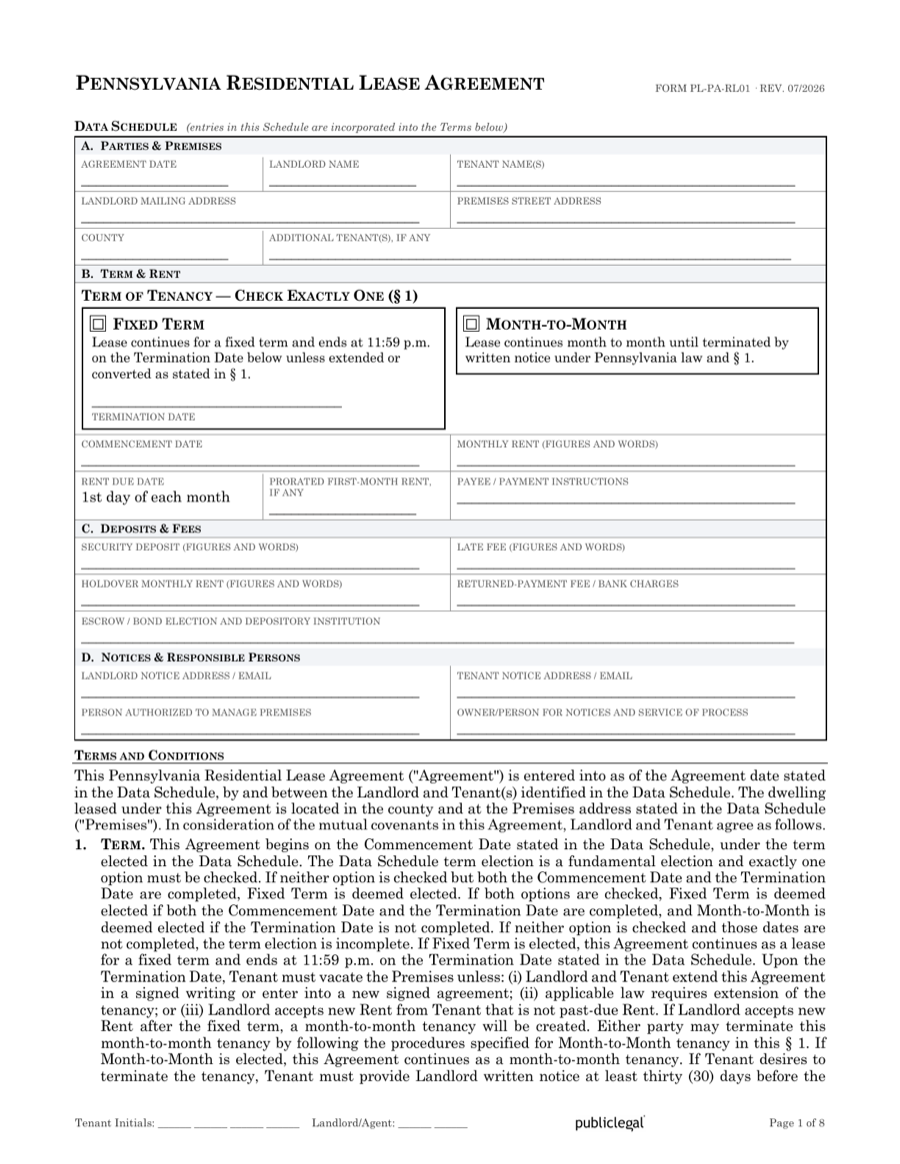
PENNSYLVANIA RESIDENTIAL LEASE AGREEMENT
This Pennsylvania Residential Lease Agreement ("Agreement") is entered into as of the Agreement date stated in the Data Schedule, by and between the Landlord and Tenant(s) identified in the Data Schedule. The dwelling leased under this Agreement is located in the county and at the Premises address stated in the Data Schedule ("Premises"). In consideration of the mutual covenants in this Agreement, Landlord and Tenant agree as follows.
1. Term. This Agreement begins on the Commencement Date stated in the Data Schedule, under the term elected in the Data Schedule. The Data Schedule term election is a fundamental election and exactly one option must be checked. If neither option is checked but both the Commencement Date and the Termination Date are completed, Fixed Term is deemed elected. If both options are checked, Fixed Term is deemed elected if both the Commencement Date and the Termination Date are completed, and Month-to-Month is deemed elected if the Termination Date is not completed. If neither option is checked and those dates are not completed, the term election is incomplete. If Fixed Term is elected, this Agreement continues as a lease for a fixed term and ends at 11:59 p.m. on the Termination Date stated in the Data Schedule. Upon the Termination Date, Tenant must vacate the Premises unless: (i) Landlord and Tenant extend this Agreement in a signed writing or enter into a new signed agreement; (ii) applicable law requires extension of the tenancy; or (iii) Landlord accepts new Rent from Tenant that is not past-due Rent. If Landlord accepts new Rent after the fixed term, a month-to-month tenancy will be created. Either party may terminate this month-to-month tenancy by following the procedures specified for Month-to-Month tenancy in this § 1. If Month-to-Month is elected, this Agreement continues as a month-to-month tenancy. If Tenant desires to terminate the tenancy, Tenant must provide Landlord written notice at least thirty (30) days before the desired termination date. If Landlord desires to terminate the tenancy, Landlord must provide Tenant written notice at least thirty (30) days before the desired termination date. Landlord and Tenant agree that these notice periods modify and replace the notice periods of 68 P.S. § 250.501(b) to the extent permitted by 68 P.S. § 250.501(e), unless a longer nonwaivable notice period applies under local, subsidized-housing, federal, or other law. Notices to terminate may be given on any calendar day, irrespective of the Commencement Date.
2. Rent. Under this Agreement, "Rent" means all monetary obligations owed to Landlord by Tenant in accordance with this Agreement, except the Security Deposit. Tenant shall pay the Monthly Rent stated in the Data Schedule on the Rent due date stated in the Data Schedule. If the Commencement Date is not the first day of a calendar month, Rent for the first partial month shall be prorated at a daily rate equal to one-thirtieth (1/30) of the Monthly Rent, and the prorated first-month Rent stated in the Data Schedule shall be due on the Commencement Date.
Acceptable payment methods:
☐ Personal check
☐ Money order
☐ Cashier's check
☐ Electronic payment
Electronic payment details:
☐ Other
Other payment method:
Rent must be paid to the payee and under the payment address or instructions stated in the Data Schedule. If a check or similar sight order tendered by Tenant is dishonored, Tenant shall pay, in addition to the unpaid amount, the service charge permitted by 18 Pa.C.S. § 4105(e): not more than Fifty Dollars ($50), unless Landlord is charged financial-institution fees in excess of $50 as a result of the dishonored check or similar sight order, in which case the service charge may equal the actual amount of those fees. The statutory service charge applies only to checks or similar sight orders and only to the extent the statutory conditions for the charge are satisfied, including any required conspicuous notice. If any ACH, card, online, electronic, or other non-check payment is returned, rejected, reversed, charged back, declined, stopped, or otherwise fails, Tenant shall reimburse Landlord for the actual bank, processor, chargeback, reversal, or similar third-party fees incurred by Landlord and shall pay the returned-payment administrative charge, if any, stated in the Data Schedule. After any returned or failed payment, Landlord may require future payments by certified funds, cashier's check, money order, electronic good funds, or other immediately available funds acceptable to Landlord.
3. Security Deposit. Upon signing this Agreement, Tenant shall pay Landlord the Security Deposit stated in the Data Schedule. The Security Deposit secures Tenant's obligations under this Agreement, including unpaid Rent, damages beyond ordinary wear and tear, and other amounts lawfully chargeable to Tenant. During the first year of the tenancy, the total of all escrow funds required by Landlord, including any refundable pet deposit, may not exceed two (2) months' Rent. Beginning with the second year of occupancy, Landlord may not retain more than one (1) month's Rent as a Security Deposit and must return or credit any excess as required by Pennsylvania law. After Tenant has occupied the Premises for five (5) years or more, Landlord may not require an additional Security Deposit because Rent increases.
4. Escrow of Deposit. If the Security Deposit exceeds One Hundred Dollars ($100), Landlord shall deposit it in an escrow account in a bank or other institution regulated by the Federal Reserve Board, the Federal Home Loan Bank Board, the Comptroller of the Currency, or the Pennsylvania Department of Banking and Securities, and shall notify Tenant in writing of the name and address of the institution and the amount deposited; OR Landlord has instead furnished a guarantee bond as permitted by 68 P.S. § 250.511c, if this option is selected below. Beginning with the twenty-fifth (25th) month of the tenancy, any deposit over $100 shall be held in an interest-bearing account as required by law.
☐ Landlord has furnished a guarantee bond as permitted by 68 P.S. § 250.511c.
Depository institution name and address, if applicable:
5. Interest on Security Deposit. If the Security Deposit exceeds $100 and Tenant has occupied the Premises for at least twenty-four (24) months, then beginning with the twenty-fifth (25th) month of the tenancy, Landlord will pay Tenant the interest earned on the Security Deposit, less an administrative fee of up to one percent (1%) per annum of the deposit amount, payable annually on or about the anniversary date of this Agreement or as otherwise required by law. Tenant shall provide Landlord with Tenant's new forwarding address in writing at or before termination of the tenancy or surrender of the Premises; Tenant's failure to do so relieves Landlord of liability for double damages under 68 P.S. § 250.512(c), as provided in 68 P.S. § 250.512(e).
6. Timing of Return of Security Deposit. Within thirty (30) days after termination of this Agreement or Tenant's surrender and Landlord's acceptance of the Premises, whichever first occurs, Landlord will provide Tenant with a written list of damages, if any, for which Landlord claims Tenant is liable and will return the balance of the Security Deposit, including any unpaid interest, after lawful deductions. Tenant must provide Landlord with Tenant's forwarding address in writing at or before surrender. If Landlord fails to provide the written damage list within the statutory period, Landlord forfeits the right to withhold any portion of the Security Deposit for damages, without limiting any rights Pennsylvania law allows for unpaid Rent or other lease breaches.
7. Use of Premises. The Premises may be used only as a private residential dwelling by Tenant and the following authorized occupants:
Authorized occupants:
Tenant may not permit any other person to reside at the Premises without Landlord's prior written consent, except as required by applicable fair housing, occupancy, or other law. Nothing in this section prohibits reasonable accommodation or modification rights required by law. No part of the Premises may be used for carrying on any business, profession, or trade, except that the incidental home-office option may be selected below.
☐ Tenant may conduct incidental home-office work that involves no employees, client visits, signage, inventory storage, or increased traffic at the Premises, provided such use complies with all laws and does not affect Landlord's insurance.
Tenant shall comply with all laws, ordinances, rules, and orders of governmental or quasi-governmental authorities affecting the cleanliness, use, occupancy, and preservation of the Premises.
8. Condition of Premises. Tenant acknowledges that Tenant has had an opportunity to inspect the Premises before signing this Agreement. Except as otherwise reported to Landlord in writing within five (5) days after the Commencement Date, Tenant accepts the Premises in clean and tenantable condition. This acknowledgment does not waive Landlord's duties under applicable law, including any nonwaivable duty to provide and maintain habitable premises.
9. Assignment and Subletting. Tenant shall not assign this Agreement or sublet or grant any license to use the Premises or any part thereof without the prior written consent of Landlord. A consent by Landlord to one such assignment, subletting, or license is not consent to any subsequent assignment, subletting, or license. An assignment, subletting, or license without Landlord's prior written consent or an assignment or subletting by operation of law is null and void and may, at Landlord's option, terminate this Agreement.
10. Alterations and Improvements. Tenant shall make no alterations, additions, or improvements to the Premises without Landlord's prior written consent, except as required by applicable fair housing or disability accommodation law. Landlord may condition approval on lawful restoration requirements, permits, insurance, and use of qualified contractors. Any alterations, changes, or improvements built, constructed, or placed on the Premises by Tenant shall, unless otherwise provided by written agreement between Landlord and Tenant, become the property of Landlord and remain on the Premises at the expiration or earlier termination of this Agreement.
11. Non-Delivery of Possession. If Landlord cannot deliver possession of the Premises to Tenant upon the commencement of the lease term through no fault of Landlord or Landlord's agents, Landlord and Landlord's agents have no liability, but Rent abates until possession is given. Landlord or Landlord's agents have thirty (30) days in which to give possession, and if possession is tendered within that time, Tenant agrees to accept the Premises and pay Rent from that date. If possession cannot be delivered within that thirty (30) day period through no fault of Landlord or Landlord's agents, either party may terminate this Agreement by written notice, and Landlord will promptly return any Rent and Security Deposit paid for periods after termination, less lawful deductions unrelated to non-delivery.
12. Smoke and Carbon Monoxide Alarms. Landlord shall provide smoke alarms as required by applicable building and fire codes and, if the Premises contain a fossil-fuel-burning heater or appliance, fireplace, or attached garage, an operational carbon monoxide alarm as required by the Carbon Monoxide Alarm Standards Act, 35 Pa.C.S. § 7220 et seq. Tenant shall keep all alarms operational, replace batteries as needed, test alarms periodically, and immediately notify Landlord in writing of any inoperable alarm. Tenant shall not disable, remove, or obstruct any alarm.
13. Utilities. Utilities and services will be provided and paid as follows:
For each utility or service below, check the responsible party:
| Electricity: | ☐ Landlord pays | ☐ Tenant pays |
|---|---|---|
| Gas: | ☐ Landlord pays | ☐ Tenant pays |
| Water/Sewer: | ☐ Landlord pays | ☐ Tenant pays |
| Trash: | ☐ Landlord pays | ☐ Tenant pays |
| Heat/Oil: | ☐ Landlord pays | ☐ Tenant pays |
| Other utility/service: | ||
| Other responsibility: | ☐ Landlord pays | ☐ Tenant pays |
Tenant shall place all utilities for which Tenant is responsible in Tenant's own name promptly after the Commencement Date and shall not permit any such service to be disconnected for nonpayment during the tenancy. Tenant is responsible only for utilities that are separately metered or otherwise lawfully chargeable to Tenant and identified above. Nothing in this section waives Landlord's duty to provide essential services or maintain habitable premises as required by applicable law.
14. Maintenance and Repair; Rules. Tenant must keep the Premises and appurtenances clean and sanitary, use the Premises and fixtures in a reasonable manner, promptly notify Landlord in writing of needed repairs, and pay for damage caused by Tenant, occupants, household members, guests, invitees, pets, or assistance animals beyond ordinary wear and tear. Landlord remains responsible for repairs and maintenance required by applicable law, including nonwaivable duties to maintain habitable premises, except where the condition results from the act or neglect of Tenant or persons under Tenant's control.
Without limiting Tenant's obligations above, Tenant must:
(a) not obstruct driveways, sidewalks, courts, entryways, stairs, halls, or common areas, which may be used only for ingress and egress;
(b) keep all windows, glass, window coverings, doors, locks, and hardware in good, clean order and repair;
(c) not obstruct or cover windows or doors;
(d) not leave windows or doors open during inclement weather;
(e) not hang laundry, clothing, sheets, or similar items from any window, rail, porch, or balcony, nor air or dry any such item within any yard area or space except as permitted by Landlord in writing;
(f) not cause or permit locks or hooks to be placed on any door or window without Landlord's prior written consent;
(g) keep all air-conditioning filters clean and free from dirt;
(h) keep all lavatories, sinks, toilets, and other water and plumbing apparatus in good order and repair and use them only for the purposes for which they were constructed. Tenant shall not allow sweepings, rubbish, sand, rags, ashes, or other substances to be thrown or deposited in them. Tenant is responsible for damage and the cost of clearing stopped plumbing resulting from misuse;
(i) maintain order on the Premises at all times, ensure that Tenant's household members and guests do the same, and not make or permit loud or improper noise or otherwise disturb other residents;
(j) keep all audio and video equipment, musical instruments, and similar devices at a volume that does not disturb other residents;
(k) deposit all trash, garbage, rubbish, and refuse in the locations provided and not allow trash, garbage, rubbish, or refuse to be deposited or permitted to stand on the exterior of any building or within common elements; and
(l) if the Premises are subject to a condominium or homeowners' association, abide by and be bound by all rules and regulations of that association affecting the Premises or appurtenant common areas, as adopted or amended from time to time; Tenant acknowledges receipt of any current rules that Landlord has provided.
15. Hazardous Materials. Tenant shall not keep on the Premises any item of a dangerous, flammable, or explosive character that might unreasonably increase the danger of fire or explosion on the Premises or that might be considered hazardous or extra hazardous by a responsible insurance company.
16. Insurance. Landlord, Landlord's agent or manager, or, if applicable, the Condominium or Homeowners' Association, are not responsible for insuring Tenant's or Tenant's permitted visitors' personal property and vehicles against loss or damage due to theft, vandalism, fire, water, rain, criminal or negligent acts of others, or any other cause.
Renter's insurance. Select one:
☐ Required. Tenant must maintain renter's insurance with personal property and liability coverage in the minimum amount of $ and must provide proof of coverage upon Landlord's request.
☐ Recommended but not required. Landlord recommends that Tenant maintain renter's insurance to protect Tenant's personal property and liability exposure.
The parties agree that, upon notification by Landlord, Tenant shall take all actions necessary to avoid: (i) an increase in Landlord's insurance premium, or Tenant shall pay for the increase in premium; or (ii) loss of insurance.
17. Damage to Premises. If the Premises are destroyed or rendered wholly uninhabitable by fire, storm, earthquake, or other casualty not caused by the negligence or other act of Tenant, occupants, guests, invitees, pets, or assistance animals, this Agreement terminates from that time except for the purpose of enforcing rights that may have then accrued. Rent shall then be accounted for by and between Landlord and Tenant up to the time of such casualty, Tenant paying Rent up to that date and Landlord refunding Rent collected beyond that date. If only part of the Premises is rendered uninhabitable and the casualty was not caused by Tenant, occupants, guests, invitees, pets, or assistance animals, Landlord may either repair the damaged portion within a reasonable time or terminate this Agreement by written notice. Rent will abate in proportion to the portion of the Premises that is unusable until the Premises is restored or this Agreement terminates.
18. Inspection of Premises. Landlord and Landlord's agents may enter the Premises at reasonable times during the term of this Agreement and any renewal for inspection, repairs, maintenance, services, alterations, showings, or other lawful purposes. Except in an emergency, suspected abandonment, court order, tenant request, or other situation where advance notice is impracticable, Landlord will give Tenant reasonable advance notice, with twenty-four (24) hours' notice presumed reasonable. In an emergency, Landlord may enter without notice. Landlord and Landlord's agents may exhibit the Premises and display usual "for sale," "for rent," or "vacancy" signs on the Premises at any time within forty-five (45) days before the expiration of this Agreement. The right of entry also exists for the purpose of removing placards, signs, fixtures, alterations, or additions that do not conform to this Agreement or to any restrictions, rules, or regulations affecting the Premises.
19. Subordination of Lease. This Agreement and Tenant's interest under it are subordinate, junior, and inferior to all mortgages, liens, or encumbrances now or later placed on the Premises by Landlord, all advances made under any such mortgages, liens, or encumbrances, including future advances, the interest payable on such mortgages, liens, or encumbrances, and all renewals, extensions, or modifications of such mortgages, liens, or encumbrances.
20. Tenant's Hold Over. If Tenant remains in possession of the Premises with Landlord's consent after the natural expiration of this Agreement, a new month-to-month tenancy will be created between Landlord and Tenant, subject to all terms and conditions of this Agreement except that monthly Rent shall be the Holdover Monthly Rent stated in the Data Schedule, if any. Either party may terminate the holdover month-to-month tenancy by giving thirty (30) days' written notice, unless a different nonwaivable notice period applies under applicable law.
21. Surrender of Premises. Upon the expiration of the term, Tenant shall surrender the Premises in as good a state and condition as they were at the commencement of this Agreement, except for reasonable use and wear and tear and damage by the elements.
22. Pets and Assistance Animals. Select one:
☐ No pets. Tenant shall not keep any animal on the Premises without Landlord's prior written consent. Assistance animals required by a person with a disability are not pets and are not subject to pet fees, pet deposits, pet rent, breed restrictions, or pet limits.
☐ Pets permitted. Tenant may keep no more than domestic dogs, cats, or birds, described as follows:
Pet description(s):
Before keeping any such animal on the Premises, Tenant shall pay Landlord:
(a) a refundable pet deposit of $, which shall be held and returned as part of the Security Deposit and is subject to the limits of 68 P.S. § 250.511a;
(b) a one-time non-refundable pet fee of $, which is not a deposit and compensates Landlord for pet-related wear, cleaning, and administration; and
(c) monthly pet rent of $, if applicable.
Tenant remains responsible for damage beyond ordinary wear and tear caused by any animal to the extent permitted by law.
23. Quiet Enjoyment. So long as Tenant is not in material default beyond any required notice or cure period, Tenant may peacefully and quietly possess and enjoy the Premises during the Term, subject to this Agreement and applicable law.
24. Indemnification. To the fullest extent permitted by law, Landlord shall not be liable for any damage or injury to Tenant, Tenant's household members, guests, invitees, agents, or employees, or to any person entering the Premises or the building of which the Premises are a part, or to goods or equipment therein, except to the extent caused by the negligence or willful misconduct of Landlord or Landlord's agents. Tenant agrees to indemnify, defend, and hold Landlord harmless from all claims, losses, damages, liabilities, costs, and reasonable attorney's fees arising from Tenant's use or occupancy of the Premises, Tenant's breach of this Agreement, or any act or neglect of Tenant, occupants, household members, guests, invitees, pets, assistance animals, or persons under Tenant's control, except to the extent caused by Landlord's negligence, willful misconduct, breach of this Agreement, or violation of applicable law. Nothing in this § waives the implied warranty of habitability or any liability that cannot be waived by law.
25. Default. If Tenant defaults, Landlord may give any Notice to Quit required or permitted by 68 P.S. § 250.501 and applicable law. Select one:
☐ Statutory notice applies. Unless a different nonwaivable rule applies, Landlord will give the statutory notice required by 68 P.S. § 250.501, including at least ten (10) days' notice for nonpayment of Rent and at least fifteen (15) or thirty (30) days' notice for other breaches, as applicable.
☐ Contractual waiver/shortened notice applies. To the fullest extent permitted by 68 P.S. § 250.501(e), Tenant waives the statutory notice period and agrees that Landlord may proceed after giving days' written Notice to Quit, except where a nonwaivable law, local ordinance, subsidized-housing rule, or federal law requires a longer period.
Landlord may provide a Notice to Quit by serving it personally on Tenant, by leaving it at the principal building on the Premises, by posting it conspicuously on the leased Premises, or by any other method permitted by applicable law. If Tenant defaults and Landlord terminates Tenant's right of possession, Tenant remains liable for Rent and other lawful charges as they become due, subject to Landlord's duty to mitigate damages and any limits imposed by applicable law. At Landlord's option, Rent payable during the remainder of the term or any renewal period may be declared immediately due and payable without further notice or demand, subject to credit for all net rent actually received by Landlord from reletting the Premises during that period. Tenant remains liable to Landlord for: (a) lost Rent and other lawful financial obligations under this Agreement; (b) Landlord's cost of reletting the Premises, including leasing fees, utility charges, and other reasonable fees necessary to relet the Premises; (c) repairs to the Premises for damage beyond normal wear and tear; (d) court costs, costs of service, prejudgment interest, and reasonable attorney's fees to the extent permitted by law; (e) lawful costs of collecting amounts due under this Agreement, including debt collection fees, late charges, and returned-payment charges; and (f) any other recovery to which Landlord is entitled by law or in equity. Landlord is obligated to make all reasonable efforts to mitigate any damage or loss resulting from Tenant's breach by attempting to relet the Premises to acceptable tenants and thereby reducing Tenant's liability.
To the extent distraint is available under 68 P.S. § 250.302 and other applicable law, Landlord may distrain only qualifying, nonexempt personal property and only by following all statutory procedures. Nothing in this Agreement permits unlawful lockout, utility shutoff, breach of the peace, seizure outside lawful process, or any other self-help remedy prohibited by applicable law.
26. Federally Covered Property. ☐ Applicable. The Premises are a "covered property" under 15 U.S.C. § 9058, such as a property with a federally backed mortgage or participation in a covered housing program. For so long as federal law requires, Landlord will provide at least thirty (30) days' notice to vacate before filing for eviction for nonpayment of rent, notwithstanding any shorter notice period in this Agreement.
☐ Not applicable or not selected.
27. Servicemembers. Nothing in this Agreement limits any right of a servicemember Tenant to terminate this lease under the Servicemembers Civil Relief Act, 50 U.S.C. § 3955, upon qualifying military orders and proper written notice.
28. Late Charge. If Rent or another amount due under this Agreement is not received within three (3) days after its due date, Tenant must pay the late fee stated in the Data Schedule. The late fee is intended to compensate Landlord for administrative costs, inconvenience, and loss caused by late payment and is not intended as a penalty. The late fee must be reasonable under applicable law.
29. Abandonment. If at any time during the term of this Agreement Tenant abandons the Premises or any part thereof, Landlord may, at Landlord's option, obtain possession of the Premises in the manner provided by law, without becoming liable to Tenant for damages or for any payment. Landlord may, at Landlord's discretion and as agent for Tenant, relet the Premises, or any part of the Premises, for all or any part of the then-unexpired Term, and may receive and collect all rent payable by virtue of such reletting. Landlord may hold Tenant liable for any difference between the Rent that would have been payable under this Agreement during the balance of the unexpired Term if this Agreement had continued in force and the net rent for such period realized by Landlord by means of such reletting.
If Tenant has relinquished possession of the Premises within the meaning of 68 P.S. § 250.505a and personal property remains on the Premises, Landlord shall provide Tenant with written notice as required by that section. If Tenant does not retrieve the property or respond within ten (10) days of the postmark of the notice, the property may be disposed of as permitted by law. If Tenant responds within ten (10) days requesting storage, Landlord will retain or store the property at a site of Landlord's choosing for up to thirty (30) days, and Tenant shall be responsible for reasonable storage costs to the extent permitted by 68 P.S. § 250.505a. After expiration of the applicable period, Landlord may dispose of remaining property without further liability to Tenant.
30. Attorneys' Fees. If Landlord employs an attorney to enforce this Agreement, collect Rent or other amounts due, or recover possession of the Premises because of Tenant's default, Tenant must pay Landlord's reasonable attorney's fees and costs to the extent permitted by applicable law, this Agreement, and any court order.
31. Recording of Agreement. Tenant shall not record this Agreement in the public records of any public office without Landlord's prior written consent. If Tenant records this Agreement without Landlord's prior written consent, Tenant is in default. Landlord may require Tenant to execute and record a lawful release or corrective filing and may pursue any remedies available under this Agreement, at law, or in equity.
32. Governing Law. This Agreement shall be governed, construed, and interpreted under the laws of the Commonwealth of Pennsylvania.
33. Severability. If any provision of this Agreement or the application thereof is, for any reason and to any extent, invalid or unenforceable, neither the remainder of this Agreement nor the application of the provision to other persons, entities, or circumstances is affected, but instead shall be enforced to the maximum extent permitted by law.
34. Binding Effect. This Agreement binds and benefits the parties and their respective heirs, legal representatives, successors, and permitted assigns. This section does not permit any assignment or sublease prohibited by this Agreement.
35. Descriptive Headings. The descriptive headings used in this Agreement are for convenience of reference only and are not intended to affect the rights or obligations of Landlord or Tenant.
36. Construction. Words used in one number include the plural and the singular as the context requires. References to a party include that party's authorized representatives where the context permits.
37. Joint and Several Liability. If more than one person signs this Agreement as Tenant, each is jointly and severally liable for all obligations of Tenant under this Agreement, including payment of all Rent. Notice given to any one Tenant is notice to all, and any Tenant may act for all Tenants with respect to this Agreement.
38. Notice. Except for a Notice to Quit or other notice that applicable law permits or requires to be served by another method, any notice required or permitted under this Agreement must be in writing and may be delivered personally to the party or that party's authorized agent, sent by certified United States mail, return receipt requested and postage prepaid, or sent by a nationally recognized overnight delivery service, in each case to the applicable notice address stated in the Data Schedule. A Notice to Quit may be served by any method permitted by 68 P.S. § 250.501 or other applicable law.
Email Notice Election. ☐ Email notices elected for ordinary lease notices. If this box is checked, e-mail to the applicable e-mail address stated in the Data Schedule is an agreed delivery method for ordinary notices under this Agreement and is deemed given when sent unless the sender receives an automated bounce-back or delivery-failure notice. Each party must keep its e-mail address current by written notice to the other party. Notice to any one Tenant by e-mail is notice to all Tenants for ordinary notices. This e-mail election does not apply to, and e-mail alone is not effective for, a Notice to Quit or possession notice under 68 P.S. § 250.501; an abandoned-property notice under 68 P.S. § 250.505a; a Security Deposit itemization or refund under 68 P.S. § 250.512; a federal, Philadelphia, municipal, court, service-of-process, or other notice for which law requires or prescribes personal service, posting, mailing, certified mail, physical delivery, a postmark-based period, delivery of a pamphlet or certificate, or another legally required method. Those notices may be sent by e-mail as courtesy copies only.
39. Owner/Manager Disclosure. The person authorized to manage the Premises and the owner or person authorized to act for and on behalf of the owner for purposes of service of process, notices, and demands are identified in the Notice section of this Agreement. Landlord will notify Tenant in writing of any change as required by Pennsylvania law.
40. Non-Waiver. No indulgence, waiver, election, or non-election by Landlord under this Agreement affects Tenant's duties and liabilities under this Agreement.
41. Modification. This document contains the entire agreement between the parties, and this Agreement may not be modified, changed, altered, or amended except through a written amendment signed by all parties.
42. Attached Addenda and Disclosures. The following addenda and disclosures are part of this Agreement if selected or if required by applicable law:
☐ Lead-Based Paint Disclosure Addendum and EPA pamphlet "Protect Your Family from Lead in Your Home" (required for most housing built before 1978).
☐ Philadelphia Certificate of Rental Suitability and City of Philadelphia "Partners for Good Housing" handbook, if the Premises is located in Philadelphia.
☐ Philadelphia lead-safe or lead-free certification and related materials, if the Premises is located in Philadelphia and the requirement applies.
☐ Pet Addendum.
☐ Rules and Regulations / Condominium or Homeowners' Association Rules.
☐ Utility Allocation or Shared Meter Disclosure.
☐ Flood, water intrusion, mold, pest, or other property-condition disclosure, if applicable or elected by Landlord.
☐ CARES Act Covered Property Notice Addendum, if applicable.
☐ Local-law addendum for the municipality where the Premises is located.
☐ Other
Other addendum/disclosure:
43. Local Law. If the Premises is located in a municipality with rental licensing, inspection, lead certification, relocation, notice, or other residential rental requirements, Landlord must complete and attach any required local-law addendum or disclosure before execution or occupancy, as applicable.
Local-law addendum / municipality:
Local license, inspection, or certificate number:
Other local-law notes:
44. Additional Property-Specific Provisions. Additional property-specific provisions, if any:
The parties have executed this Agreement and agree to be bound by its terms as of the date first written above.
Signatures
If you are not satisfied with your PublicLegal form purchase, contact support for help. We keep the purchase path simple: secure checkout, immediate access, and no subscription.
The purchase includes 3 document groups and 5 delivered files in the Word and PDF formats shown in the included-documents list. A completed sample lease is available as a separate $4.99 add-on and is not part of that count.
This is PL-PA-RL01, Rev. 07/2026, last revised July 8, 2026. Addresses fixed-term and month-to-month elections, deposit limits, escrow or bond handling, owner and manager disclosure, and local-law completion fields.
Use the Word version when you want to edit the agreement in Microsoft Word or a compatible editor. Use the PDF version for on-screen completion or a consistent print layout. Review the included-documents list for the exact formats delivered for each packet document.
Yes. Once purchased, you can reuse the lease and companion forms for additional properties, tenants, or transactions. Update the property, parties, dates, terms, disclosures, and other facts for each use, and confirm the law and local requirements are still current.
Pennsylvania municipalities can add rental licensing, lead, inspection, disclosure, and other requirements. Philadelphia and other locally regulated properties require a separate local-law check before signing.
No. You can check out as a guest, and the purchase is a one-time charge. There is no subscription or recurring membership fee.
Contact PublicLegal support for help with the download or delivered files. Keep your order email so the support team can locate the purchase quickly.
No. PublicLegal provides self-help legal forms and information, not legal advice. You are responsible for reviewing the completed lease and confirming state, local, federal, subsidized-housing, and property-specific requirements before signing.