
Find legal forms, law schools, and legal resources
Try “residential lease” — forms for your state are shown first.
Try “Yale” or “University of Texas” — the full ABA directory is searchable as you type.
Wisconsin residential lease agreement
Download the October 2026 Wisconsin Residential Lease Agreement for houses, apartments, condos, and other residential rentals. The packet includes a complete editable DOCX, a true fillable PDF, a separate one-page nonstandard rental provisions sheet, federal lead-based paint materials, and an optional completed sample of the lease.
Bundle & save $19.97
Handle tenant screening, the lease, move-in condition records, and a Wisconsin nonpayment notice workflow if you need it.
Use each document only when appropriate. The notice packet is not a move-in document and should be used only when the facts and current law support it.
A practical Wisconsin lease packet built to document the rental relationship, current deposit and notice rules, disclosure obligations, and clean completion in your own PDF reader or on paper.
The lease addresses the 21-day security-deposit return and the separate nonstandard rental provisions sheet (Wis. Stat. § 704.28 and ATCP 134.06), the check-in sheet (Wis. Stat. § 704.08), landlord entry on at least 12 hours’ notice (ATCP 134.09(2) and Wis. Stat. § 704.05(2)), clauses that void a rental agreement (Wis. Stat. § 704.44 and ATCP 134.08), the 5-day and 14-day termination structure (Wis. Stat. § 704.17), and at least 28 days’ notice to end a month-to-month tenancy (Wis. Stat. § 704.19).
Download the files, customize the lease in Word or type directly into the fillable PDF fields in your own PDF reader, and keep a signed copy for your records.
Use the editable DOCX with click-to-fill controls, or open the true fillable PDF in your own PDF reader and type directly into the form fields — no online interview or ILRG account required; both print cleanly for signing.
Your $9.99 purchase includes 4 document groups and 7 delivered files in the Word and PDF formats shown below. The completed sample PDF is an optional $4.99 add-on and is not included in the 7-file count.
Self-help lease overview
A written Wisconsin residential lease helps document the landlord, tenant, premises, county, term, rent, security deposit, utilities, repairs, disclosures, rules, and signatures for a rental property. This agreement captures the key deal terms in a front Data Schedule before the numbered sections.
This packet includes the Wisconsin Residential Lease Agreement in editable DOCX and true fillable PDF, a separate one-page nonstandard rental provisions sheet in Word and PDF, and the federal lead-based paint materials listed below for pre-1978 housing. The nonstandard sheet in the packet is blank.
Review the completed lease and any municipal, subsidized-housing, association, or property-specific requirements before signing. ILRG provides self-help legal forms and information, not legal advice.
This page highlights the current downloadable Wisconsin residential lease packet: a complete editable DOCX, a true fillable PDF, a separate nonstandard rental provisions sheet in Word and PDF, and federal lead-based paint materials. The lease uses a front Data Schedule and a lease-for-term or month-to-month election. A completed sample of the lease is available as an add-on. The nonstandard sheet in the packet is blank.
Page 1 below is the blank Data Schedule, with the term election. The list under it names every section of the agreement. Checkout delivers the fillable lease, the separate nonstandard rental provisions sheet, and the federal lead-based paint materials listed above. The completed sample of the lease is optional. The nonstandard sheet included in the packet is blank.
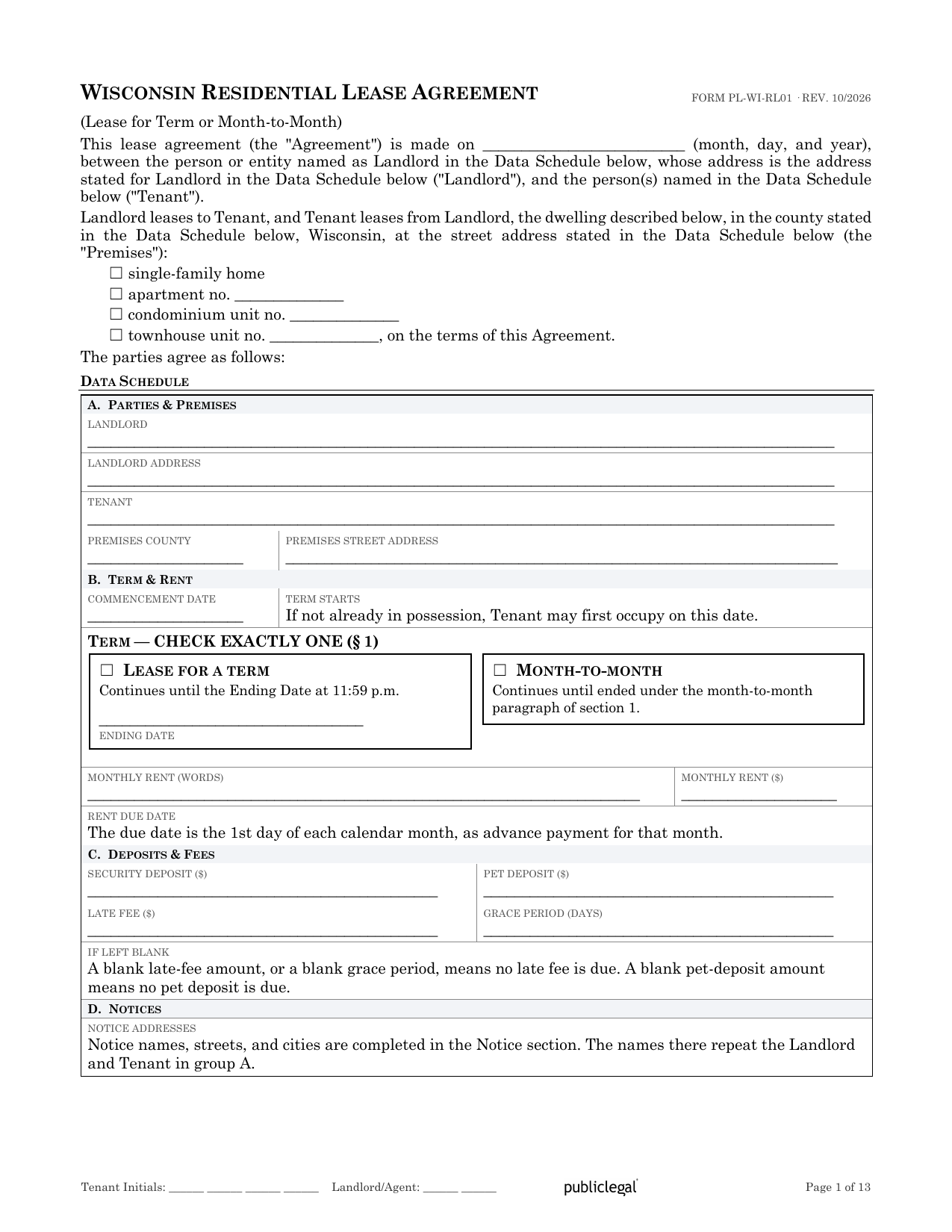
Page 1 above is the blank Data Schedule. Each line names a section and what it covers. The lease itself is the file you download.
The packet also includes a separate one-page sheet for a nonstandard deposit term or a different entry rule. The sheet in the packet is blank.
If you are not satisfied with your PublicLegal form purchase, contact support for help. We keep the purchase path simple: secure checkout, immediate access, and no subscription.
The purchase includes 4 document groups and 7 delivered files in the Word and PDF formats shown in the included-documents list. A completed sample lease is available as a separate $4.99 add-on and is not part of that count.
This is PL-WI-RL01, Rev. 10/2026, last revised October 10, 2026. Addresses the 21-day security-deposit return (Wis. Stat. § 704.28 and ATCP 134.06), the check-in sheet (Wis. Stat. § 704.08), entry on at least 12 hours’ notice (ATCP 134.09(2) and Wis. Stat. § 704.05(2)), the separate nonstandard rental provisions sheet (Wis. Stat. § 704.28(2) and ATCP 134.06(3)(b)), clauses that void a rental agreement (Wis. Stat. § 704.44 and ATCP 134.08), and at least 28 days’ notice to end a month-to-month tenancy (Wis. Stat. § 704.19(3)).
The return period is 21 days from the date in Wis. Stat. § 704.28(4) and ATCP 134.06(2).
Wis. Stat. § 704.44 and ATCP 134.08 list provisions that void a residential rental agreement, including some attempts to waive landlord duties or tenant rights.
It is a separate sheet under Wis. Stat. § 704.28(2) and ATCP 134.06(3)(b) for a deposit term outside the standard list, and under ATCP 134.09(2)(c) for a different entry rule. The copy in this packet is blank.
Wis. Stat. § 704.25 covers a tenant who stays after the term. Ending a month-to-month tenancy takes at least 28 days’ notice under § 704.19(3).
At least 12 hours’ advance notice under ATCP 134.09(2) and Wis. Stat. § 704.05(2).
Use the Word version when you want to edit the agreement in Microsoft Word or a compatible editor. The fillable fields are in the PDF itself — this is not an online interview or document-building wizard, and no ILRG account is required. Open the PDF in a compatible PDF reader (Adobe Acrobat Reader is one free option), type in the fields, save, and print — or print a blank copy and complete it by hand. This is a one-time purchase, not a subscription; save your downloaded copies to your device.
Yes. Once purchased, you can reuse the lease and companion forms for additional properties, tenants, or transactions. Update the property, parties, dates, terms, disclosures, and other facts for each use, and confirm the law and local requirements are still current.
The packet is built for ordinary private Wisconsin residential rentals under chapter 704 and ATCP 134. Cities and counties can add rental-registration, inspection, and housing-code rules, and subsidized or federally regulated housing and association rules can add requirements. Confirm those overlays before signing.
No. You can check out as a guest, and the purchase is a one-time charge. There is no subscription or recurring membership fee.
Contact PublicLegal support for help with the download or delivered files. Keep your order email so the support team can locate the purchase quickly.
No. PublicLegal provides self-help legal forms and information, not legal advice. You are responsible for reviewing the completed lease and confirming state, local, federal, subsidized-housing, and property-specific requirements before signing.