Find legal forms, law schools, and legal resources
Try “residential lease” — forms for your state are shown first.
Try “Yale” or “University of Texas” — the full ABA directory is searchable as you type.
Last updated: December 26, 2025
Protect your introductions from being bypassed or cut out.
Ideal for referral partners, deal intermediaries, sourcing agents, and capital intro professionals.
7-page, fully editable template • MS Word & PDF formats • Unlimited reuse after purchase
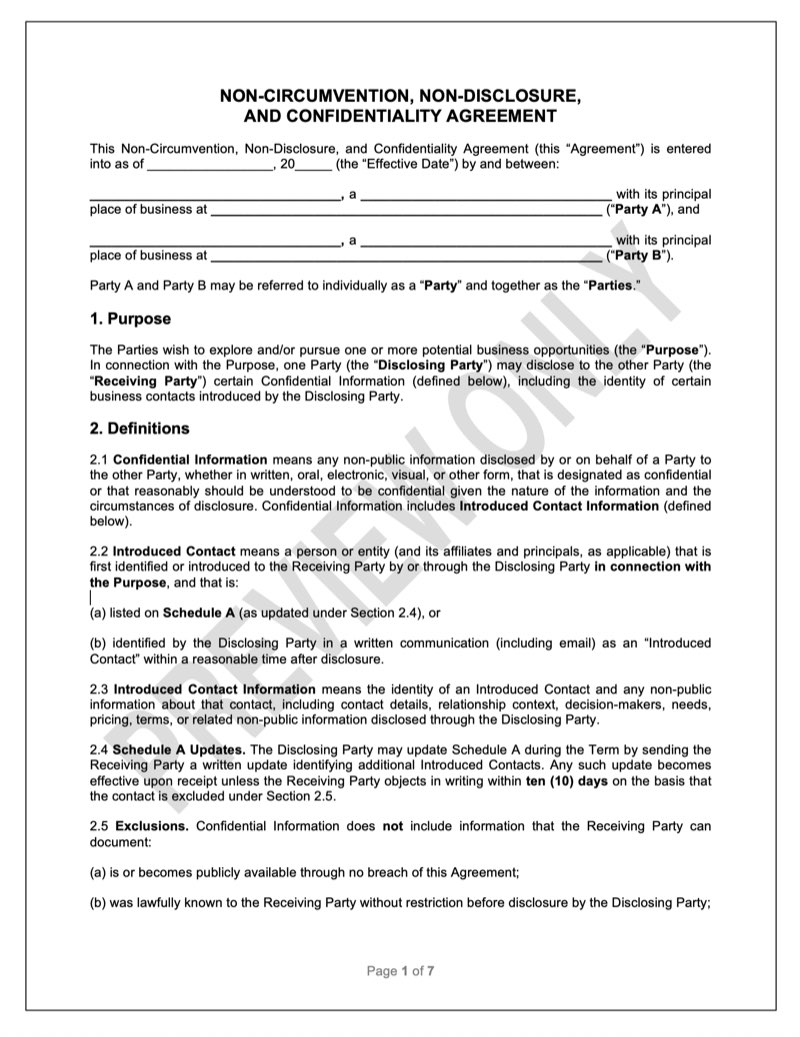
Preview of page 1 of the Non-Circumvention Agreement template
A well-drafted non-circumvention agreement needs to balance protection with enforceability. This template addresses five key requirements that make these agreements more defensible.
The template treats contact identity and contact context as Confidential Information, then limits use to the defined Purpose. Standard NDA mechanics ensure it remains workable in real business discussions.
The non-circumvention obligation is tied to Introduced Contacts (identified on Schedule A) and to a stated Purpose—targeting bypass behavior rather than general competition.
Many transactions require direct contact for diligence, fulfillment, or onboarding. The template permits operational contact as reasonably necessary for the Purpose, while still prohibiting bypass deals.
Many templates fail by calling damages a "penalty." This template provides injunctive relief plus either fee-based liquidated damages (with Schedule B) or an actual-damages approach.
Instead of rollover mechanics that can accidentally become perpetual, the non-circumvention obligation runs contact-by-contact for a defined period with clear survival provisions.
Typical use cases share a common structure: one party provides access to a specific relationship, and the receiving party could otherwise bypass the introducer once the contact is known.
Use when a referrer introduces a buyer or seller and wants to prevent a direct deal that cuts them out.
Use when a sourcing party introduces a supplier, manufacturer, or distributor and wants the introduction protected.
Use when parties explore collaboration and one party's contact network is being shared.
Use when an introducer connects investors or lenders and wants anti-bypass protection tied to the introduction.
Use when an intermediary introduces counterparties and wants bypass transactions restricted.
Recommended workflow for implementing this agreement
A non-circumvention agreement is a contract used in business introductions to prevent the receiving party from using an introduced relationship to cut out the introducer and transact directly.
Yes. It includes confidentiality and non-disclosure provisions that treat introduced contact identity and related non-public context as Confidential Information, limited to a defined Purpose.
The non-circumvention obligation is tied to Introduced Contacts (identified on Schedule A or in a written designation) and to a stated Purpose, rather than a general restriction on doing business.
Yes. The template permits contact as reasonably necessary to evaluate or perform the Purpose, while still restricting bypass transactions that exclude the introducer.
It is structured to run for a defined period on a contact-by-contact basis (as set in the agreement, with the ability to specify a different period per contact if needed).
No. Enforceability depends on state law and the specific facts. This is a national base form drafted to keep scope contact-specific (Schedule A) and to avoid common pitfalls like overbroad restraints and "penalty" damages, but high-stakes or regulated transactions may warrant counsel review under your chosen governing law.
A fee schedule is helpful when the introducer's compensation is known up front. It can reduce disputes about what compensation was expected for a covered transaction.
No. This is for B2B introductions and deal contexts. Employment and worker restrictive covenants are a separate category and are treated differently under many state laws.
Ready to protect your business introductions?
Get Started — $9.99See the full agreement structure before purchasing
This Non-Circumvention, Non-Disclosure, and Confidentiality Agreement (this "Agreement") is entered into as of _______________, 20_____ (the "Effective Date") by and between:
_________________________________, a _________________________________ with its principal place of business at _________________________________________________ ("Party A"), and
_________________________________, a _________________________________ with its principal place of business at _________________________________________________ ("Party B").
Party A and Party B may be referred to individually as a "Party" and together as the "Parties."
The Parties wish to explore and/or pursue one or more potential business opportunities (the "Purpose"). In connection with the Purpose, one Party (the "Disclosing Party") may disclose to the other Party (the "Receiving Party") certain Confidential Information (defined below), including the identity of certain business contacts introduced by the Disclosing Party.
2.1 Confidential Information means any non-public information disclosed by or on behalf of a Party to the other Party, whether in written, oral, electronic, visual, or other form, that is designated as confidential or that reasonably should be understood to be confidential given the nature of the information and the circumstances of disclosure. Confidential Information includes Introduced Contact Information (defined below).
2.2 Introduced Contact means a person or entity (and its affiliates and principals, as applicable) that is first identified or introduced to the Receiving Party by or through the Disclosing Party in connection with the Purpose, and that is: (a) listed on Schedule A (as updated under Section 2.4), or (b) identified by the Disclosing Party in a written communication (including email) as an "Introduced Contact" within a reasonable time after disclosure.
2.3 Introduced Contact Information means the identity of an Introduced Contact and any non-public information about that contact, including contact details, relationship context, decision-makers, needs, pricing, terms, or related non-public information disclosed through the Disclosing Party.
2.4 Schedule A Updates. The Disclosing Party may update Schedule A during the Term by sending the Receiving Party a written update identifying additional Introduced Contacts. Any such update becomes effective upon receipt unless the Receiving Party objects in writing within ten (10) days on the basis that the contact is excluded under Section 2.5.
2.5 Exclusions. Confidential Information does not include information that the Receiving Party can document: (a) is or becomes publicly available through no breach of this Agreement; (b) was lawfully known to the Receiving Party without restriction before disclosure by the Disclosing Party; (c) is independently developed by the Receiving Party without use of or reference to the Disclosing Party's Confidential Information; or (d) is lawfully received from a third party without breach of any duty of confidentiality. For Introduced Contacts, exclusion (b) includes a pre-existing, documented relationship (e.g., prior communications, contract, or active discussions) that predates the Disclosing Party's introduction.
2.6 Representatives means a Party's directors, officers, employees, contractors, professional advisers (including attorneys and accountants), financing sources, and agents who have a need to know Confidential Information for the Purpose and who are bound by confidentiality obligations at least as protective as those in this Agreement (by written agreement or professional duty).
2.7 Transaction means a business arrangement between the Receiving Party (or its affiliates) and an Introduced Contact (or its affiliates) that is within the scope of the Purpose and that reasonably relates to the opportunity contemplated by the Parties at the time of introduction.
3.1 Non-Disclosure and Restricted Use. The Receiving Party will: (a) keep the Disclosing Party's Confidential Information strictly confidential; (b) use the Disclosing Party's Confidential Information solely for the Purpose; and (c) not disclose the Disclosing Party's Confidential Information to any person except its Representatives who have a need to know for the Purpose.
3.2 Standard of Care. The Receiving Party will protect Confidential Information using at least reasonable care, and in any event no less than the care it uses to protect its own confidential information of like sensitivity.
3.3 Compelled Disclosure. If the Receiving Party is required by law, regulation, or court order to disclose any Confidential Information, it may do so only to the extent required, provided it gives the Disclosing Party prompt notice (to the extent legally permitted) and reasonably cooperates with efforts to seek protective treatment.
3.4 No License. Except for the limited right to use Confidential Information for the Purpose, no license or other rights are granted by either Party under any patent, copyright, trade secret, trademark, or other intellectual property right.
4.1 No Bypass of Introduced Contacts. During the Non-Circumvention Period (defined in Section 4.4), the Receiving Party will not, directly or indirectly, Circumvent the Disclosing Party with respect to any Introduced Contact.
4.2 Circumvent / Circumvention. "Circumvent" means entering into, pursuing, or consummating a Transaction with an Introduced Contact outside the Disclosing Party's participation in a manner that has the intent or effect of avoiding the Disclosing Party's expected role or compensation in connection with that Transaction, as reasonably contemplated by the Parties at the time of introduction.
4.3 Operational Contact Permitted. This Agreement does not prohibit the Receiving Party from communicating with an Introduced Contact to the extent reasonably necessary to evaluate or perform the Purpose, so long as the Receiving Party does not use that access to Circumvent the Disclosing Party.
4.4 Non-Circumvention Period. The "Non-Circumvention Period" is two (2) years from the date the relevant Introduced Contact first became an Introduced Contact under Section 2.2, unless the Parties specify a different period for that contact in Schedule A.
5.1 No Implied Brokerage. This Agreement does not by itself create an obligation for either Party to pay a commission, fee, or other compensation, except as expressly provided in Section 6 (Remedies) or in a separate written agreement.
5.2 Optional Fee Schedule. If the Parties wish to define the Disclosing Party's compensation for Transactions with one or more Introduced Contacts, they may do so in a separate written agreement or in Schedule B (if attached and executed).
6.1 Injunctive Relief. The Parties agree that unauthorized disclosure or use of Confidential Information, or Circumvention of an Introduced Contact, may cause irreparable harm for which monetary damages may be insufficient. The Disclosing Party is entitled to seek injunctive or equitable relief, in addition to any other remedies available at law or in equity, without the requirement of posting bond to the extent permitted by law.
6.2 Compensation Remedy (Choose One Option). [Check the box for either Option A or Option B:]
❏ Option A (Fee-Based Liquidated Damages; Only If You Use Schedule B): If (i) Schedule B specifies a fee for the applicable Introduced Contact or Transaction type, and (ii) the Receiving Party Circumvents the Disclosing Party, then the Receiving Party will pay the Disclosing Party the fee specified in Schedule B for that Transaction as liquidated damages, not as a penalty.
❏ Option B (Actual Damages + Disgorgement Concept): If the Receiving Party Circumvents the Disclosing Party, the Disclosing Party may recover its actual damages, including the value of the Disclosing Party's reasonably expected compensation in connection with the Transaction as supported by evidence, and may seek equitable relief as available under applicable law.
6.3 Attorneys' Fees. In any action to enforce or interpret this Agreement, the prevailing Party is entitled to recover its reasonable attorneys' fees and costs.
6.4 No "Penalty" Language. The Parties intend that any agreed remedy under this Agreement is compensatory and enforceable to the maximum extent permitted by applicable law.
7.1 Term. This Agreement begins on the Effective Date and continues for two (2) years (the "Term"), unless earlier terminated under Section 7.2.
7.2 Termination. Either Party may terminate this Agreement for convenience upon thirty (30) days' written notice to the other Party.
7.3 Survival. (a) Sections 3 (Confidentiality), 6 (Remedies), 8–12 (Miscellaneous), and this Section 7.3 survive termination. (b) Confidentiality obligations for Confidential Information (other than trade secrets) survive for three (3) years after termination. (c) Confidentiality obligations for trade secrets survive for so long as the information remains a trade secret under applicable law. (d) The Non-Circumvention obligations survive termination for the remainder of the applicable Non-Circumvention Period under Section 4.4 for each Introduced Contact.
Upon written request by the Disclosing Party, the Receiving Party will promptly return or destroy the Disclosing Party's Confidential Information in its possession, except that the Receiving Party may retain one archival copy for legal/compliance purposes and may retain Confidential Information contained in routine system backups, in each case subject to continued confidentiality obligations.
Nothing in this Agreement creates a partnership, joint venture, fiduciary relationship, or agency relationship. Neither Party is obligated to proceed with any transaction, and each Party reserves the right, in its sole discretion, to discontinue discussions.
Neither Party may assign this Agreement without the prior written consent of the other Party, except to an affiliate or successor in connection with a merger, acquisition, or sale of substantially all assets, provided the assignee assumes all obligations.
This Agreement is governed by the laws of the State of ______________, without regard to its conflict of laws principles. The Parties agree that any action arising out of this Agreement will be brought exclusively in the state or federal courts located in ______________ County, ______________, and each Party consents to personal jurisdiction and venue in those courts.
Notices must be in writing and will be deemed given when delivered by (a) personal delivery, (b) nationally recognized overnight courier, or (c) email with confirmation of transmission, to the addresses below (or to such other address a Party designates by notice):
If to Party A:
Name/Title: __________________________________________________
Address: __________________________________________________
Email: __________________________________________________
If to Party B:
Name/Title: __________________________________________________
Address: __________________________________________________
Email: __________________________________________________
This Agreement is the entire agreement between the Parties with respect to its subject matter and supersedes all prior understandings. Any amendment must be in writing and signed by both Parties. If any provision is held unenforceable, the remaining provisions remain in effect, and the unenforceable provision will be modified to the minimum extent necessary to make it enforceable. A waiver must be in writing and is effective only for the specific instance.
This Agreement may be executed in counterparts, each of which is deemed an original. Signatures delivered electronically (including PDF and e-signature platforms) are effective as originals.
For: _________________________________ [Party A]
Printed Name: _________________________________
Signature: _________________________________
Title: _________________________________
For: _________________________________ [Party B]
Printed Name: _________________________________
Signature: _________________________________
Title: _________________________________
(Attach additional pages if needed. If none at signing, write "None at Effective Date.")
1. Introduced Contact: _________________________________
Date Introduced: _________________________________
Purpose / Context (optional): _________________________________
Non-Circumvention Period override (optional): _________________________________
2. Introduced Contact: _________________________________
Date Introduced: _________________________________
Purpose / Context (optional): _________________________________
Non-Circumvention Period override (optional): _________________________________
(Use only if you want Option A in Section 6.2.)
• Introduced Contact / Transaction Type: _________________________________
• Fee / Commission: _________________________________
• When Earned (e.g., signing, closing, first payment): _________________________________
• Payment Terms: _________________________________
• Cap / Floor (optional): _________________________________
Disclaimer: This template is provided for general use and does not constitute legal advice. You may need to customize it for your transaction and governing law. This is a national base form for business introductions; enforceability depends on state law and the specific facts. For high-value or regulated transactions, consider attorney review under your chosen governing law.