
Find legal forms, law schools, and legal resources
Try “residential lease” — forms for your state are shown first.
Try “Yale” or “University of Texas” — the full ABA directory is searchable as you type.
National settlement form
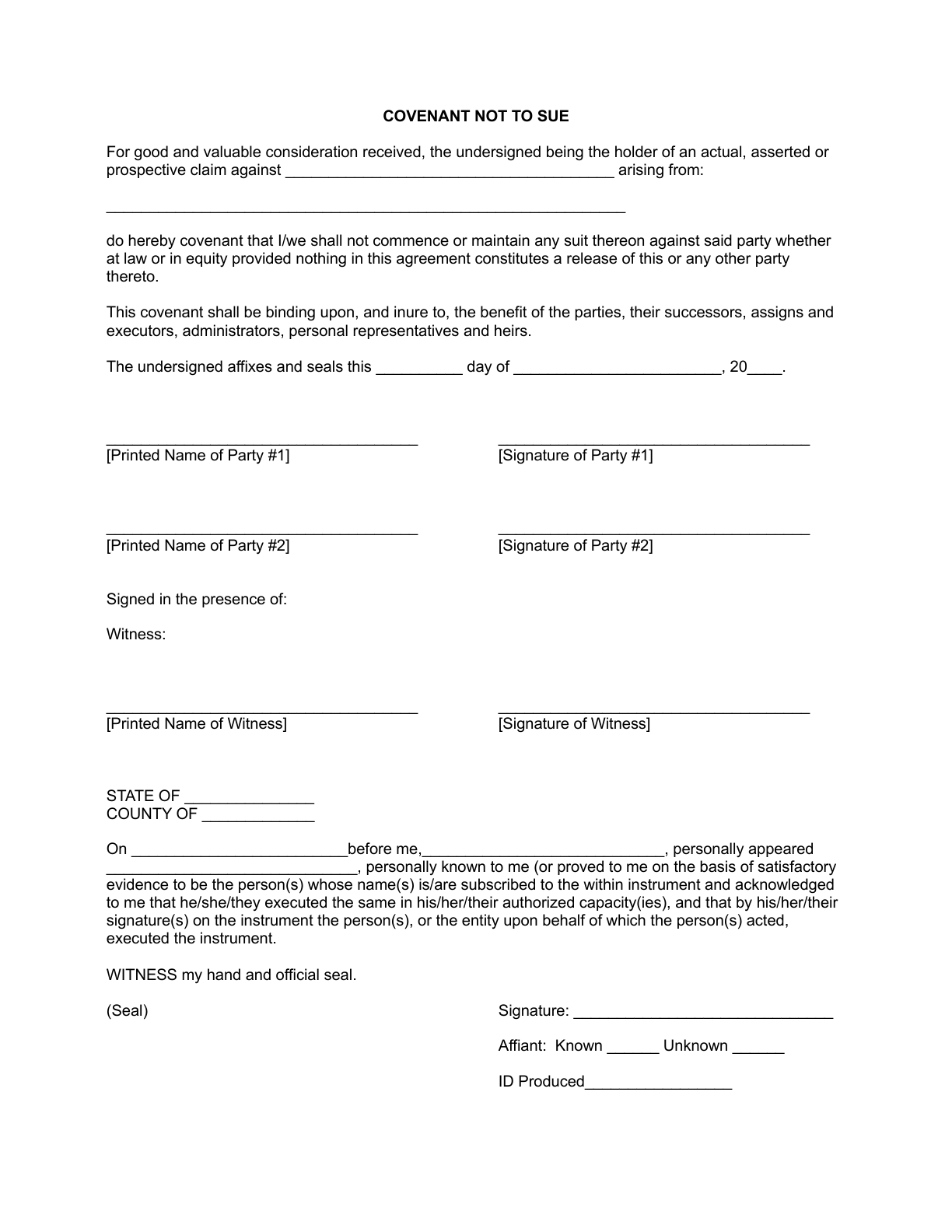
See the top of the actual instrument before you buy. A one-page settlement instrument: the holder of an actual, asserted, or prospective claim covenants not to sue on it — at law or in equity — while expressly preserving the claim itself, so rights against every other party survive. Signed under seal with a witness line and a notary acknowledgment. Word for editing; PDF for printing.
This download includes the covenant in both Word and PDF. Use the Word version to name the parties and describe the claim and the events it arises from; the PDF is formatted for printing and reference.
See the top of the actual one-page instrument below — the covenant paragraph itself. Your complete editable download (Word and PDF) — the execution date line, the party and witness signature blocks, and the notary acknowledgment — is delivered after checkout.
Legal currency, verified
A one-page settlement instrument: the holder of an actual, asserted, or prospective claim covenants not to commence or maintain any suit on it against the named party, at law or in equity — and expressly provides that nothing in the instrument is a release of this or any other party. That preservation is the point: the claim survives against everyone else, and the instrument says so. Executed under seal with a witness line and a notary acknowledgment. The top of the actual one-page instrument is previewed above before purchase.
A covenant not to sue is not a release, and the difference decides settlements. A release extinguishes the claim — and under the traditional rule still applied in some states, releasing one party can discharge others who share the same liability. This covenant promises only that the holder will not sue the named party on the described claim, which is why it is the classic tool for settling with one of several potentially liable parties. Two practical notes: the covenant recites "good and valuable consideration received," so the settlement payment or other value should actually change hands; and the claim description is where the instrument's breadth is set — describe the events it arises from with care, because a description that is too narrow leaves the dispute alive. The instrument closes under seal, with a witness and a notary acknowledgment — the formality that makes the promise hard to reopen later.
The covenant paragraph — the holder of an actual, asserted, or prospective claim against the named party, arising from the events you describe, covenants not to commence or maintain any suit on it, at law or in equity, and declares that nothing in the instrument is a release of this or any other party; the clause binding the parties and their successors, assigns, executors, administrators, personal representatives, and heirs; the under-seal execution date line; the printed-name and signature blocks for two parties; the witness line; and the notary acknowledgment with venue and identification lines.
The covenant in editable Word and print-ready PDF — one page with the party and date blanks, the claim description, and the signature, witness, and notary blocks you complete.
This form is not legal advice. It is a national instrument; consult a licensed attorney in your state for advice about your situation. Settlement instruments interact with state release and contribution rules — where more than one party may be liable, that interaction is exactly what should be reviewed.
ILRG is committed to top-quality legal forms. If you are not 100 percent satisfied after purchase, contact us for a full refund.
A contract by which the holder of a claim promises not to sue on it — here, not to commence or maintain any suit, at law or in equity. Unlike a release, it does not extinguish the claim, and this instrument says so expressly: nothing in it is a release of this or any other party.
A release extinguishes the claim entirely — and under the traditional release-of-one rule — still a live risk in some states, and wherever a general release is broadly worded — releasing one party can discharge everyone who shares the liability. A covenant not to sue leaves the claim alive and promises only forbearance as to the named party, which is why it is the classic tool for settling with one of several potentially liable parties. Where the goal is to extinguish the claim as to everyone, that is release territory — this instrument is deliberately not one.
The claim holder is the covenanting signer; the form carries printed-name and signature lines for two parties — two co-holders, or the holder and the protected party — plus a witness line and a notary acknowledgment. The party receiving the covenant’s protection should keep the executed original with the settlement papers — it is the defense to any later suit on the described claim.
The covenant opens “for good and valuable consideration received” — and the consideration should be real: the settlement payment or other value should actually change hands. A covenant signed with no actual consideration invites a failure-of-consideration defense later.
A contract covenant does not generally require one, but the instrument includes a witness line and a full notary acknowledgment — the formality courts and insurers expect when a settlement is later contested. The acknowledgment block includes the identification lines a notary’s journal expects.
Any actual, asserted, or prospective claim — personal injury, contract, property, or otherwise — against the named party, arising from the events you describe. The breadth comes from your description of what the claim arises from, so draft it with care: too narrow and the dispute survives the settlement.