Find legal forms, law schools, and legal resources
Try “residential lease” — forms for your state are shown first.
Try “Yale” or “University of Texas” — the full ABA directory is searchable as you type.
National secured-lending form
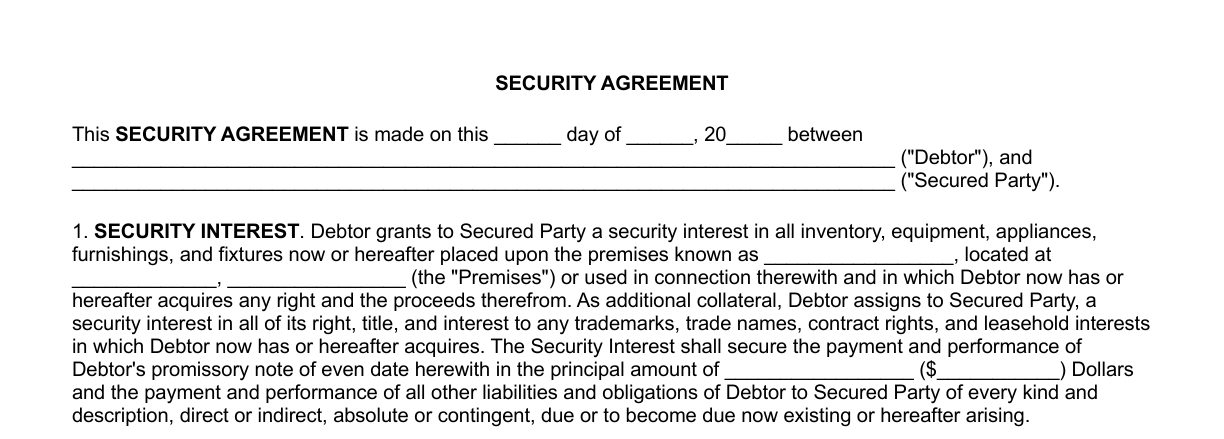
See the opening of the actual agreement before you buy. The instrument that turns a loan into a secured loan: the debtor grants the lender a security interest in business assets — inventory, equipment, furnishings, and fixtures at the named premises, now-owned and after-acquired, plus proceeds, trademarks, contract rights, and leasehold interests — to secure a promissory note of even date and, through a dragnet clause, every other present and future liability to the same lender, with UCC remedies on default. Written from the lender’s side. Word for editing; PDF for printing.
This download includes the agreement in both Word and PDF. Use the Word version to complete the parties, premises, and note identification; the PDF is formatted for printing and reference.
See the top of the actual agreement below — the collateral grant. Your complete editable download (Word and PDF), including the debtor’s covenants, default triggers, remedies, and signature blocks, is delivered after checkout.
Legal currency, verified
The instrument that turns a loan into a secured loan: the debtor grants the lender a security interest in business assets — inventory, equipment, appliances, furnishings, and fixtures at the named premises, now-owned and after-acquired, plus proceeds, trademarks, trade names, contract rights, and leasehold interests — securing a promissory note of even date, with UCC remedies on default. The top of the actual agreement is previewed above before purchase.
Signing creates the security interest between debtor and lender — but priority against other creditors and a bankruptcy trustee usually requires filing a UCC-1 financing statement with the state, typically the Secretary of State where the debtor is organized. The agreement obligates the debtor to sign financing statements and pay filing costs (the PDF’s closing note directs prompt filing); the UCC-1 form itself comes from the state and is not included in this download. Borrowers, read paragraph 1 carefully: the grant secures not just the note but all other liabilities to the lender, now existing or arising later — a dragnet clause — so negotiate it down if the lien should cover only this loan. It is the modern counterpart to the “chattel mortgage and financing statement” that our Agreement to Sell Business calls for when the seller finances part of the price. Always pair it with a signed promissory note — it secures a note, it is not one.
The collateral grant — inventory, equipment, appliances, furnishings, and fixtures at the named premises, now-owned and after-acquired, plus proceeds, trademarks, trade names, contract rights, and leasehold interests; the dragnet clause securing other present and future obligations to the same lender; the debtor’s covenants; the default triggers; the UCC remedies on default; and the signature blocks for debtor and secured party.
The security agreement in editable Word and print-ready PDF, with the collateral grant, seven debtor covenants (insurance, no removal or encumbrance, financing-statement cooperation), default triggers including financial-difficulty events, and UCC default remedies.
This form is not legal advice. It is a national instrument; consult a licensed attorney in your state for advice about your situation. Fixture filings, purchase-money priority, and perfection rules have state-specific wrinkles this form does not attempt to cover.
ILRG is committed to top-quality legal forms. If you are not 100 percent satisfied after purchase, contact us for a full refund.
It grants the lender a security interest — a lien — in described collateral to secure repayment of a promissory note. If the debtor defaults, the lender may exercise UCC remedies: repossess and sell the collateral and apply the proceeds to the debt. Without it, the lender is an unsecured creditor standing in line with everyone else.
All inventory, equipment, appliances, furnishings, and fixtures at the named premises or used in connection with them — property the debtor owns now and acquires later — plus proceeds, and as additional collateral the debtor’s trademarks, trade names, contract rights, and leasehold interests. That is a broad, business-assets grant; a debtor should confirm the description matches what it intends to pledge.
More than the note — read paragraph 1 carefully. The grant secures the promissory note of even date and all other liabilities of the debtor to the secured party, now existing or arising later. Lenders call this a dragnet or cross-collateralization clause; a borrower who wants the lien limited to this one loan should negotiate that sentence down before signing.
Signing creates the security interest between the two parties. To protect the lender against other creditors and a bankruptcy trustee, the lender usually must also file a UCC-1 financing statement with the state — typically the Secretary of State where the debtor is organized. This agreement obligates the debtor to sign financing statements and pay filing costs; the UCC-1 form itself comes from the state and is not included here.
Three triggers: a misrepresentation made in connection with this agreement; nonperformance under the note or this agreement; and financial-difficulty events — an assignment for the benefit of creditors, or an attachment, receivership, or bankruptcy proceeding that isn’t dismissed within 30 days. On default the secured party may declare the debt immediately due and exercise UCC remedies.
No — the instrument closes as an “instrument under seal” with signature lines for the debtor and the secured party; neither a notary block nor witness lines are included or generally required to create a security interest. Some lenders notarize as a matter of practice, and fixtures filings have their own recording rules.