
Find legal forms, law schools, and legal resources
Try “residential lease” — forms for your state are shown first.
Try “Yale” or “University of Texas” — the full ABA directory is searchable as you type.
Delaware statutory health care form
Download the August 2026 Delaware Advance Health-Care Directive, the optional form in 16 Del. C. § 2511 under the Uniform Health-Care Decisions Act (2023), effective September 30, 2025. Name an agent, record treatment priorities and instructions, grant optional special powers, and state organ-donation wishes. Get the form in editable Word and true fillable PDF. Add the completed sample PDF if you want a filled-in reference.
A state-specific advance health-care directive packet, reviewed against the current Delaware statute and ready for instant secure access.
Reproduces the optional form in 16 Del. C. § 2511 under the Uniform Health-Care Decisions Act (2023). It replaces Delaware’s prior advance-directive chapter effective September 30, 2025.
Part A names your agent and alternate. Part B records life-sustaining treatment choices and priorities. Parts C and D cover optional special powers and organ donation.
If you appoint an agent, you sign and one qualified adult witness signs under § 2508. Notarization is not required. The form prints the witness eligibility rules, including nursing-home limits.
This download includes 1 document in editable Word and fillable PDF formats. Use the Word version for editing; the fillable PDF can be completed on screen, then printed and signed.
Review the complete statutory form text below before purchasing. Your licensed download (editable Word and fillable PDF) is delivered after checkout.
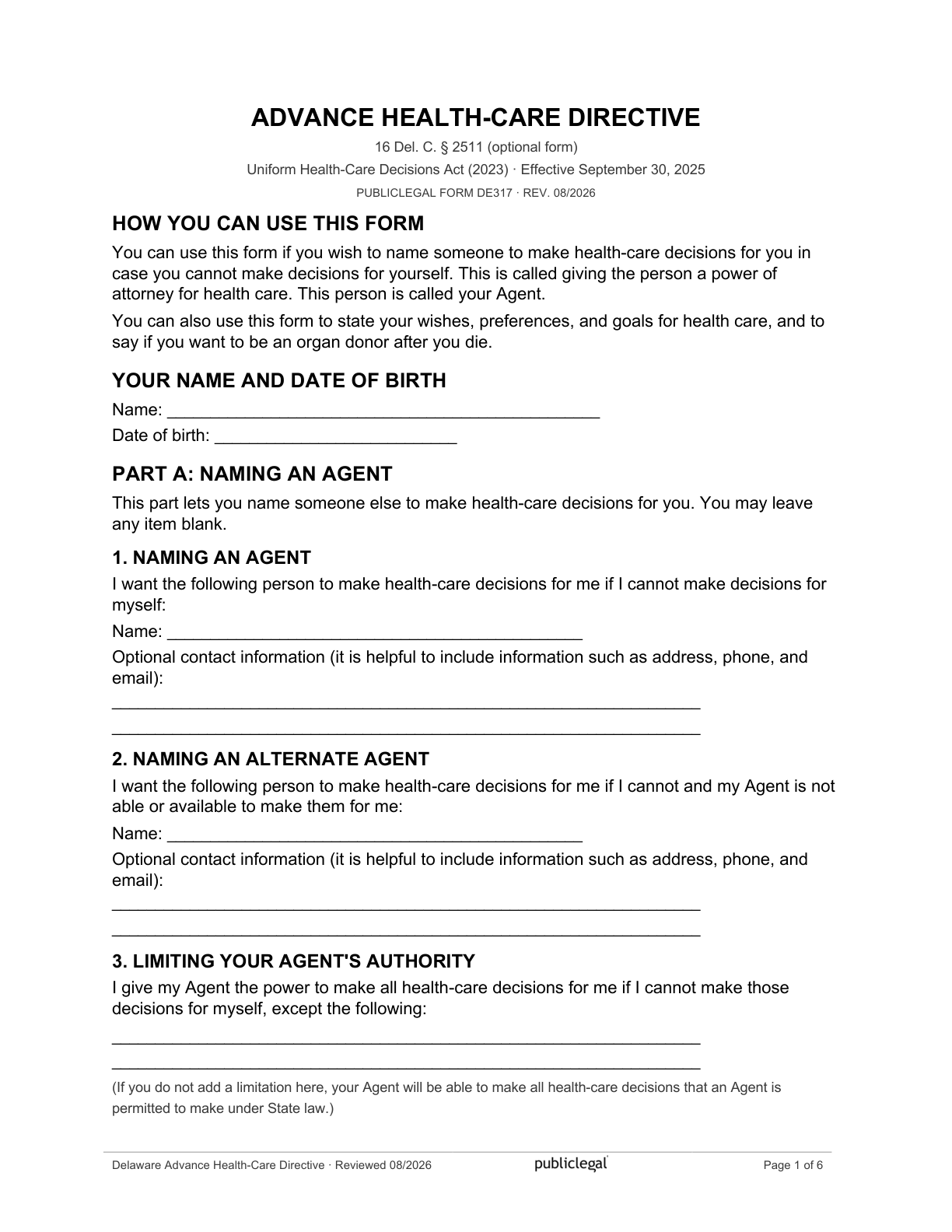
ADVANCE HEALTH-CARE DIRECTIVE
16 Del. C. § 2511 (optional form)
Uniform Health-Care Decisions Act (2023) · Effective September 30, 2025
HOW YOU CAN USE THIS FORM
You can use this form if you wish to name someone to make health-care decisions for you in case you cannot make decisions for yourself. This is called giving the person a power of attorney for health care. This person is called your Agent.
You can also use this form to state your wishes, preferences, and goals for health care, and to say if you want to be an organ donor after you die.
YOUR NAME AND DATE OF BIRTH
Name: __________________________________________________
Date of birth: ____________________________
PART A: NAMING AN AGENT
This part lets you name someone else to make health-care decisions for you. You may leave any item blank.
1. NAMING AN AGENT
I want the following person to make health-care decisions for me if I cannot make decisions for myself:
Name: ________________________________________________
Optional contact information (it is helpful to include information such as address, phone, and email):
____________________________________________________________________
____________________________________________________________________
2. NAMING AN ALTERNATE AGENT
I want the following person to make health-care decisions for me if I cannot and my Agent is not able or available to make them for me:
Name: ________________________________________________
Optional contact information (it is helpful to include information such as address, phone, and email):
____________________________________________________________________
____________________________________________________________________
3. LIMITING YOUR AGENT'S AUTHORITY
I give my Agent the power to make all health-care decisions for me if I cannot make those decisions for myself, except the following:
____________________________________________________________________
____________________________________________________________________
(If you do not add a limitation here, your Agent will be able to make all health-care decisions that an Agent is permitted to make under State law.)
PART B: HEALTH-CARE INSTRUCTIONS
This part lets you state your priorities for health care and to state types of health care you do and do not want. You may leave any item blank.
1. INSTRUCTIONS ABOUT LIFE-SUSTAINING TREATMENT
This section gives you the opportunity to say how you want your Agent to act while making decisions for you. You may mark or initial each choice. You also may leave any choice blank.
Treatment. Medical treatment needed to keep me alive but not needed for comfort or any other purpose should (mark or initial all that apply):
(___) Always be given to me. (If you mark or initial this choice, you should not mark or initial other choices in this "treatment" section.)
(___) Not be given to me if I have a condition that is not curable and is expected to cause my death soon, even if treated.
(___) Not be given to me if I am unconscious and I am not expected to be conscious again.
(___) Not be given to me if I have a medical condition from which I am not expected to recover that prevents me from communicating with people I care about, caring for myself, and recognizing family and friends.
(___) Other (write what you want or do not want):
Food and liquids. If I can't swallow and staying alive requires me to get food or liquids through a tube or other means for the rest of my life, then food or liquids should (mark or initial all that apply):
(___) Always be given to me. (If you mark or initial this choice, you should not mark or initial other choices in this "food and liquids" section.)
(___) Not be given to me if I have a condition that is not curable and is expected to cause me to die soon, even if treated.
(___) Not be given to me if I am unconscious and am not expected to be conscious again.
(___) Not be given to me if I have a medical condition from which I am not expected to recover that prevents me from communicating with people I care about, caring for myself, and recognizing family and friends.
(___) Other (write what you want or do not want):
Pain relief. If I am in significant pain, care that will keep me comfortable but is likely to shorten my life should (mark or initial all that apply):
(___) Always be given to me. (If you mark or initial this choice, you should not mark or initial other choices in this "pain relief" section.)
(___) Never be given to me. (If you mark or initial this choice, you should not mark or initial other choices in this "pain relief" section.)
(___) Be given to me if I have a condition that is not curable and is expected to cause me to die soon, even if treated.
(___) Be given to me if I am unconscious and am not expected to be conscious again.
(___) Be given to me if I have a medical condition from which I am not expected to recover that prevents me from communicating with people I care about, caring for myself, and recognizing family and friends.
(___) Other (write what you want or do not want):
2. MY PRIORITIES
You can use this section to indicate what is important to you, and what is not important to you. This information can help your Agent make decisions for you if you cannot. It also helps others understand your preferences. You may mark or initial each choice. You also may leave any choice blank.
Staying alive as long as possible even if I have substantial physical limitations is:
(___) Very important
(___) Somewhat important
(___) Not important
Staying alive as long as possible even if I have substantial mental limitations is:
(___) Very important
(___) Somewhat important
(___) Not important
Being free from significant pain is:
(___) Very important
(___) Somewhat important
(___) Not important
Being independent is:
(___) Very important
(___) Somewhat important
(___) Not important
Having my Agent talk with my family before making decisions about my care is:
(___) Very important
(___) Somewhat important
(___) Not important
Having my Agent talk with my friends before making decisions about my care is:
(___) Very important
(___) Somewhat important
(___) Not important
3. OTHER INSTRUCTIONS
You can write in this section more information about your goals, values, and preferences for treatment, including care you want or do not want. You can also use this section to name anyone who you do not want to make decisions for you under any conditions.
____________________________________________________________________
____________________________________________________________________
____________________________________________________________________
____________________________________________________________________
PART C: OPTIONAL SPECIAL POWERS AND GUIDANCE
This part lets you give your Agent additional powers, and to provide more guidance about your wishes. You may mark or initial each choice. You also may leave any choice blank.
1. OPTIONAL SPECIAL POWERS
My Agent can do the following things ONLY if I have marked or initialed them below:
(___) Admit me as a voluntary patient to a facility for mental health treatment for up to __________ days (write in the number of days you want like 7, 14, 30 or another number).
(If I do not mark or initial this choice, my Agent MAY NOT admit me as a voluntary patient to this type of facility.)
(___) Place me in a nursing home for more than 100 days even if my needs can be met somewhere else, I am not terminally ill, and I object.
(If I do not mark or initial this choice, my Agent MAY NOT do this.)
2. ACCESS TO MY HEALTH INFORMATION
My Agent may obtain, examine, and share information about my health needs and health care if I am not able to make decisions for myself. If I mark or initial below, my Agent may also do that at any time my Agent thinks it will help me.
(___) I give my Agent permission to obtain, examine, and share information about my health needs and health care whenever my Agent thinks it will help me.
3. FLEXIBILITY FOR MY AGENT
Mark or initial below if you want to give your Agent flexibility in following instructions you provide in this form. If you do not, your Agent must follow the instructions even if your Agent thinks something else would be better for you.
(___) I give my Agent permission to be flexible in applying these instructions if my Agent thinks it would be in my best interest based on what my Agent knows about me.
4. NOMINATION OF GUARDIAN
You can say who you would want as your guardian if you needed one. A guardian is a person appointed by a court to make decisions for someone who cannot make decisions. Filling this out does NOT mean you want or need a guardian. There is no guarantee that the court will appoint the person you want as guardian.
If a court appoints a guardian to make personal decisions for me, I want the court to choose:
(___) My Agent named in this form. If my Agent cannot be a guardian, I want the Alternate Agent named in this form.
(___) Other (write who you would want and their contact information):
PART D: ORGAN DONATION
This part lets you donate your organs after you die. You may have already indicated a decision on your driver's license, identification card, or in another registry. You may leave any item blank.
1. DONATION
You may mark or initial only one choice. Leave this "donation" section blank if you do not want to include your decision here.
(___) I donate my organs, tissues, and other body parts after I die, even if it requires maintaining treatments that conflict with other instructions I have put in this form, EXCEPT for those I list below (list any body parts you do NOT want to donate):
(___) I do not want my organs, tissues, or other body parts donated to anybody for any reason. (If you mark or initial this choice, you should skip the "purpose of donation" section.)
2. PURPOSE OF DONATION
You may mark or initial all that apply. (If you do not mark or initial any of the purposes below, your donation can be used for all of them.)
Organs, tissues, or other body parts that I donate may be used for:
(___) Transplant
(___) Therapy
(___) Research
(___) Education
(___) All of the above
PART E: SIGNATURES
YOUR SIGNATURE
Sign your name: ____________________________________________
Today's date: ____________________________
City/Town/Village and State (optional): ______________________________
SIGNATURE OF A WITNESS
You need a witness if you are using this form to name an Agent. The witness must be an adult and cannot be the person you are naming as Agent or the Agent's spouse, domestic partner, or someone the Agent lives with as a couple. If you live or are receiving care in a nursing home or long-term care facility, the witness cannot be an employee or contractor of the home or someone who owns or runs the home.
Name of Witness: __________________________________________
Signature of Witness: ________________________________________
(Only sign as a witness if you think the person signing above is doing it voluntarily.)
Date witness signed: ____________________________
PART F: INFORMATION FOR AGENTS
1. If this form names you as an Agent, you can make decisions about health care for the person who named you when the person cannot make their own.
2. If you make a decision for the person, follow any instructions the person gave, including any in this form.
3. If you do not know what the person would want, make the decision that you think is in the person's best interest. To figure out what is in the person's best interest, consider the person's values, preferences, and goals if you know them or can learn them. Some of these preferences may be in this form. You should also consider any behavior or communication from the person that indicates what the person currently wants.
4. If this form names you as an Agent, you can also get and share the person's health information. But unless the person has said so in this form, you can get or share this information only when the person cannot make decisions about the person's health care.
Legal currency, verified
This Delaware advance health-care directive lets you name an agent to make health-care decisions if you cannot, record treatment priorities and instructions, grant optional special powers, and state organ-donation wishes. It follows the optional form in 16 Del. C. § 2511 under the Uniform Health-Care Decisions Act (2023), effective September 30, 2025.
Delaware replaced its prior advance-directive chapter with the Uniform Health-Care Decisions Act effective September 30, 2025 (84 Del. Laws c. 467). This packet uses the optional statutory form in § 2511. Directives created before that date can remain valid under the savings rule in § 2529, but new planning should use the current form.
If you appoint an agent, § 2508 requires your signature and the signature of one qualified adult witness. The witness must be present (in person or by a qualifying real-time electronic connection) and must reasonably believe your appointment is voluntary and knowing. The witness cannot be your agent or alternate agent, or the agent's spouse, domestic partner, or cohabitant. If you live or receive care in a nursing home or long-term care facility, the witness also cannot be an employee, contractor, owner, or operator of that home. Notarization is not required. Health-care instructions alone do not require a witness under § 2507, but this combined form includes the witness block for agent appointments.
Delaware law limits an agent's authority to consent to voluntary admission for mental-health treatment to the shorter of the period written in Part C and 72 hours. See 16 Del. C. § 2518(e). The statutory form still lets you write a number of days. The shorter statutory cap controls.
Editable Word and true fillable PDF of the complete § 2511 optional form. A completed sample PDF is available separately as a filled-in reference.
This form is not legal advice. Consider speaking with a Delaware attorney about your circumstances.
ILRG is committed to top quality legal forms that are valid in all states. If you are not 100 percent satisfied after purchase, contact us for a full refund.
Yes. This packet reproduces the optional form in 16 Del. C. § 2511 under the Uniform Health-Care Decisions Act (2023), effective September 30, 2025 (84 Del. Laws c. 467). It replaces the pre-2025 Delaware advance-directive form. Reviewed and verified against the current statute in August 2026.
If you appoint an agent, § 2508 requires your signature and the signature of one qualified adult witness. The witness must be present and must reasonably believe the appointment is voluntary and knowing. The witness cannot be your agent or alternate agent, or the agent’s spouse, domestic partner, or cohabitant. Extra limits apply if you live or receive care in a nursing home or long-term care facility. Notarization is not required.
Under § 2529, an advance health-care directive created before September 30, 2025 remains valid if it complied with the law at the time it was made or complies with the current chapter. New planning should use the current form.
The statutory form lets you write a number of days for voluntary mental-health admission. Separately, 16 Del. C. § 2518(e) limits that agent authority to the shorter of the period you write and 72 hours. The shorter cap controls.
Both contain the same form text. Use the editable Word (.docx) file to type in your details, or the fillable PDF to complete the form on screen. Either way, print the finished document and sign it with your qualified witness. Marks, initials, and signatures belong on paper.