
Find legal forms, law schools, and legal resources
Try “residential lease” — forms for your state are shown first.
Try “Yale” or “University of Texas” — the full ABA directory is searchable as you type.
Texas statutory health care form
Download the August 2026 Texas Directive to Physicians on Behalf of a Minor, built on the current Chapter 166 Directive to Physicians language, for execution by a minor patient’s adult spouse, parent, or legal guardian under § 166.035, to direct end-of-life care for a qualified patient under 18. Get the form in editable Word and true fillable PDF. Add the completed sample PDF if you want a filled-in reference.
A state-specific directive to physicians on behalf of a minor packet, reviewed against the current Texas statute and ready for instant secure access.
Chapter 166 prescribes no form (§ 166.036) and prints no separate minor version, so this directive adapts the current statutory Directive to Physicians text to execution on behalf of a minor, the terminology Texas physicians and hospitals recognize.
The patient’s own desire supersedes the directive even while under 18 (§ 166.037), and no life-sustaining treatment may be withdrawn or withheld during pregnancy (§ 166.049). Both safeguards appear in the document itself.
Download and complete the files on your own device, then print and sign before two witnesses or a notary, your choice, and notarization is optional. Your personal details are never entered into an online form builder.
This download includes 1 document in editable Word and fillable PDF formats. Use the Word version for editing; the fillable PDF can be completed on screen, then printed and signed.
Review the complete form text below before purchasing. Your licensed download (editable Word and fillable PDF) is delivered after checkout.
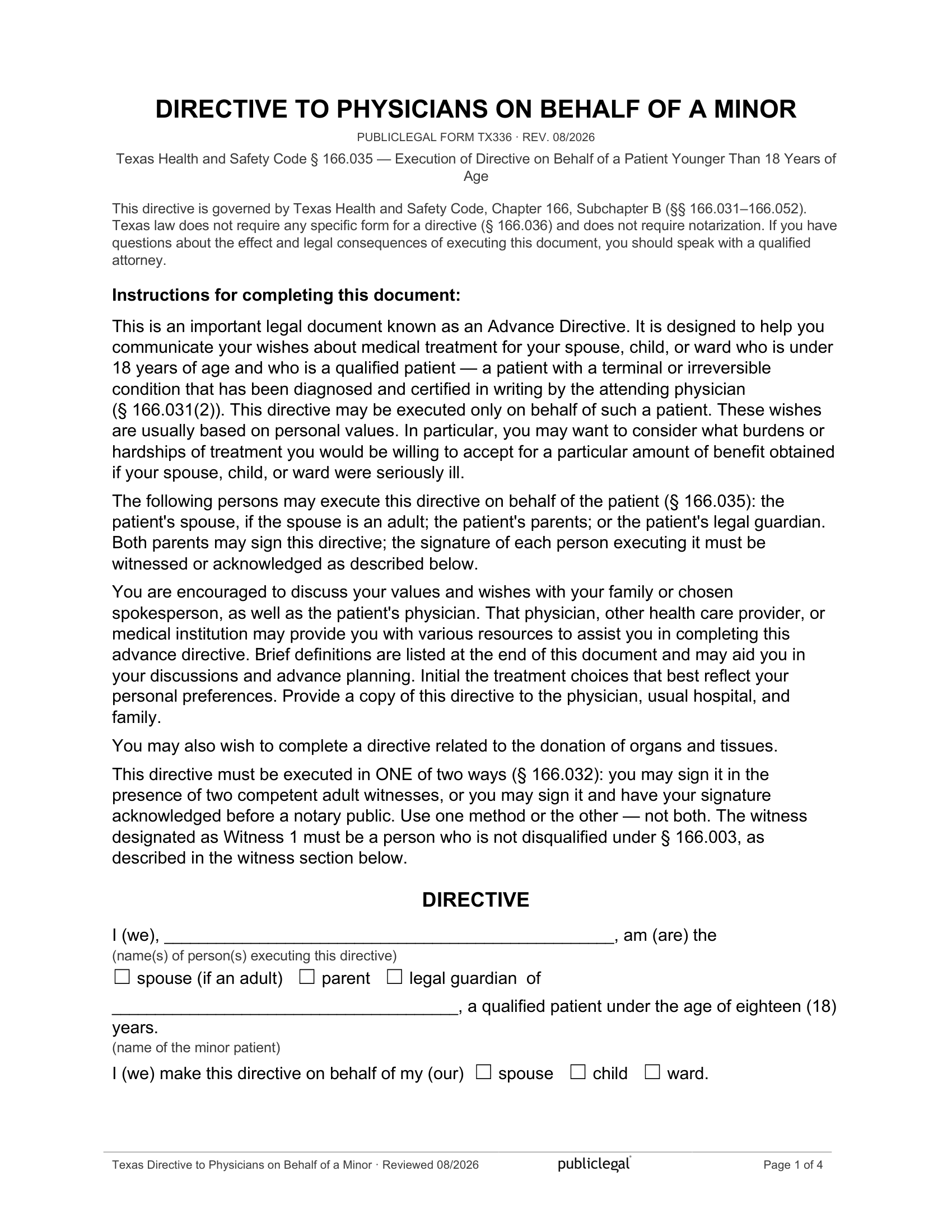
DIRECTIVE TO PHYSICIANS ON BEHALF OF A MINOR
Texas Health and Safety Code § 166.035 — Execution of Directive on Behalf of a Patient Younger Than 18 Years of Age
This directive is governed by Texas Health and Safety Code, Chapter 166, Subchapter B (§§ 166.031–166.052). Texas law does not require any specific form for a directive (§ 166.036) and does not require notarization. If you have questions about the effect and legal consequences of executing this document, you should speak with a qualified attorney.
Instructions for completing this document:
This is an important legal document known as an Advance Directive. It is designed to help you communicate your wishes about medical treatment for your spouse, child, or ward who is under 18 years of age and who is a qualified patient — a patient with a terminal or irreversible condition that has been diagnosed and certified in writing by the attending physician (§ 166.031(2)). This directive may be executed only on behalf of such a patient. These wishes are usually based on personal values. In particular, you may want to consider what burdens or hardships of treatment you would be willing to accept for a particular amount of benefit obtained if your spouse, child, or ward were seriously ill.
The following persons may execute this directive on behalf of the patient (§ 166.035): the patient's spouse, if the spouse is an adult; the patient's parents; or the patient's legal guardian. Both parents may sign this directive; the signature of each person executing it must be witnessed or acknowledged as described below.
You are encouraged to discuss your values and wishes with your family or chosen spokesperson, as well as the patient's physician. That physician, other health care provider, or medical institution may provide you with various resources to assist you in completing this advance directive. Brief definitions are listed at the end of this document and may aid you in your discussions and advance planning. Initial the treatment choices that best reflect your personal preferences. Provide a copy of this directive to the physician, usual hospital, and family.
You may also wish to complete a directive related to the donation of organs and tissues.
This directive must be executed in ONE of two ways (§ 166.032): you may sign it in the presence of two competent adult witnesses, or you may sign it and have your signature acknowledged before a notary public. Use one method or the other — not both. The witness designated as Witness 1 must be a person who is not disqualified under § 166.003, as described in the witness section below.
DIRECTIVE
I (we), __________________________________________________________, am (are) the
(name(s) of person(s) executing this directive)
spouse (if an adult) parent legal guardian of
________________________________________, a qualified patient under the age of eighteen (18) years.
(name of the minor patient)
I (we) make this directive on behalf of my (our) spouse child ward.
I (we) recognize that the best health care is based upon a partnership of trust and communication between a patient and the patient's physician. The patient's physician and I (we) will make health care or treatment decisions together that we believe to be in the best interests of the patient. Keeping in mind that I (we) have consulted with the physician, I (we) direct that the following treatment preferences be honored:
If, in the judgment of the physician, the patient is suffering with a terminal condition from which the patient is expected to die within six months, even with available life-sustaining treatment provided in accordance with prevailing standards of medical care:
__________ I request that all treatments other than those needed to keep the patient comfortable be discontinued or withheld and that the physician allow the patient to die as gently as possible; OR
__________ I request that the patient be kept alive in this terminal condition using available life-sustaining treatment. (THIS SELECTION DOES NOT APPLY TO HOSPICE CARE.)
If, in the judgment of the physician, the patient is suffering with an irreversible condition so that the patient cannot care for or make decisions for the patient's own self and is expected to die without life-sustaining treatment provided in accordance with prevailing standards of medical care:
__________ I request that all treatments other than those needed to keep the patient comfortable be discontinued or withheld and that the physician allow the patient to die as gently as possible; OR
__________ I request that the patient be kept alive in this irreversible condition using available life-sustaining treatment. (THIS SELECTION DOES NOT APPLY TO HOSPICE CARE.)
Additional requests:
(After discussion with the physician, you may wish to consider listing particular treatments in this space that you do or do not want to be used or administered in specific circumstances, such as artificially administered nutrition and hydration, intravenous antibiotics, etc. Be sure to state whether you do or do not want the physician to use the particular treatment.)
________________________________________________________________________________________
________________________________________________________________________________________
________________________________________________________________________________________
After signing this directive, if hospice care is elected for the patient, I (we) understand and agree that only those treatments needed to keep the patient comfortable would be provided and that the patient would not be given available life-sustaining treatments.
If, in the judgment of the patient's physician, the patient's death is imminent within minutes to hours, even with the use of all available medical treatment provided within the prevailing standard of care, I (we) acknowledge that all treatments may be withheld or removed except those needed to maintain the patient's comfort, subject to applicable Texas law and the patient's superseding desire.
No person may withdraw or withhold life-sustaining treatment under this directive from the patient while the patient is pregnant (§ 166.049). To that extent, this directive has no effect during the pregnancy.
The desire of the patient, while the patient is a qualified patient, supersedes the effect of this directive, including while the patient is younger than 18 years of age (§ 166.037).
This directive remains in effect until revoked. The person(s) executing this directive may revoke it at any time without regard to mental state or competency: by canceling, defacing, obliterating, burning, tearing, or otherwise destroying it; by signing and dating a written revocation; or by orally stating the intent to revoke it. A written or oral revocation takes effect when the attending physician is notified (§ 166.042).
Execution:
______________________________________________________ ________________________
(signature of person executing this directive) (date)
______________________________________________________ ________________________
(signature of second person executing, if any) (date)
City, County, State of Residence: ________________________________________________
(city, county, and state where the person executing this directive resides)
I (we) am (are) the spouse (if an adult) parent legal guardian of
________________________________________, a qualified patient under the age of eighteen (18) years.
(name of the minor patient)
Use ONE of the two execution methods below: sign in the presence of two competent adult witnesses, OR sign and have each signature acknowledged before a notary public (§ 166.032). Texas law does not require this directive to be notarized (§ 166.036).
SIGNATURE IN PRESENCE OF TWO COMPETENT ADULT WITNESSES
Two competent adult witnesses must sign below, acknowledging the signature of each person executing this directive. The witness designated as Witness 1 may not be a person designated by the person executing this directive to make a health care or treatment decision, and may not be related to the person executing this directive by blood or marriage. This witness may not be entitled to any part of the estate of the person executing this directive and may not have a claim against that estate. This witness may not be the attending physician or an employee of the attending physician. If this witness is an employee of a health care facility in which the patient is being cared for, this witness may not be involved in providing direct patient care to the patient. This witness may not be an officer, director, partner, or business office employee of a health care facility in which the patient is being cared for or of any parent organization of the health care facility.
_____________________________________ ____________________________ ________________
(signature of Witness 1) (printed name of Witness 1) (date)
_____________________________________ ____________________________ ________________
(signature of Witness 2) (printed name of Witness 2) (date)
SIGNATURE ACKNOWLEDGED BEFORE NOTARY (IN LIEU OF WITNESSES)
State of Texas, County of ________________________. This directive was acknowledged before me on __________________ (date) by
__________________________________________________________________.
(name(s) of person(s) acknowledging)
________________________________________
(signature of Notary Public, State of Texas)
________________________________________ ________________________________________
(printed name of notary) (my commission expires)
Definitions:
"Artificially administered nutrition and hydration" means the provision of nutrients or fluids by a tube inserted in a vein, under the skin in the subcutaneous tissues, or in the gastrointestinal tract.
"Irreversible condition" means a condition, injury, or illness:
(1) that may be treated, but is never cured or eliminated;
(2) that leaves a person unable to care for or make decisions for the person's own self; and
(3) that, without life-sustaining treatment provided in accordance with the prevailing standard of medical care, is fatal.
Explanation: Many serious illnesses such as cancer, failure of major organs (kidney, heart, liver, or lung), and serious brain disease such as Alzheimer's dementia may be considered irreversible early on. There is no cure, but the patient may be kept alive for prolonged periods of time if the patient receives life-sustaining treatments. Late in the course of the same illness, the disease may be considered terminal when, even with treatment, the patient is expected to die. You may wish to consider which burdens of treatment you would be willing to accept in an effort to achieve a particular outcome. This is a very personal decision that you may wish to discuss with the physician, family, or other important persons in your life.
"Life-sustaining treatment" means treatment that, based on reasonable medical judgment, sustains the life of a patient and without which the patient will die. The term includes both life-sustaining medications and artificial life support such as mechanical breathing machines, kidney dialysis treatment, and artificially administered nutrition and hydration. The term does not include the administration of pain management medication, the performance of a medical procedure necessary to provide comfort care, or any other medical care provided to alleviate a patient's pain.
"Terminal condition" means an incurable condition caused by injury, disease, or illness that according to reasonable medical judgment will produce death within six months, even with available life-sustaining treatment provided in accordance with the prevailing standard of medical care.
Explanation: Many serious illnesses may be considered irreversible early in the course of the illness, but they may not be considered terminal until the disease is fairly advanced. In thinking about terminal illness and its treatment, you again may wish to consider the relative benefits and burdens of treatment and discuss your wishes with the physician, family, or other important persons in your life.
"Qualified patient" means a patient with a terminal or irreversible condition that has been diagnosed and certified in writing by the attending physician (§ 166.031(2)).
Legal currency, verified
This document lets a minor patient’s adult spouse, parent, or legal guardian direct the patient’s end-of-life care if the patient is a “qualified patient” — one whose attending physician has diagnosed and certified in writing a terminal or irreversible condition (Texas Health & Safety Code § 166.031(2)). Texas Health & Safety Code § 166.035 expressly authorizes these family members to execute a directive on behalf of a patient younger than 18 years of age.
Texas prescribes no form for a directive (§ 166.036), and Chapter 166 contains no separate printed form for minors, so this directive adapts the current statutory Directive to Physicians language — the post-2015 terminology physicians and hospitals recognize, including “health care or treatment decision” and “artificially administered nutrition and hydration” — to execution on behalf of a minor. It opens by stating exactly that, so there is no confusion about what the document is.
Texas law is explicit: the patient’s own desire supersedes this directive at all times, even while the patient is younger than 18 (§ 166.037), and no life-sustaining treatment may be withdrawn or withheld while the patient is pregnant (§ 166.049). Both protections are printed in the document itself.
For both a terminal condition and an irreversible condition, you choose whether treatments other than comfort care should be discontinued or withheld, or whether the patient should be kept alive using available life-sustaining treatment. You indicate each election by placing your initials on the line for the choice you want, and you may add specific instructions about particular treatments.
Execute the directive in one of two ways (§ 166.032): sign it in the presence of two competent adult witnesses, or sign it and have your signature acknowledged before a notary public — notarization is optional, not required (§ 166.036). If two people execute the directive (for example, both parents), each signature must be witnessed or acknowledged. Witness 1 must satisfy every disqualification rule of § 166.003, which the witness section restates in full.
You may revoke the directive at any time, without regard to your mental state or competency, by destroying it, by a signed and dated written revocation, or by orally stating your intent to revoke; a written or oral revocation takes effect when the attending physician is notified (§ 166.042).
Your purchase includes an editable Word file and a true fillable PDF you can complete on screen before printing and signing. For an adult’s own directive, see the Texas Directive to Physicians and Family or Surrogates.
This form is not legal advice and does not replace advice from a Texas attorney about your circumstances.
ILRG is committed to top quality legal forms that are valid in all states. If you are not 100 percent satisfied after purchase, contact us for a full refund.
Under Texas Health & Safety Code § 166.035, only the patient’s spouse (if an adult), the patient’s parents, or the patient’s legal guardian may execute a directive on behalf of a patient younger than 18. Both parents may sign. Each signature must be witnessed or acknowledged.
Only when the patient is a “qualified patient”, a patient whose attending physician has diagnosed and certified in writing a terminal or irreversible condition (§ 166.031(2)). It has no effect before that certification.
No, and Texas law says no specific form is required (§ 166.036). Chapter 166 prints a Directive to Physicians for adults but no minor version, so this document adapts the current statutory language to execution on behalf of a minor, and states that plainly on page 1.
Yes, always. Section 166.037 provides that the desire of a qualified patient supersedes the effect of a directive executed on the patient’s behalf, including while the patient is younger than 18. That protection is printed in the document.
You choose one: sign in the presence of two competent adult witnesses, or sign and have your signature acknowledged before a notary public (§ 166.032). Notarization is optional (§ 166.036). Witness 1 must satisfy every § 166.003 disqualification rule, restated in full in the witness section.
At any time, without regard to mental state or competency: destroy the document, sign and date a written revocation, or orally state your intent to revoke. A written or oral revocation takes effect when the attending physician is notified (§ 166.042).