
Find legal forms, law schools, and legal resources
Try “residential lease” — forms for your state are shown first.
Try “Yale” or “University of Texas” — the full ABA directory is searchable as you type.
Minnesota residential lease agreement
Download the rebuilt September 2026 Minnesota Residential Lease Agreement packet for houses, apartments, condos, and other residential rentals. The packet includes a complete editable DOCX, a true fillable PDF, a landlord instruction sheet, the Minnesota utility-bills attachment, and federal lead-based paint disclosure materials.
Bundle & save $19.97
Handle tenant screening, the lease, move-in condition records, and a Minnesota nonpayment notice workflow if you need it.
Use each document only when appropriate. The notice packet is not a move-in document and should be used only when the facts and current law support it.
A practical Minnesota lease packet built to document the rental relationship, current chapter 504B terms, disclosure obligations, and clean completion in your own PDF reader or on paper.
The lease is organized around Minnesota chapter 504B, with deposit, notice, disclosure, and statutory terms written into numbered sections of the agreement itself — see the section guide below.
Download the files, customize the lease in Word or type directly into the fillable PDF fields in your own PDF reader, and keep a signed copy for your records.
Use the editable DOCX with click-to-fill controls, or open the true fillable PDF in your own PDF reader and type directly into the form fields — no online interview or ILRG account required; both print cleanly for signing.
Minnesota chapter 504B integration
Minnesota-specific terms, disclosures, and elections are organized into numbered lease sections, with completion fields where needed. Separate disclosure materials must still be provided when applicable.
Applicability varies. The utility-bills attachment applies only to leases entered or renewed on or after January 1, 2025 where natural gas or water-and-sewer charges are apportioned in a shared-metered building; this packet includes that attachment for those tenancies. Lead-based paint materials apply to covered pre-1978 housing and are delivered separately in the packet. Outstanding inspection-order copies and foreclosure/contract-for-deed facts are property-specific; the landlord must furnish current copies when election (b) or (c) applies. Move-in and move-out inspections under § 504B.182 are tenant options, not a required condition form. A separate inspection checklist is sold separately and included in the Minnesota Landlord Essentials Bundle.
Your $9.99 purchase includes 5 document groups and 9 delivered files in the Word and PDF formats shown below. The completed sample PDF is an optional $4.99 add-on and is not included in the 9-file count.
Self-help lease overview
A written Minnesota residential lease helps document the landlord, tenant, premises, county, term, rent, security deposit, utilities, repairs, disclosures, rules, and signatures for a rental property. This agreement captures the key deal terms in a front Data Schedule before the detailed provisions.
This packet includes the Minnesota Residential Lease Agreement in editable DOCX and true fillable PDF formats, the landlord instruction sheet, the Minnesota utility-bills attachment for apportioned natural-gas or water-and-sewer billing, and the lead-based paint disclosure materials listed below for pre-1978 housing.
Review the completed lease and any municipal, subsidized-housing, association, or property-specific requirements before signing. This packet is for ordinary chapter 504B rentals, not chapter 327C manufactured-home-park lots or program-mandated leases. Confirm St. Paul rent stabilization and other overlays where they apply. ILRG provides self-help legal forms and information, not legal advice.
This page highlights the current downloadable Minnesota residential lease packet: a complete editable DOCX, a true fillable PDF, the landlord instruction sheet, the Minnesota utility-bills attachment, and federal lead-based paint disclosure materials. The lease uses a front Data Schedule and a lease-for-term or month-to-month election. A completed sample lease is available as an add-on.
Review the operative agreement terms below before you buy. This preview is not the full download package: checkout delivers the complete agreement layout, completion fields, signature pages, and the companion files listed above. The completed sample PDF remains optional.
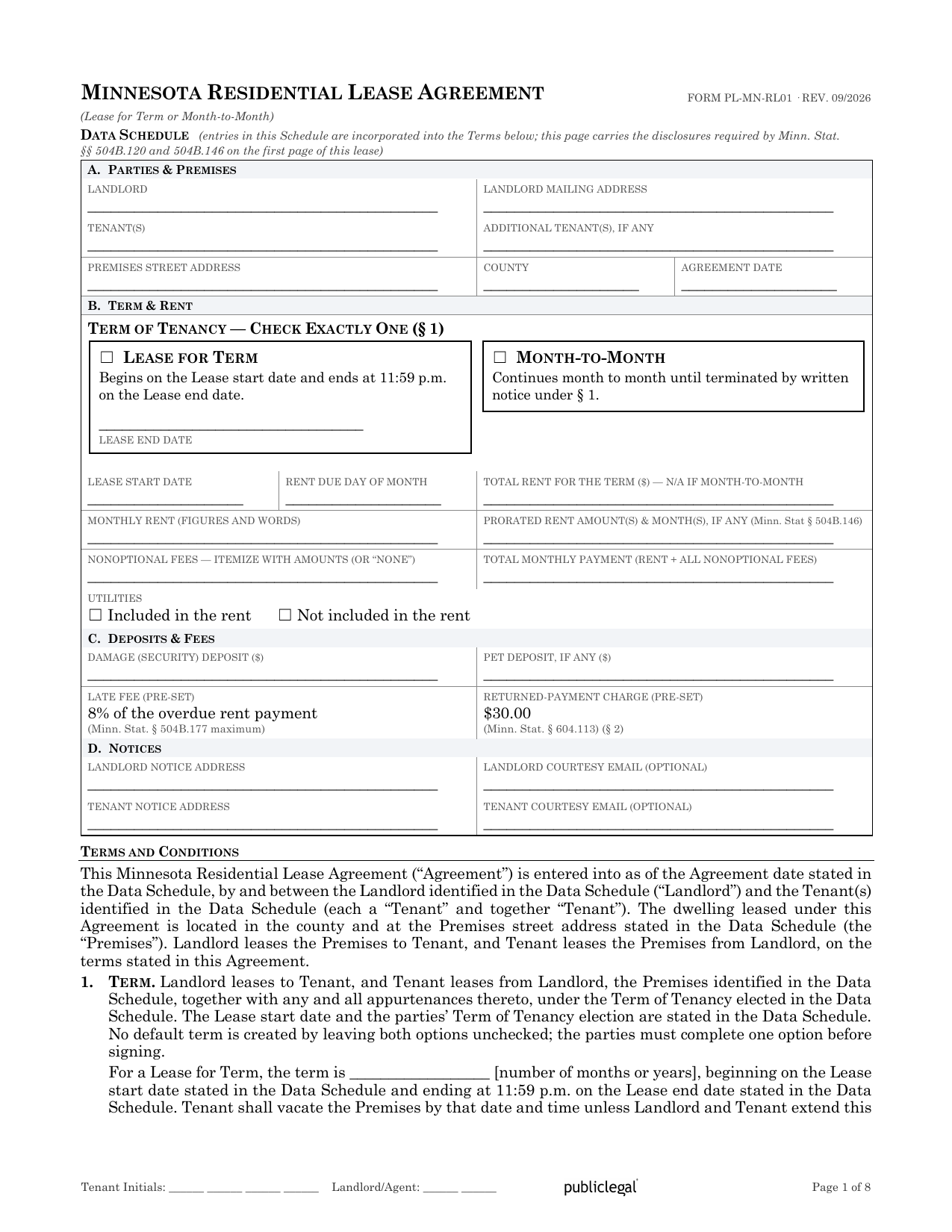
Minnesota Residential Lease Agreement
(Lease for Term or Month-to-Month)
Terms and Conditions
This Minnesota Residential Lease Agreement (“Agreement”) is entered into as of the Agreement date stated in the Data Schedule, by and between the Landlord identified in the Data Schedule (“Landlord”) and the Tenant(s) identified in the Data Schedule (each a “Tenant” and together “Tenant”). The dwelling leased under this Agreement is located in the county and at the Premises street address stated in the Data Schedule (the “Premises”). Landlord leases the Premises to Tenant, and Tenant leases the Premises from Landlord, on the terms stated in this Agreement.
1. Term. Landlord leases to Tenant, and Tenant leases from Landlord, the Premises identified in the Data Schedule, together with any and all appurtenances thereto, under the Term of Tenancy elected in the Data Schedule. The Lease start date and the parties’ Term of Tenancy election are stated in the Data Schedule. No default term is created by leaving both options unchecked; the parties must complete one option before signing.
For a Lease for Term, the term is _____ [number of months or years], beginning on the Lease start date stated in the Data Schedule and ending at 11:59 p.m. on the Lease end date stated in the Data Schedule. Tenant shall vacate the Premises by that date and time unless Landlord and Tenant extend this Agreement in writing or execute a new agreement, applicable law requires extension, or a holdover tenancy arises under Section 16 (Tenant’s Hold Over).
For a Month-to-Month Tenancy, this Agreement continues as a month-to-month tenancy beginning on the Lease start date stated in the Data Schedule until terminated as provided in this Section 1. Either party may terminate the month-to-month tenancy by written notice to the other party given at least as long before the termination date as the interval between the time rent is due or three (3) months, whichever is less (Minn. Stat. § 504B.135). The termination date stated in the notice must be the last day of a rental period, and the notice must be received by the other party before the first day of that rental period. Any notice of a rent increase during the month-to-month tenancy is subject to the same notice period (Minn. Stat. § 504B.147) and takes effect on the first day of a rental period. All other terms of this Agreement remain in effect throughout the month-to-month tenancy.
2. Rent. Rent is payable on the Rent due day of month stated in the Data Schedule, in equal monthly installments of $ _____, the first and last installments to be paid upon the due execution of this Agreement (the last installment being exclusively an advance payment of rent for the final month of the tenancy and not a deposit securing performance), the second installment to be paid on _____. If a lease for term is elected, the total rent for the term is the sum of $ _____. If a month-to-month tenancy is elected, the final month of the tenancy is the last rental period ending on the termination date stated in a notice given under Section 1, and the advance payment of the last installment shall be applied to rent for that rental period. If rent has been increased under Section 1, Tenant shall pay the difference between the advance payment and the rent in effect for that rental period when that rent is due. If a lease for term is elected and the term ends on a date before the last day of the final month, rent for the final month is prorated at the average daily rate for that month, calculated using the actual number of calendar days in that month, so that Tenant pays only for the days occupancy is allowed, and any portion of the advance final-month payment exceeding the prorated amount will be credited or refunded to Tenant (Minn. Stat. § 504B.116). The advance payment of the last installment shall be applied only to rent accruing under this Agreement, including rent for any period for which Tenant remains liable under Minn. Stat. § 504B.154, and shall not be applied to damages or other non-rent charges; any excess will be refunded to Tenant. All such payments shall be made to Landlord at Landlord’s mailing address stated in the Data Schedule on or before the due date and without demand.
☐ Landlord elects to accept payment through the following digital payment platform:
_____.
If Landlord requires or permits payment through a digital payment platform and the platform is not functioning, Landlord will offer Tenant an alternative means of payment, for which no fee will be charged, and will restore access to the platform or offer the alternative as soon as practicable after Landlord knows the platform is not functioning. No late fee will be assessed and no other adverse action will be taken against Tenant when rent or other charges are not paid because both the digital payment platform and the alternative payment method Landlord provided are not functioning for Tenant (Minn. Stat. § 504B.118, subd. 3). If a check, draft, or other negotiable or nonnegotiable instrument of Tenant is dishonored, Tenant shall pay to Landlord a service charge of $30.00, as provided by Minn. Stat. § 604.113.
3. Damage Deposit. Upon the due execution of this Agreement, Tenant shall deposit with Landlord the sum of $ _____, receipt of which is hereby acknowledged by Landlord, as security for Tenant’s performance of this Agreement, including payment of rent and other sums due and the condition of the Premises. Such deposit shall be returned to Tenant, along with simple non-compounded interest at one percent (1%) per annum computed as provided in Minn. Stat. § 504B.178, subd. 2, and less any set off to remedy Tenant defaults in the payment of rent or of other funds due to Landlord under this Agreement or to restore the Premises to their condition at the commencement of the tenancy, ordinary wear and tear excepted, upon the termination of this Agreement. If applicable, Landlord will furnish to the Tenant a written statement showing the specific reason for the withholding of the deposit within three (3) weeks, or within five (5) days if the Premises are condemned without any fault attributed to Tenant, of the termination of this Agreement. The three (3) week or five (5) day period runs only after termination of the tenancy and after Landlord’s receipt of Tenant’s mailing address or other delivery instructions (Minn. Stat. § 504B.178, subd. 3). Tenant may not withhold payment of all or any portion of rent for the last payment period on the grounds that the damage deposit should serve as payment of the rent, except as Minn. Stat. § 504B.178, subd. 8, permits for a month-to-month tenancy concerning which neither party has served a notice to quit.
4. Use of Premises. The Premises shall be used and occupied by Tenant and Tenant’s immediate family, consisting of the persons listed in the occupancy roster below, exclusively, as a private single family dwelling, and no part of the Premises shall be used at any time during the tenancy under this Agreement by Tenant for the purpose of carrying on any business, profession, or trade of any kind, or for any purpose other than as a private single family dwelling. Tenant shall not allow any other person, other than Tenant’s immediate family or transient relatives and friends who are guests of Tenant, to use or occupy the Premises without first obtaining Landlord’s written consent to such use. Tenant shall comply with any and all laws, ordinances, rules and orders of any and all governmental or quasi-governmental authorities affecting the cleanliness, use, occupancy and preservation of the Premises. Each person signing this Agreement as Tenant is jointly and severally liable for all of Tenant’s obligations under this Agreement. Every adult occupying the Premises must sign this Agreement as Tenant. Minor children listed in the occupancy roster above are occupants only and are not parties to this Agreement.
Occupancy roster (occupants only — not parties to this Agreement): _____
_____
5. Condition of Premises. Tenant stipulates, represents and warrants that Tenant has examined the Premises, and that they are at the time of this Lease in good order, repair, and in a safe, clean and tenantable condition. This stipulation is Tenant’s acknowledgment of observed condition only; it does not waive or modify the covenants imposed on Landlord by Minn. Stat. § 504B.161, which by law may not be waived or modified.
6. Assignment and Subleasing. Tenant shall not assign this Agreement, or sublease or grant any license to use the Premises or any part thereof without the prior written consent of Landlord. A consent by Landlord to one such assignment, subleasing or license shall not be deemed to be a consent to any subsequent assignment, subleasing or license. An assignment, subleasing or license without the prior written consent of Landlord or an assignment or subleasing by operation of law shall be absolutely null and void and shall, at Landlord’s option, terminate this Agreement.
7. Alterations and Improvements. Tenant shall make no alterations to the buildings or improvements on the Premises or construct any building or make any other improvements on the Premises without the prior written consent of Landlord. Any and all alterations, changes, and/or improvements built, constructed or placed on the Premises by Tenant shall, unless otherwise provided by written agreement between Landlord and Tenant, be and become the property of Landlord and remain on the Premises at the expiration or earlier termination of this Agreement.
8. Non-Delivery of Possession. In the event Landlord cannot deliver possession of the Premises to Tenant upon the commencement of the Lease term, through no fault of Landlord or its agents, then Landlord or its agents shall have no liability, but the rental herein provided shall abate until possession is given. Landlord or its agents shall have thirty (30) days in which to give possession, and if possession is tendered within such time, Tenant agrees to accept the demised Premises and pay the rental herein provided from that date. In the event possession cannot be delivered within such time, through no fault of Landlord or its agents, then this Agreement and all rights hereunder shall terminate. If the Premises are new construction as defined in Minn. Stat. § 504B.153 and will not be available for occupancy by the commencement date, that section governs Landlord’s obligations in place of this clause.
9. Hazardous Materials. Tenant shall not keep on the Premises any item of a dangerous, flammable or explosive character that might unreasonably increase the danger of fire or explosion on the Premises or that might be considered hazardous or extra hazardous by any responsible insurance company. Smoking or vaporizing of tobacco, cannabis, hemp-derived, or any other product, and inhalation of the resulting smoke, aerosol or vapor, is prohibited inside the Premises, in the building of which they are a part, and in any outdoor common areas, grounds, or appurtenant balconies or patios. Nothing in this Agreement prohibits Tenant from lawfully possessing, or using by means other than combustion or vaporization, cannabis products, lower-potency hemp edibles, or hemp-derived consumer products (Minn. Stat. § 504B.171, subd. 1(c)).
10. Utilities. Tenant shall be responsible for arranging for and paying for all utility services required on the Premises, except the following, which Landlord shall provide: _____ (write “None” if none). Whether utilities are included or not included in the rent is stated in the Lease Summary on the first page of this Agreement. If the Premises are in a shared-metered residential building, as defined by Minn. Stat. § 504B.216, and natural gas or water and sewer charges are apportioned to Tenant rather than billed directly to Tenant by the utility provider: (1) the “UTILITY BILLS” attachment prescribed by Minn. Stat. § 504B.216, subd. 10 shall be attached to and incorporated into this Agreement (see DISCLOSURES); (2) Landlord will charge a single administrative billing charge of $8.00 per billing period for all separately billed utilities and, if Tenant’s utility bill payment is not received by the next scheduled billing date, one late payment charge of $5.00 per month, not compounded; if Landlord has not received the actual utility bill by the date Tenant vacates, Landlord may issue an estimated final utility bill calculated as provided in Minn. Stat. § 504B.216, subd. 7a; (3) payments received from Tenant shall be applied first to unpaid rent, then to other unpaid charges (Minn. Stat. § 504B.216, subd. 12(b)); (4) Landlord shall not disconnect or discontinue Tenant’s utility service for nonpayment; and (5) upon Tenant’s request Landlord will provide a copy of the current actual natural gas or water and sewer bill from the utility provider that is being apportioned, and copies of past natural gas or water and sewer bills for which Tenant received an apportioned bill for the preceding two years or from the time Landlord acquired the building, whichever is more recent (Minn. Stat. § 504B.216, subd. 5(c)). Apportionment of electricity usage to Tenant is prohibited. (Minn. Stat. § 504B.216.)
11. Maintenance and Repair; Rules. Tenant will, at its sole expense, keep and maintain the Premises and appurtenances in good and sanitary condition and repair during the tenancy under this Agreement. Without limiting the generality of the foregoing, Tenant shall:
(a) Not obstruct the driveways, sidewalks, courts, entry ways, stairs and/or halls, which shall be used for the purposes of ingress and egress only;
(b) Keep all windows, glass, window coverings, doors, locks and hardware in good, clean order and repair;
(c) Not obstruct or cover the windows or doors;
(d) Not leave windows or doors in an open position during any inclement weather;
(e) Not hang any laundry, clothing, sheets, etc. from any window, rail, porch or balcony nor air or dry any of same within any yard area or space;
(f) Not cause or permit any locks or hooks to be placed upon any door or window without the prior written consent of Landlord;
(g) Keep all air conditioning filters clean and free from dirt;
(h) Keep all lavatories, sinks, toilets, and all other water and plumbing apparatus in good order and repair and shall use same only for the purposes for which they were constructed. Tenant shall not allow any sweepings, rubbish, sand, rags, ashes or other substances to be thrown or deposited therein. Any damage to any such apparatus and the cost of clearing stopped plumbing resulting from misuse shall be borne by Tenant;
(i) And Tenant’s family and guests shall at all times maintain order in the Premises and at all places on the Premises, and shall not make or permit any loud or improper noises, or otherwise disturb other residents;
(j) Keep all radios, television sets, stereos, phonographs, etc., turned down to a level of sound that does not annoy or interfere with other residents;
(k) Deposit all trash, garbage, rubbish or refuse in the locations provided therefor and shall not allow any trash, garbage, rubbish or refuse to be deposited or permitted to stand on the exterior of any building or within the common elements;
(l) Abide by and be bound by any and all rules and regulations affecting the Premises or the common area appurtenant thereto which may be adopted or promulgated by the Condominium or Homeowners’ Association having control over them.
The foregoing are housekeeping obligations of Tenant only and do not waive or modify the covenants imposed on Landlord by Minn. Stat. § 504B.161, subd. 1. Any agreement for Tenant to perform specified repairs or maintenance beyond the housekeeping obligations above is enforceable only if supported by adequate consideration and set forth in a conspicuous writing and does not waive Minn. Stat. § 504B.161, subd. 1, or relieve Landlord of the duty to maintain common areas (Minn. Stat. § 504B.161, subd. 2).
12. Insurance. Landlord, Landlord’s agent or manager, or, if applicable, the Condominium or Homeowners’ Association, are not responsible for insuring Tenant’s or Tenant’s permitted visitors’ personal property and vehicles against loss or damage due to theft, vandalism, fire, water, rain, criminal or negligent acts of others, or any other cause. Landlord has advised Tenant to carry Tenant’s own insurance (renter’s insurance) to protect Tenant from any such loss or damage. The parties agree that, upon notification by Landlord, Tenant shall take all actions necessary to avoid: (i) an increase in Landlord’s insurance premium (or Tenant shall pay for the increase in premium); or (ii) loss of insurance.
13. Damage to Premises. In the event the Premises are destroyed or rendered wholly uninhabitable by fire, storm, earthquake, or other casualty not caused by the negligence of Tenant, this Agreement shall terminate from such time except for the purpose of enforcing rights that may have then accrued hereunder. The rental provided for herein shall then be accounted for by and between Landlord and Tenant up to the time of such injury or destruction of the Premises, Tenant paying rentals up to such date and Landlord refunding rentals collected beyond such date. Should a portion of the Premises thereby be rendered uninhabitable, the Landlord shall have the option of either repairing such injured or damaged portion or terminating this Lease. In the event that Landlord exercises its right to repair such uninhabitable portion, the rental shall abate in the proportion that the injured parts bears to the whole Premises, and such part so injured shall be restored by Landlord as speedily as practicable, after which the full rent shall recommence and the Agreement continue according to its terms.
14. Inspection of Premises. Landlord and Landlord’s agents may enter the Premises for any reasonable business purpose, including but not limited to: inspecting the Premises; making necessary or agreed repairs, decorations, alterations or improvements; supplying necessary or agreed services; performing maintenance work; showing the Premises to prospective tenants during the notice period before this Agreement terminates, after Tenant has given notice to move, or within forty-five (45) days of the expiration of this Agreement; showing the Premises to prospective purchasers, mortgagees, insurance representatives, workers or contractors; allowing inspections by state, county, or city officials charged with enforcing health, housing, building, fire prevention, or housing maintenance codes; responding to a disturbance within the Premises; investigating Landlord’s reasonable belief that Tenant is violating this Agreement within the Premises or that the Premises are occupied by a person without a legal right to occupy them; or after Tenant has vacated. Except as provided below, Landlord will make a good faith effort to give Tenant reasonable notice under the circumstances of not less than twenty-four (24) hours in advance of the intent to enter, specifying a time or anticipated window of time of entry, and will enter only between 8:00 a.m. and 8:00 p.m. unless Landlord and Tenant agree to an earlier or later time. Tenant may permit entry on less than 24 hours’ notice. Landlord may enter without prior notice to inspect or take appropriate action if Landlord reasonably suspects that immediate entry is necessary to prevent injury to persons or property because of conditions relating to maintenance, building security, or law enforcement; to determine Tenant’s safety; or to comply with local ordinances regarding unlawful activity occurring within the Premises. If Landlord enters when Tenant is not present and prior notice has not been given, Landlord will leave a written disclosure of the entry in a conspicuous place in the Premises. Tenant’s right to prior notice of entry under Minn. Stat. § 504B.211 is not waived by this Agreement.
15. Subordination of Lease. This Agreement and Tenant’s interest hereunder are and shall be subordinate, junior and inferior to any and all mortgages, liens or encumbrances now or hereafter placed on the Premises by Landlord, all advances made under any such mortgages, liens or encumbrances (including, but not limited to, future advances), the interest payable on such mortgages, liens or encumbrances and any and all renewals, extensions or modifications of such mortgages, liens or encumbrances.
16. Tenant’s Hold Over. If Tenant remains in possession of the Premises with the consent of Landlord after the natural expiration of this Agreement, a new tenancy from month-to-month shall be created between Landlord and Tenant which shall be subject to all of the terms and conditions hereof, with rent continuing at the monthly installment then in effect, except that such tenancy shall be terminable upon written notice served by either party given at least as long before the termination date as the interval between the time rent is due or three (3) months, whichever is less (Minn. Stat. § 504B.135). The termination date stated in the notice must be the last day of a rental period, and the notice must be received by the other party before the first day of that rental period. Any notice of a rent increase during such a tenancy is subject to the same notice period (Minn. Stat. § 504B.147).
17. Surrender of Premises. Upon the expiration or other termination of the tenancy under this Agreement, Tenant shall surrender the Premises in as good a state and condition as they were at the commencement of this Agreement, reasonable use and wear and tear thereof and damages by the elements excepted.
18. Animals. Tenant shall be entitled to keep no more than _____ domestic dogs, cats or birds; however, at such time as Tenant shall actually keep any such animal on the Premises, Tenant shall pay to Landlord a pet deposit of $ _____. Any pet deposit is a security deposit subject to the DAMAGE DEPOSIT clause and Minn. Stat. § 504B.178 and is refundable as provided in that clause; no portion of it is non-refundable. This clause does not apply to service animals or support animals as defined by law: no pet deposit or pet fee is charged for a service animal or support animal, and documentation of the need for a service animal or support animal may be requested only as permitted by Minn. Stat. § 504B.113 and applicable fair-housing law. Tenant is liable to Landlord for any damage to the Premises caused by a service animal or support animal (Minn. Stat. § 504B.113, subd. 3(a)).
19. Quiet Enjoyment. Tenant, upon payment of all of the sums referred to herein as being payable by Tenant and Tenant’s performance of all Tenant’s agreements contained herein and Tenant’s observance of all rules and regulations, shall and may peacefully and quietly have, hold and enjoy said Premises for the term hereof.
20. Indemnification. Landlord shall not be liable for any damage or injury of or to the Tenant, Tenant’s family, guests, invitees, agents or employees or to any person entering the Premises or the building of which the Premises are a part or to goods or equipment, or in the structure or equipment of the structure of which the Premises are a part, except to the extent such damage or injury results from the negligence or willful misconduct of Landlord or Landlord’s agents, or from Landlord’s breach of this Agreement or violation of applicable law, including Minn. Stat. § 504B.161. Tenant hereby agrees to indemnify, defend and hold Landlord harmless from any and all claims or assertions of every kind and nature to the extent arising from Tenant’s breach of this Agreement or from the acts of Tenant or Tenant’s family, guests, or invitees. This clause does not waive, modify, or relieve the covenants imposed on Landlord by Minn. Stat. § 504B.161 or any other non-waivable right or remedy provided to Tenant by law, including Minn. Stat. §§ 504B.231, 504B.381, and 504B.395.
21. Default. If Landlord determines that the Tenant is in default of this Agreement, including but not limited to the nonpayment of rent, failure to vacate the Premises at termination or breach of any other provision of this Agreement, Landlord may, at its option, terminate this Agreement upon the notice and in the manner provided by law. Tenant’s material breach of any provision of this Agreement, including nonpayment of rent, entitles Landlord to terminate this Agreement and to recover possession of the Premises by eviction action; this sentence is the provision of this Agreement granting Landlord the right to evict for breach for purposes of Minn. Stat. § 504B.321, subd. 3. Before bringing an eviction action alleging nonpayment of rent or any other unpaid financial obligation under this Agreement, Landlord shall deliver to Tenant, personally or by first-class mail at the Premises, the written notice required by Minn. Stat. § 504B.321, subd. 1a, and may bring the action if Tenant neither pays the total amount due nor vacates within fourteen (14) days of delivery or mailing, or within any longer period required by local law. Nothing in this Agreement constitutes an acceleration of future rent; upon termination for Tenant’s default, Landlord may recover rent and other amounts due as they accrue, together with damages for Tenant’s breach, subject to Landlord’s duty to mitigate damages under Minn. Stat. § 504B.154. If the Premises are a “covered dwelling” under Section 4024 of the federal CARES Act (15 U.S.C. § 9058(c)) (for example, the Premises are subject to a federally backed mortgage loan or participate in a covered federal housing program), Landlord shall not require Tenant to vacate before the date that is thirty (30) days after the date on which Landlord provides Tenant with a notice to vacate.
22. Late Charge. If any installment of rent is not paid on or before the date it is due, Tenant shall pay to Landlord, in addition to the installment due, a late fee equal to eight percent (8%) of the overdue rent payment, the maximum permitted by Minn. Stat. § 504B.177. If the tenancy is subsidized under a housing assistance payments contract with a federal, state, or local government, the late fee is calculated and assessed only on the portion of the rent payable by Tenant. No late fee will be assessed when Minn. Stat. § 504B.118 prohibits it. A late fee is not interest or liquidated damages. Late payment charges on apportioned utility bills, if any, are governed by the UTILITIES clause and Minn. Stat. § 504B.216.
23. Abandonment. If at any time during the tenancy under this Agreement Tenant abandons the Premises or any part thereof, Landlord may, at Landlord’s option, obtain possession of the Premises in the manner provided by law. Taking possession of the Premises under this clause does not waive Minn. Stat. §§ 504B.154 or 504B.271. Landlord shall make reasonable efforts to rent the Premises at a fair rental value (Minn. Stat. § 504B.154). Tenant remains liable for rent as it accrues under this Agreement until the earliest of (i) the date a new tenancy of the Premises begins, (ii) the date Landlord accepts the abandonment as a surrender, or (iii) the expiration or termination of the tenancy; if the tenancy under this Agreement is or has become a periodic tenancy, Tenant’s rent liability after abandonment shall not exceed the notice period required to end the tenancy, measured from the date Landlord has notice of the abandonment. Tenant remains liable for all rent and other sums that accrued before termination, for the cost of restoring the Premises beyond ordinary wear and tear, and for Landlord’s other damages caused by Tenant’s breach, other than rent for any period after the tenancy terminates. If Tenant leaves personal property on the Premises, Landlord may take possession of it and shall store and care for it, and Tenant is liable for the reasonable costs and expenses of removal, storage and care. Landlord may sell or otherwise dispose of the property twenty-eight (28) days after the later of Landlord’s receipt of actual notice of the abandonment or the date it reasonably appears to Landlord that Tenant has abandoned the Premises. Before a sale Landlord will make reasonable efforts to notify Tenant of the sale at least fourteen (14) days before the sale, by personal service in writing or by first-class and certified mail to Tenant’s last known address or usual place of abode if known to Landlord, and by posting notice of the sale in a conspicuous place on the Premises at least two (2) weeks before the sale; if notice is mailed, the 14-day period begins on the day the notices are deposited in the United States mail. Landlord may apply a reasonable amount of the sale proceeds to removal, care and storage costs and to any amounts Landlord may withhold from a security deposit under Minn. Stat. § 504B.178, subd. 3, and shall pay any remaining proceeds to Tenant upon Tenant’s written demand. (Minn. Stat. §§ 504B.154, 504B.271.)
24. Attorneys’ Fees. Each party shall bear its own attorneys’ fees and costs, except as a court may award fees or costs to a party as provided by statute, rule, or court order.
25. Recording of Agreement. Tenant shall not record this Agreement on the Public Records of any public office. In the event that Tenant shall record this Agreement, this Agreement shall, at Landlord’s option, terminate immediately and Landlord shall be entitled to all rights and remedies that it has at law or in equity.
26. Governing Law. This Agreement shall be governed, construed and interpreted by, through and under the Laws of the State of Minnesota.
27. Severability. If any provision of this Agreement or the application thereof shall, for any reason and to any extent, be invalid or unenforceable, neither the remainder of this Agreement nor the application of the provision to other persons, entities or circumstances shall be affected thereby, but instead shall be enforced to the maximum extent permitted by law.
28. Binding Effect. The covenants, obligations and conditions herein contained shall be binding on and inure to the benefit of the heirs, legal representatives, and assigns of the parties hereto.
29. Descriptive Headings. The descriptive headings used herein are for convenience of reference only and they are not intended to have any effect whatsoever in determining the rights or obligations of the Landlord or Tenant.
30. Construction. The pronouns used herein shall include, where appropriate, either gender or both, singular and plural.
31. Non-Waiver. No indulgence, waiver, election or non-election by Landlord under this Agreement shall affect Tenant’s duties and liabilities hereunder.
32. Modification. The parties hereby agree that this document contains the entire agreement between the parties and this Agreement shall not be modified, changed, altered or amended in any way except through a written amendment signed by all of the parties hereto. Electronic signatures on this Agreement are valid and binding to the fullest extent permitted by law (federal ESIGN Act, 15 U.S.C. § 7001 et seq.; Minnesota Uniform Electronic Transactions Act, Minn. Stat. ch. 325L).
33. Notice; Landlord and Agent Disclosure. Any notice required or permitted under this Lease or under state law shall be deemed sufficiently given or served if sent by United States certified mail, return receipt requested, addressed to the applicable notice address stated in the Data Schedule.
Landlord and Tenant shall each have the right from time to time to change the place notice is to be given under this paragraph by written notice thereof to the other party.
Notices to Tenant may also be given by personal delivery or by first class mail addressed to Tenant at the Premises. Where a specific method of service is required by statute for a particular notice, that statutory method governs. Landlord may, in Landlord’s discretion and as a courtesy only, also send a copy of any notice to Tenant by email to an email address provided by Tenant; any such email is not a required or operative method of service.
In accordance with Minn. Stat. § 504B.181, Landlord discloses the name and address of the person authorized to manage the Premises and of the owner of the Premises or an agent authorized by the owner to accept service of process and to receive and give receipts for notices and demands:
_____
PERSON AUTHORIZED TO MANAGE THE PREMISES — NAME (§ 504B.181)
_____
MANAGER ADDRESS
_____
OWNER OF THE PREMISES OR AGENT AUTHORIZED TO ACCEPT SERVICE OF PROCESS AND TO RECEIVE AND GIVE RECEIPTS FOR NOTICES AND DEMANDS — NAME (§ 504B.181)
_____
OWNER / AGENT ADDRESS
_____
PERSON AUTHORIZED TO MANAGE THE PREMISES — NAME (§ 504B.181)
_____
MANAGER ADDRESS
_____
OWNER OF THE PREMISES OR AGENT AUTHORIZED TO ACCEPT SERVICE OF PROCESS AND TO RECEIVE AND GIVE RECEIPTS FOR NOTICES AND DEMANDS — NAME (§ 504B.181)
_____
OWNER / AGENT ADDRESS
_____
PERSON AUTHORIZED TO MANAGE THE PREMISES — NAME (§ 504B.181)
_____
MANAGER ADDRESS
_____
OWNER OF THE PREMISES OR AGENT AUTHORIZED TO ACCEPT SERVICE OF PROCESS AND TO RECEIVE AND GIVE RECEIPTS FOR NOTICES AND DEMANDS — NAME (§ 504B.181)
_____
OWNER / AGENT ADDRESS
34. Unlawful Activities. Landlord and Tenant covenant as provided in Minn. Stat. § 504B.171, including that Tenant will not unlawfully allow controlled substances, prostitution, unlawful use or possession of firearms, or stolen property on the Premises or in the common area or curtilage of the Premises, and will not commit an act enumerated in Minn. Stat. § 504B.206, subd. 1(a), against any tenant, licensee, or authorized occupant. A breach of that covenant voids Tenant’s right to possession; all other provisions, including the obligation to pay rent, remain in effect until this Agreement terminates. Landlord will not impose a penalty or terminate for off-premises conduct except as Minn. Stat. § 504B.171, subd. 2a, allows.
35. Cold Weather Notice. Except upon termination of the tenancy, if Tenant removes from, abandons, or vacates the Premises or any part thereof between November 15 and April 15, and the Premises contain plumbing, water, steam, or other pipes liable to injury from freezing, Tenant shall give Landlord three (3) days’ notice of intention to remove (Minn. Stat. § 504B.155).
36. Disclosures. The following elections and disclosures are completed as applicable (Minn. Stat. §§ 504B.146, 504B.151, 504B.182, 504B.195, 504B.216):
(a) Move-in and move-out inspection options (Minn. Stat. § 504B.182): Tenant has the option to request an initial inspection of the Premises at the commencement of the tenancy to identify existing deficiencies; if requested, Landlord and Tenant will schedule it at a mutually acceptable date and time. In lieu of an initial or move-out inspection, if Tenant agrees, Landlord may provide Tenant written acknowledgment of photos or videos documenting the condition of the Premises. Tenant has the option to request a move-out inspection, at which Tenant has the right to be present, to be conducted at a reasonable time no earlier than five (5) days before the termination or end of the lease date or the day Tenant plans to vacate; if requested, Landlord and Tenant will attempt to schedule it at a mutually acceptable date and time.
(b) Outstanding inspection orders and condemnation orders or declarations (Minn. Stat. § 504B.195):
☐ Landlord has provided Tenant, before Tenant signed this Agreement or paid any rent or deposit, with a copy of each outstanding inspection order (for which a citation has been issued, identifying violations that threaten health or safety) and each outstanding condemnation order or declaration, listed here: _____.
☐ None. (Outstanding inspection orders not threatening health or safety are disclosed by posted summary as provided in Minn. Stat. § 504B.195, subd. 1(b).)
(c) Foreclosure or cancellation of contract for deed (Minn. Stat. § 504B.151):
☐ Notice of mortgage foreclosure or cancellation of contract for deed involving the Premises has been given to Landlord, as follows: _____, and the end of the redemption period or cancellation period is: _____.
☐ Not applicable.
(d) Utility bills attachment (Minn. Stat. § 504B.216):
☐ Attached and incorporated into this Agreement (required for leases entered or renewed on or after January 1, 2025 where natural gas or water and sewer charges are apportioned to Tenant in a shared-metered residential building).
☐ Not applicable.
(e) Lead-based paint disclosure (42 U.S.C. § 4852d):
☐ The Premises were built before 1978 and the federally required lead-based paint disclosure and information pamphlet are attached and incorporated into this Agreement.
☐ The Premises were built in 1978 or later; not applicable.
37. Additional Provisions. Additional provisions, if any, are written in the ruled area below (continue on an attached sheet if needed).
If you are not satisfied with your PublicLegal form purchase, contact support for help. We keep the purchase path simple: secure checkout, immediate access, and no subscription.
The purchase includes 5 document groups and 9 delivered files in the Word and PDF formats shown in the included-documents list. A completed sample lease is available as a separate $4.99 add-on and is not part of that count.
This is PL-MN-RL01, Rev. 09/2026, last revised September 21, 2026. Addresses security-deposit interest and return, the 8% late-fee cap, move-in and move-out inspection options, owner and agent identity disclosure, and utility-apportionment and cold-weather notices.
Use the Word version when you want to edit the agreement in Microsoft Word or a compatible editor. The fillable fields are in the PDF itself — this is not an online interview or document-building wizard, and no ILRG account is required. Open the PDF in a compatible PDF reader (Adobe Acrobat Reader is one free option), type in the fields, save, and print — or print a blank copy and complete it by hand. This is a one-time purchase, not a subscription; save your downloaded copies to your device.
Yes. Once purchased, you can reuse the lease and companion forms for additional properties, tenants, or transactions. Update the property, parties, dates, terms, disclosures, and other facts for each use, and confirm the law and local requirements are still current.
The packet is built for ordinary private Minnesota residential rentals under chapter 504B. It is not for manufactured-home-park lots under chapter 327C or for program-mandated leases. St. Paul rent stabilization and other municipal overlays, subsidized or federally regulated housing, and association rules can add requirements. Confirm those overlays before signing.
No. You can check out as a guest, and the purchase is a one-time charge. There is no subscription or recurring membership fee.
Contact PublicLegal support for help with the download or delivered files. Keep your order email so the support team can locate the purchase quickly.
No. PublicLegal provides self-help legal forms and information, not legal advice. You are responsible for reviewing the completed lease and confirming state, local, federal, subsidized-housing, and property-specific requirements before signing.