
Find legal forms, law schools, and legal resources
Try “residential lease” — forms for your state are shown first.
Try “Yale” or “University of Texas” — the full ABA directory is searchable as you type.
National private-lending form
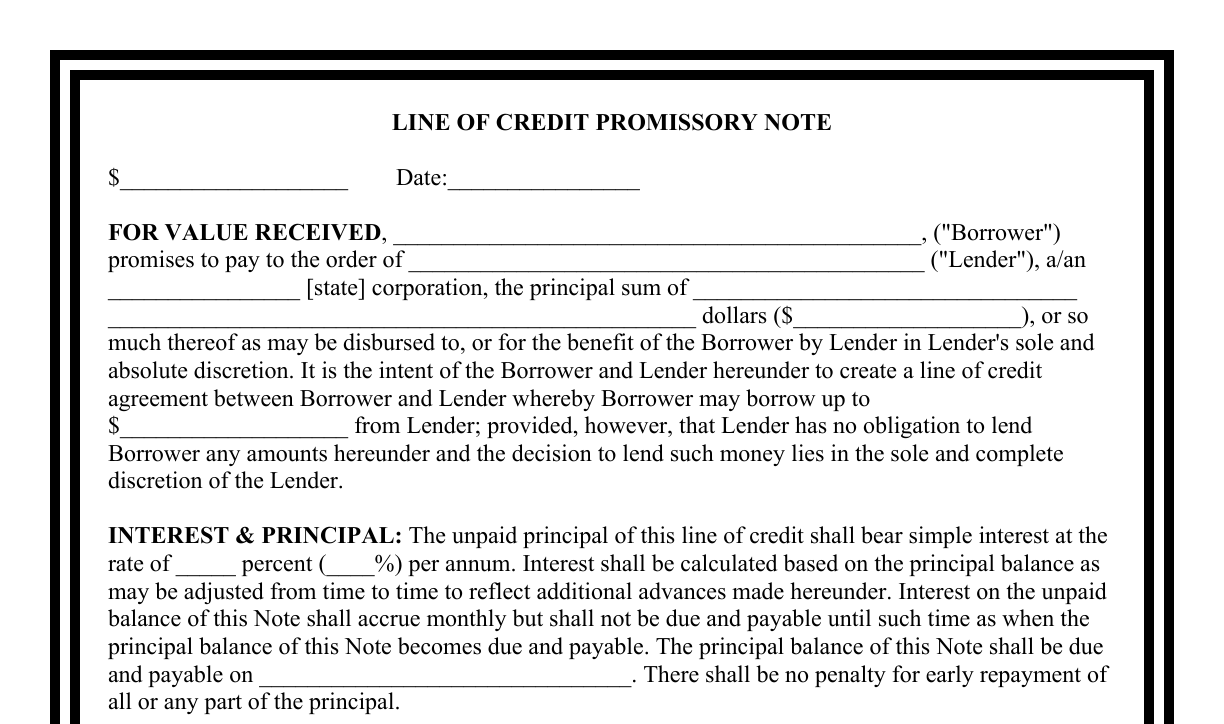
See the opening of the actual note before you buy. A revolving line-of-credit promissory note for private loans: the borrower may draw up to a ceiling you set, pays simple interest that accrues monthly and comes due with the principal at the maturity date you choose, and can prepay without penalty. Written to protect the lender — until money actually moves, every advance remains at the lender’s sole discretion. Includes an Excel loan amortization calculator.
This download includes the line of credit note in Word and PDF, plus a general-purpose Excel amortization calculator (scheduled and optional extra payments) for planning repayment — the note itself has no installment schedule; principal and accrued interest come due at maturity.
See the top of the actual note below. Your complete editable download (Word and PDF) — plus the Excel loan amortization calculator — is delivered after checkout.
Legal currency, verified
A revolving line-of-credit promissory note for private and business loans: the borrower may draw up to a maximum you set, owes only what has actually been advanced, pays simple interest that accrues monthly and comes due with the principal at the maturity date you choose, and may prepay without penalty. The top of the actual note is previewed above before purchase.
This note is written to protect the lender: until money actually moves, every advance remains in the lender’s sole and absolute discretion — the borrower should never treat the ceiling as committed funds. The caption contemplates a corporate borrower (“a/an ___ corporation”); an individual borrower edits the caption in Word before signing. Keep a written ledger of every advance and repayment — the borrower owes only what was actually advanced, and the ledger is the proof. Borrowers, note what you give up: there is no cure period, and the note waives demand, presentment, and protest. The note references a mortgage on the borrower’s property as its security; a note by itself is only a promise, so pair it with a signed, recorded Mortgage Deed for real security. Before setting the interest rate, check your state’s usury law — maximum private-loan rates vary by state and loan type.
A promise to pay only what is actually advanced, up to the ceiling you set; simple interest accruing monthly, with principal and accrued interest due at the maturity date you choose; prepayment without penalty; security by a mortgage on the borrower’s property; the default triggers; the remedies on default; waiver of demand, presentment, and protest; and the borrower’s signature block. The download also includes a general-purpose Excel loan amortization calculator.
The line of credit promissory note in editable Word and print-ready PDF, plus an Excel loan amortization calculator — a general-purpose installment amortizer for payment planning; it does not model this note’s interest-at-maturity balloon structure.
This form is not legal advice. It is a national instrument; consult a licensed attorney in your state for advice about your situation. Consumer-purpose lending carries federal and state disclosure rules this form does not attempt to satisfy.
ILRG is committed to top-quality legal forms. If you are not 100 percent satisfied after purchase, contact us for a full refund.
A standard note evidences one fixed loan. This note sets a maximum the borrower may draw over time: the borrower owes only what has actually been advanced (plus interest), and the balance rises and falls with draws and repayments up to the ceiling. One document covers the whole lending relationship instead of a new note per advance. The note is drafted for an entity borrower and a lender described as “a/an ___ [state] corporation” — an individual on either side simply edits that phrase and the entity default events in Word.
No — the note says so in plain terms. Every advance remains in the lender’s sole and absolute discretion until it is made, so the borrower should never treat the ceiling as committed funds. That discretionary structure is what lets a private lender extend credit without being locked into funding the full amount. If you are the borrower, read the discretion clause and the default list before you sign — this is not a committed facility, it has no notice-or-cure period, and you waive demand, presentment, and protest.
Simple interest at the annual rate you enter, computed on the outstanding balance as it adjusts for additional advances. Interest accrues monthly but is not payable until the principal comes due on the maturity date you set. There is no prepayment penalty. Before setting the rate, check your state’s usury law — maximum private-loan rates vary by state and loan type.
The note references a mortgage on the borrower’s property as its security — but a note by itself is only a promise. The security comes from a signed, recorded mortgage. Our Mortgage Deed secures “a Note having the same date” and works with this one — in a deed-of-trust state, use that state’s instrument instead.
The borrower signs; the lender does not, and the form has no notary block. Private notes are commonly signed without notarization. What protects the lender is evidence: keep the signed original and a written ledger of every advance (date, amount, running balance). The Excel calculator is a general amortization tool for planning repayment — it does not track draws against this note.