
Find legal forms, law schools, and legal resources
Try “residential lease” — forms for your state are shown first.
Try “Yale” or “University of Texas” — the full ABA directory is searchable as you type.
National real-estate security form
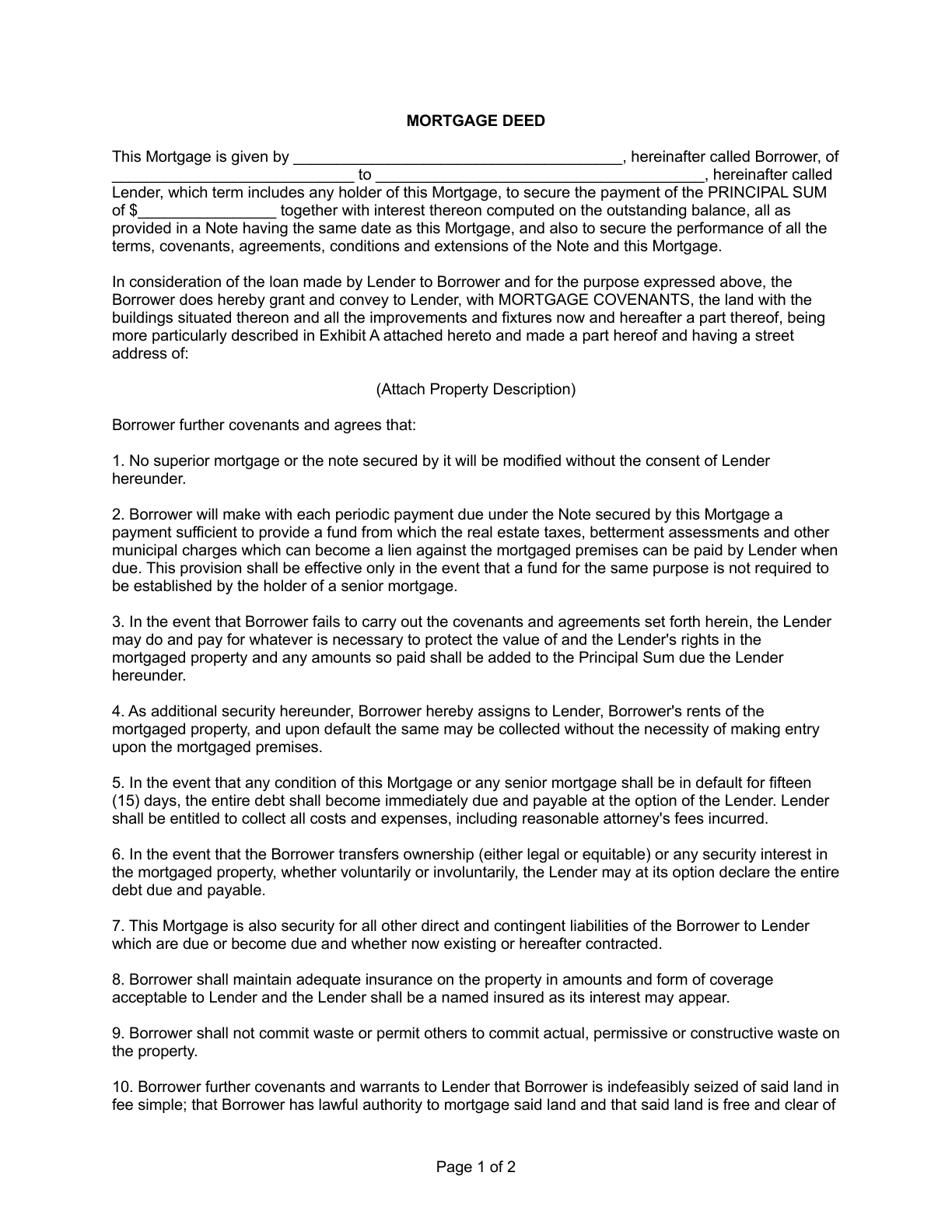
See page 1 of the actual instrument before you buy. A mortgage deed granting a lender a security interest in real property to secure a promissory note of the same date: statutory condition and statutory power of sale where state law provides one, and ten borrower covenants — including escrow funding, assignment of rents on default, due-on-transfer acceleration, a dragnet clause that also secures other debts owed to the same lender, and a warranty of title. You attach the property’s legal description as Exhibit A; closes with two witnesses and a notary acknowledgment.
This download includes the mortgage deed in both Word and PDF, with a notary acknowledgment and an Exhibit A attachment point for the property’s legal description (copy it exactly from the current deed). Use the Word version for editing; the PDF is formatted for printing and reference.
See page 1 of the actual instrument below. Your complete editable download (Word and PDF) is delivered after checkout.
Legal currency, verified
A mortgage deed granting a lender a security interest in real property to secure a promissory note of the same date: statutory condition and statutory power of sale where state law provides one, ten borrower covenants, and execution blocks with two witnesses and a notary acknowledgment; you attach the property’s legal description as Exhibit A (copy it exactly from the current deed). Page 1 of the actual instrument is previewed above before purchase.
States secure real-estate loans with either a mortgage or a deed of trust, and recording offices expect the instrument their state recognizes. This is a national mortgage deed in the statutory-condition, power-of-sale tradition — claimed only “to the extent existing under State law.” Confirm your state uses mortgages rather than deeds of trust, and check your county’s recording requirements (witnesses, notarization, formatting) before signing. Note paragraph 7: the mortgage also secures the borrower’s other present and future liabilities to the same lender (a “dragnet” clause) — read it before signing. The mortgage secures a promissory note of the same date; our Line of Credit Promissory Note is the companion piece — read both before signing; they are not a single integrated loan agreement. A local professional should review anything securing a substantial loan.
The granting clause secures a promissory note of the same date; statutory condition and statutory power of sale to the extent state law provides; and ten borrower covenants — no modification of a superior mortgage; tax and municipal-charge escrow funding; lender protection advances added to principal; assignment of rents on default; 15-day acceleration; due-on-transfer; the dragnet clause securing other liabilities to the same lender; insurance with the lender as named insured; no waste; and a fee-simple warranty of title — closing with the witnessed execution blocks and a notary acknowledgment.
The mortgage deed with its notary acknowledgment, in editable Word and print-ready PDF; you attach the property’s legal description as Exhibit A.
This form is not legal advice. It is a national instrument; consult a licensed attorney in your state for advice about your situation.
ILRG is committed to top-quality legal forms. If you are not 100 percent satisfied after purchase, contact us for a full refund.
It grants the lender a security interest in real property to secure a promissory note of the same date. If the borrower defaults, the lender can foreclose — by the statutory power of sale in states that authorize one, or through the courts elsewhere. Recording the mortgage in the county land records is what gives the lien priority over later claims.
Both secure real-estate loans, but they differ: a mortgage is two-party (borrower, lender); a deed of trust adds a trustee who holds title until payoff. Many states use deeds of trust by custom or statute; others use mortgages. This form is a mortgage. Check your state’s practice — and your county recorder’s requirements — before choosing.
In plain terms: no modification of any senior mortgage without the lender’s consent; funding for taxes and municipal assessments with each periodic payment the note requires (dormant if the note has no periodic payments, and off if a senior mortgage already escrows); reimbursement of the lender’s protective advances, added to principal; assignment of rents to the lender on default; acceleration of the whole debt after 15 days of uncured default — including a default under a senior mortgage — with the lender’s costs and reasonable attorney’s fees recoverable; lender consent before transferring the property (due-on-transfer); the mortgage also secures the borrower’s other present and future liabilities to the same lender (a “dragnet” clause — read it before signing); insurance naming the lender as an insured; no waste on the property; and a warranty that the borrower owns the land free of undisclosed encumbrances.
Where state law provides one, a power of sale lets the lender sell the property after default without filing a foreclosure lawsuit — faster and cheaper than judicial foreclosure. The form claims the power only “to the extent existing under State law”: in states without one, the lender forecloses through the courts instead. Likewise, “mortgage covenants” and “statutory condition” are incorporation-by-reference terms with defined content in a handful of states (the Massachusetts short-form tradition); elsewhere they carry no fixed meaning, and the lender relies on the ten express covenants and the courts.
The instrument closes with borrower and lender signature lines, two witnesses, and a notary acknowledgment. Recording requirements vary by county — some demand two witnesses, specific margins, or a particular acknowledgment form — so confirm the local requirements before signing and recording.
The legal description of the mortgaged property, attached to and incorporated into the mortgage. A street address is not a legal description — copy the description exactly from the current deed to the property, lot-and-block or metes-and-bounds as it appears of record.