
Find legal forms, law schools, and legal resources
Try “residential lease” — forms for your state are shown first.
Try “Yale” or “University of Texas” — the full ABA directory is searchable as you type.
National employment form
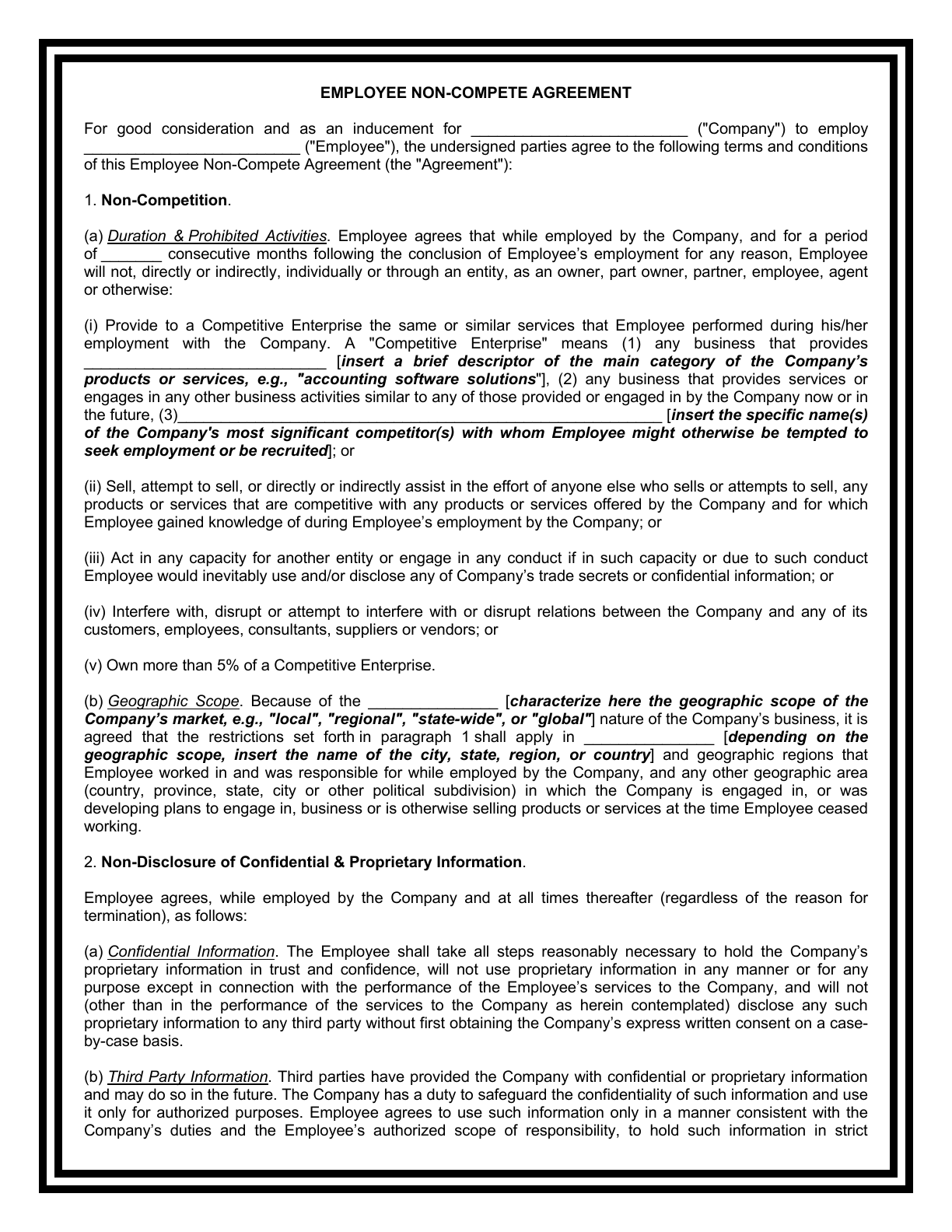
See page 1 of the actual agreement before you buy. A non-compete and confidentiality agreement built for a new hire: for a months-blank period after employment, the employee stays out of the same or similar services for a defined competitive enterprise — you can name specific competitors — stops selling competing products or services, and caps any ownership stake in a competitor at five percent, within a geographic scope keyed to your actual market. A parallel confidentiality section covers proprietary and third-party information, with a savings clause preserving the employee’s right to discuss employment terms with the EEOC, the Department of Labor, and the NLRB. Word for editing; PDF for printing.
This download includes the agreement in both Word and PDF. Use the Word version to set the duration, define the competitive enterprise and the territory, and fill the governing-law blanks — deleting the bracketed drafting notes as you go; the PDF is formatted for printing and reference.
See page 1 of the actual agreement below. Your complete editable download (Word and PDF) — the government-agency and NLRA §7 savings clause, the severability and reformation clause, the governing-law section, and the signature blocks — is delivered after checkout.
Legal currency, verified
A non-compete and confidentiality agreement built for a new hire: the employee covenants not to work for, sell for, assist, or hold more than a five-percent stake in a defined competitive enterprise — you can name specific competitors — during employment and for a months-blank period after it ends, within a geographic scope keyed to your actual market. A parallel confidentiality section covers proprietary and third-party information, with a savings clause preserving the employee's right to discuss employment terms with the EEOC, the Department of Labor, and the NLRB. Page 1 of the actual agreement is previewed above before purchase.
Non-competes live or die by state law. They are void for most employees in California, Minnesota, North Dakota, and Oklahoma; a growing list of states enforce them only under wage thresholds, advance-notice requirements, or duration caps; and the FTC's 2024 nationwide ban was set aside in court before it took effect, leaving state law in control. This form is drafted for the reasonableness test the enforcing states apply: you set the duration in months, define the competitive enterprise — including by naming competitors — and key the territory to the markets where the company actually does business, and the severability clause authorizes a court to narrow an overbroad term rather than void the agreement. The recital is the hiring itself — the strongest consideration footing; several states require fresh consideration for covenants signed by existing employees. The document carries integrated bracketed drafting notes — delete them when you finalize.
The non-competition section — a months-blank post-employment duration and five prohibited activities: providing services to a competitive enterprise (defined three ways, including named competitors), selling or assisting the sale of competing products or services the employee learned about, any role that would inevitably use or disclose the company's trade secrets, interference with the company's customers, employees, consultants, suppliers, or vendors, and owning more than five percent of a competitive enterprise; the geographic scope keyed to the company's market, the employee's responsibility areas, and the areas where the company does or plans to do business; the non-disclosure section — proprietary information held in trust, third-party information in the company's care, and an exceptions clause: the employee keeps the agreement's own terms confidential but may disclose them to immediate family and professional advisers in confidence or as required by law, and keeps the right to discuss employment terms with the EEOC, the Department of Labor, the NLRB, or any government agency under Section 7 of the National Labor Relations Act; severability with court reformation; governing law with exclusive jurisdiction and venue blanks; successors and assigns; and the company and employee signature blocks.
The agreement in editable Word and print-ready PDF — with the duration, competitive-enterprise, territory, and governing-law blanks you complete and the bracketed drafting notes you delete as you finalize. A completed sample PDF is available as an add-on at checkout.
This form is not legal advice. It is a national instrument; consult a licensed attorney in your state for advice about your situation. Covenant enforceability varies sharply by state and is changing by legislation every year — verify your state's current rules before use.
ILRG is committed to top-quality legal forms. If you are not 100 percent satisfied after purchase, contact us for a full refund.
It depends entirely on the state. California, Minnesota, North Dakota, and Oklahoma void most employment non-competes; states like Washington, Oregon, Illinois, Colorado, Massachusetts, and Maine allow them only under conditions — wage thresholds, advance notice, or duration caps; and the FTC’s 2024 nationwide ban was set aside in court, so state law controls. Where they are enforced, the test is reasonableness of time, geography, and restricted activity — the test this form is drafted around.
Three definitions at once: any business providing the category of products or services you describe in the blank; any business similar to anything the company does now or in the future; and the specific competitors you name — naming names is the strongest drafting, because it removes the argument about who the restraint covers.
It prohibits owning more than five percent of a competitive enterprise — which means passive public-market positions below that line stay permitted, while a meaningful stake in a competitor is barred — and the no-services and no-selling prongs still apply on top of it.
Yes — a parallel section holds the company’s proprietary information in trust during and after employment and extends to third-party information in the company’s care. A separate exceptions clause lets the employee disclose the agreement’s own terms to immediate family and professional advisers in confidence or as required by law, and expressly preserves the right to discuss employment terms with the EEOC, the Department of Labor, the NLRB, or any government agency under Section 7 of the NLRA — rights an employment agreement cannot lawfully restrict.
The recital is the hiring itself — the strongest consideration footing. For an existing employee, several states require fresh consideration — a raise, promotion, bonus, or other new value — and in the ban states no consideration cures the covenant. Check your state’s rule before presenting it to a current employee.
Integrated drafting guidance — for example, how to characterize the market’s geographic scope or describe the company’s product category. They are prompts for you, not contract terms: delete every bracketed note when you finalize the agreement.