
Find legal forms, law schools, and legal resources
Try “residential lease” — forms for your state are shown first.
Try “Yale” or “University of Texas” — the full ABA directory is searchable as you type.
Oregon legal form
Download the Oregon general durable power of attorney for property and finances — effective only upon disability or incapacity. Ready for instant secure access.
A durable power of attorney document for managing property and finances, prepared for Oregon.
Prepared for Oregon, granting broad financial authority effective only upon your disability or incapacity.
The authority continues through incapacity — the moment a power of attorney matters most. A non-durable document would end exactly then.
Download the file, complete it on your own device, then sign with the required notarization or witnesses. No online data entry.
This state packet includes 1 document in editable Word and print-ready PDF formats. Use the Word version for editing and the PDF for print-ready reference.
About this packet
A general durable power of attorney lets you appoint an agent to manage your property and finances — banking, real estate, investments, and similar matters. This version takes effect only upon your disability or incapacity, keeping full control in your hands while you are able.
The powers granted are broad. Choose your agent carefully, and consider consulting an attorney if your financial situation is complex.
Review representative packet content before purchasing. Your licensed download is delivered after checkout.
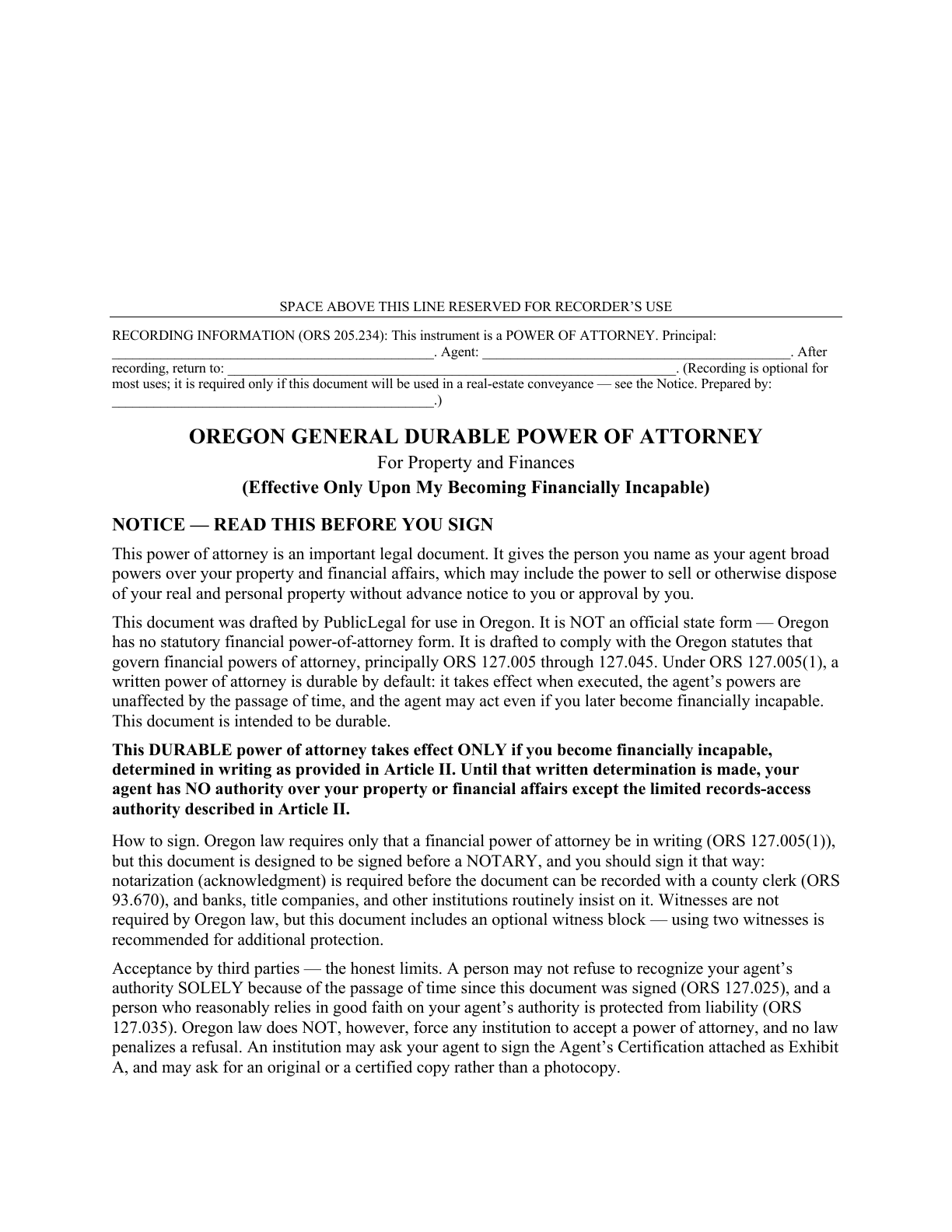
SPACE ABOVE THIS LINE RESERVED FOR RECORDER'S USE
RECORDING INFORMATION (ORS 205.234): This instrument is a POWER OF ATTORNEY. Principal: ______________________________________________. Agent: ____________________________________________. After recording, return to: ________________________________________________________________. (Recording is optional for most uses; it is required only if this document will be used in a real-estate conveyance — see the Notice. Prepared by: ______________________________________________.)
OREGON GENERAL DURABLE POWER OF ATTORNEY
(Oregon Revised Statutes Chapter 127 — Powers of Attorney)
For Property and Finances
(Effective Only Upon My Becoming Financially Incapable)
NOTICE — READ THIS BEFORE YOU SIGN
This power of attorney is an important legal document. It gives the person you name as your agent broad powers over your property and financial affairs, which may include the power to sell or otherwise dispose of your real and personal property without advance notice to you or approval by you.
This document was drafted by PublicLegal for use in Oregon. It is NOT an official state form — Oregon has no statutory financial power-of-attorney form. It is drafted to comply with the Oregon statutes that govern financial powers of attorney, principally ORS 127.005 through 127.045. Under ORS 127.005(1), a written power of attorney is durable by default: it takes effect when executed, the agent's powers are unaffected by the passage of time, and the agent may act even if you later become financially incapable. This document is intended to be durable.
This DURABLE power of attorney takes effect ONLY if you become financially incapable, determined in writing as provided in Article II. Until that written determination is made, your agent has NO authority over your property or financial affairs except the limited records-access authority described in Article II.
How to sign. Oregon law requires only that a financial power of attorney be in writing (ORS 127.005(1)), but this document is designed to be signed before a NOTARY, and you should sign it that way: notarization (acknowledgment) is required before the document can be recorded with a county clerk (ORS 93.670), and banks, title companies, and other institutions routinely insist on it. Witnesses are not required by Oregon law, but this document includes an optional witness block — using two witnesses is recommended for additional protection.
Acceptance by third parties — the honest limits. A person may not refuse to recognize your agent's authority SOLELY because of the passage of time since this document was signed (ORS 127.025), and a person who reasonably relies in good faith on your agent's authority is protected from liability (ORS 127.035). Oregon law does NOT, however, force any institution to accept a power of attorney, and no law penalizes a refusal. An institution may ask your agent to sign the Agent's Certification attached as Exhibit A, and may ask for an original or a certified copy rather than a photocopy.
Your agent's duty. Your agent is your fiduciary. Under ORS 127.045, your agent must use your property for YOUR benefit unless this document provides otherwise. Misusing this power of attorney against a vulnerable person — anyone 65 or older, financially incapable, or incapacitated — is civil financial abuse under ORS 124.100 to 124.140, and a court MUST award a prevailing plaintiff THREE TIMES economic damages plus attorney's fees and costs. Your agent may also bring such an action on your behalf (ORS 124.100(3)(b)).
This document does NOT give anyone authority to make health care decisions for you (ORS 127.005(6)). Oregon health care decisions are made under a separate Oregon Advance Directive (ORS 127.505 to 127.660). It does not let anyone make or change your will, create or revoke a transfer on death deed (see ORS 93.959 and 93.965(2)), or act as your Social Security representative payee — those are separate matters with their own rules.
Real estate. If this document will be used in a transaction involving Oregon land, it should be notarized and recorded with the county clerk of each county where the land lies (ORS 93.670). A recorded power of attorney is not revoked as to the record until the revocation is ALSO recorded in the same office (ORS 93.670(2)). If your property is held with your spouse as tenants by the entirety (the Oregon default for property conveyed to spouses, ORS 93.180), YOUR agent cannot deal with your spouse's interest — your spouse must sign too.
Vehicles, boats, and manufactured homes. The Oregon DMV has its own vehicle power-of-attorney form (Form 735-500), and dealer odometer transactions require DMV's secure Form 735-402; this document is not a substitute for those forms, although DMV may accept a certified copy of a general power of attorney (OAR 735-028-0070(3)(a)). Manufactured structures that are not deeded as real property are titled through the Building Codes Division, not DMV (ORS chapter 446).
Taxes and benefits agencies. The IRS may require its Form 2848, and the Oregon Department of Revenue its OR-AUTH-REP form (ORS 305.230), before treating your agent as your tax representative. The Social Security Administration and the VA have their own appointment processes.
Divorce or separation. If you name your spouse or registered domestic partner as your agent, that person's authority TERMINATES AUTOMATICALLY if an action is filed for dissolution or annulment of the marriage or partnership, or for separation — on the FILING, not the final decree (ORS 127.015(1)(e)) — unless you initial the contrary election in Article IX. A successor agent you have named continues to serve.
If a conservator is appointed for you. Appointment of a conservator does NOT end this power of attorney, but your agent must then account to the conservator, and the conservator (or the court) may revoke, suspend, or terminate it (ORS 127.005(5), 127.015(2)).
You may revoke this power of attorney at any time while you have capacity, by a signed written revocation delivered to your agent and to anyone relying on it. This document terminates at your death. Gifts and other transfers can affect Oregon Health Plan (Medicaid) eligibility look-back rules — this document is not a benefits-planning tool. If there is anything about this document you do not understand, ask an Oregon lawyer of your own choosing to explain it before you sign.
I have read or had explained to me this Notice and I understand its contents.
___________________________________________ __________________
(Signature of Principal) (Date)
ARTICLE I — APPOINTMENT OF AGENT
I, the undersigned principal:
Name: ____________________________________________________________
Address: ____________________________________________________________
designate the following person as my agent (attorney-in-fact), to act for me as provided in this power of attorney:
Name: ____________________________________________________________
Address: ____________________________________________________________
Telephone: ________________________________________________________
Co-agents (optional). I may name a second agent to serve at the same time: _______________________________________________. If I name two agents, EACH MAY ACT INDEPENDENTLY unless I check here: [ ] my two agents must act JOINTLY. If one of two co-agents dies, becomes financially incapable or incapacitated, or resigns, the other may continue to act alone (ORS 127.015(1)(c)).
Successor agents (optional, recommended). If my agent dies, becomes financially incapable or incapacitated, or resigns (ORS 127.015(1)(c)), or declines to serve, I designate the following successor(s), each to act alone and successively in the order named, with the same authority:
First successor: ____________________________________________________
Second successor: ____________________________________________________
ARTICLE II — EFFECTIVENESS AND DURABILITY
This power of attorney becomes effective ONLY if I become financially incapable (ORS 127.005(2)).
It is a durable power of attorney with postponed effectiveness. Until the written determination described below is made, my agent has NO authority over my property or financial affairs except the limited records-access authority described in this Article. Once effective, my agent's powers are unaffected by the passage of time and continue through my financial incapability (ORS 127.005(1), (4)) until I revoke this document, it terminates by its own terms or under ORS 127.015, or I die.
Definition. For purposes of this power of attorney, "financially incapable" has the meaning given in ORS 125.005(3): a condition in which I am unable to manage my financial resources effectively for reasons including, but not limited to, mental illness, mental retardation, physical illness or disability, chronic use of drugs or controlled substances, chronic intoxication, confinement, detention by a foreign power, or disappearance. "Manage financial resources" means those actions necessary to obtain, administer and dispose of real and personal property, intangible property, business property, benefits and income.
OPTIONAL DESIGNATION OF DETERMINER(S). I may designate one or more persons to determine whether I have become financially incapable (ORS 127.005(2)): Designee: ______________________________________________. Successor designee: ______________________________________________. This designation is effective only if I BOTH initial here _______ AND name at least one person above. Each named person acts separately and in the order listed. A person designated under this paragraph is my personal representative for purposes of ORS 192.553 to 192.581 and the federal HIPAA privacy regulations, 45 C.F.R. parts 160 and 164 (ORS 127.005(2)), and may obtain and discuss my health information to the extent needed to make the determination.
DEFAULT DETERMINATION. If I have not effectively designated a determiner above, or none of the designated persons is willing or able to make the determination, a determination that I am financially incapable may be made by ANY PHYSICIAN, in writing (ORS 127.005(3)). A determination form is attached as Exhibit B.
LIMITED RECORDS AUTHORIZATION. Solely so that the determination described in this Article can be made, I authorize each physician who examines or treats me to disclose to my agent and to any person making the determination the health information needed to determine whether I am financially incapable, and I authorize the persons making the determination to discuss that information with my agent. This authorization is limited to that purpose and ends when the determination is made.
DELIVERY AND ATTACHMENT. The written determination must be delivered to my agent and kept with (and, when presented, attached to) this power of attorney. When my agent presents this document, my agent should also complete the Agent's Certification (Exhibit A), certifying that the power of attorney is in effect and that the triggering event has occurred.
If I recover. If a determination has been made but I later regain the ability to manage my financial resources, I may resume acting for myself and may revoke this power of attorney by a signed written revocation delivered to my agent (recorded in the same county if this document was recorded — see Article IX).
ARTICLE III — GRANT OF GENERAL AUTHORITY
I grant my agent general authority over my property and financial affairs as described in this Article. EACH CATEGORY BELOW IS GRANTED UNLESS I INITIAL ITS "WITHHOLD" LINE. Initialing WITHHOLD deletes that category from this grant. A blank WITHHOLD line means the category IS granted.
Each grant below is written out in full — Oregon has no statutory catalog of powers, so this document states each power itself rather than incorporating one. This authority applies to property I own now or acquire later, wherever located, and includes authority to do whatever is reasonably necessary to carry out each granted power, including accessing my electronic files, user names, and passwords.
WITHHOLD _______ (1) Real property: buy, sell, exchange, lease, mortgage, encumber, manage, improve, insure, and otherwise deal with real estate and interests in real estate, and execute and deliver deeds and other conveyances (see the tenancy-by-the-entirety caution in the Notice).
WITHHOLD _______ (2) Tangible personal property: buy, sell, lease, store, transport, repair, insure, and otherwise deal with tangible personal property.
WITHHOLD _______ (3) Stocks, bonds, and other securities: buy, sell, exchange, pledge, transfer, and vote securities; operate securities and brokerage accounts; and exercise rights incident to securities.
WITHHOLD _______ (4) Commodities and options: operate commodity and option accounts.
WITHHOLD _______ (5) Banks and other financial institutions: open, modify, and close accounts of any kind; deposit and withdraw funds; write and endorse checks and other payment orders; borrow money and give security; rent, enter, and remove the contents of safe-deposit boxes; and receive statements and other account information.
WITHHOLD _______ (6) Operation of an entity or business: organize, operate, continue, restructure, or close sole proprietorships and business interests; exercise rights as an owner, partner, member, or shareholder; and sign business filings.
WITHHOLD _______ (7) Insurance and annuities: procure, continue, modify, borrow against, surrender, and collect on insurance policies and annuity contracts, and pay premiums (naming or changing a beneficiary is a Special Power in Article IV).
WITHHOLD _______ (8) Estates, trusts, and other beneficial interests: receive, manage, and transfer inheritances and interests in estates, trusts, and other beneficial interests; act for me in estate and trust administration; and transfer my property into a revocable trust that I have created.
WITHHOLD _______ (9) Claims and litigation: bring, defend, settle, compromise, and satisfy claims and lawsuits, including bankruptcy matters, and hire and instruct professionals.
WITHHOLD _______ (10) Personal and family maintenance: maintain the customary standard of living of me, my spouse or registered domestic partner, and my dependents, including paying health-care costs and signing facility admission agreements (this authority does not depend on any gift power, and it does NOT include authority to make health-care decisions — see the Notice).
WITHHOLD _______ (11) Benefits from governmental programs or civil or military service: apply for, manage, appeal, and receive Social Security, Medicare, Medicaid, veterans, and other governmental or service benefits (federal agencies may require their own appointment forms — see the Notice).
WITHHOLD _______ (12) Retirement plans: establish, contribute to, and take distributions from retirement plans and IRAs; elect payment options, including rollover and distribution elections and required-minimum-distribution timing; and exercise all other plan rights (naming or changing a plan beneficiary is a Special Power in Article IV).
WITHHOLD _______ (13) Taxes: prepare, sign, and file federal, state, and local tax returns, declarations, and elections; pay taxes; claim refunds; contest deficiencies; and act before the Internal Revenue Service, the Oregon Department of Revenue, and other taxing authorities (the IRS and the Department of Revenue may require their own authorization forms — see the Notice).
WITHHOLD _______ (14) Digital assets and accounts (other than content): access, manage, control, transfer, and close my digital assets and online accounts OTHER THAN THE CONTENT OF ELECTRONIC COMMUNICATIONS sent or received by me, including accessing catalogues of my electronic communications, as provided in ORS 119.036 (content of electronic communications is a Special Power in Article IV); a direction I give through a custodian's online tool controls over this grant (ORS 119.016).
ARTICLE IV — SPECIAL POWERS (GRANT ONLY BY INITIALING)
MY AGENT HAS NONE OF THE FOLLOWING POWERS UNLESS I INITIAL THE LINE FOR THAT POWER. A blank line means the power is NOT granted. These powers can significantly change your estate plan or dissipate your property — initial only the powers you intend.
INITIAL _______ (1) Make gifts of my property — give away my property (see the gift-limit election below).
INITIAL _______ (2) Make gifts to my agent — let my agent give my property to the agent personally — initial only if you intend this; without this line, my agent may not use any power to enrich the agent (ORS 127.045).
INITIAL _______ (3) Create, amend, revoke, or terminate a trust — change or end trusts.
INITIAL _______ (4) Create or change a beneficiary designation — name or change who receives accounts, policies, plans, or annuities at my death.
INITIAL _______ (5) Create or change rights of survivorship — add or remove survivorship rights on accounts and property.
INITIAL _______ (6) Delegate authority granted under this power of attorney — let my agent hand some or all authority to another person (delegation ends when my agent's authority ends; authority to make gifts may NOT be delegated).
INITIAL _______ (7) Disclaim or renounce property or powers — refuse inheritances or property I am entitled to (see the restriction note below).
INITIAL _______ (8) Exercise a power of appointment — direct who receives property under a power of appointment I hold.
INITIAL _______ (9) Access the content of my electronic communications — read the substance of my emails, messages, and other electronic communications — an EXPRESS grant, as ORS 119.032 requires.
Gift-limit election (applies only if power (1) is initialed). Unless I initial the broader-authority line below, gift authority is limited as follows: gifts to any one recipient in a calendar year are capped at the federal gift-tax annual exclusion amount under Internal Revenue Code § 2503(b) AS IN EFFECT IN THE YEAR OF THE GIFT (twice that amount if my spouse consents to split gifts), and gifts must be consistent with my known objectives or, if unknown, my best interest, considering my property, my foreseeable needs, taxes, eligibility for benefits and programs, and my gifting history.
INITIAL _______ Broader gift authority. My agent may make gifts exceeding the limits stated above, as instructed here: _______________________________________________
Disclaimer restriction (ORS 105.629(2)). Oregon law otherwise lets a fiduciary — including an agent under a power of attorney (ORS 105.624(4)) — disclaim property or powers on my behalf. THIS DOCUMENT EXPRESSLY RESTRICTS THAT DEFAULT: my agent may disclaim or renounce an interest in property or a power over property ONLY if power (7) above is initialed, and then only as ORS 105.623 to 105.649 provide.
ARTICLE V — SPECIAL INSTRUCTIONS
I may delete from, add to, or modify the powers granted by this document as follows (if none, write "None"):
________________________________________________________________
________________________________________________________________
________________________________________________________________
________________________________________________________________
ARTICLE VI — COMPENSATION OF MY AGENT
Oregon law does not set a default rule on compensating an agent under a financial power of attorney. I elect (check ONE):
[ ] Reimbursement only. My agent is NOT entitled to compensation for services. My agent IS entitled to reimbursement of expenses reasonably incurred on my behalf.
[ ] Reimbursement plus reasonable compensation. My agent is entitled to reimbursement of expenses reasonably incurred on my behalf PLUS reasonable compensation from my funds for services as my agent.
If I do not check either box, the REIMBURSEMENT-ONLY election applies.
ARTICLE VII — CONSERVATORSHIP; NOMINATION OF CONSERVATOR OR GUARDIAN (OPTIONAL)
If a court appoints a conservator for me, this power of attorney does NOT terminate, but my agent must account to the conservator (rather than to me) for as long as the conservatorship lasts, and the conservator has the same power I would have to revoke, suspend, or terminate all or part of this power of attorney (ORS 127.005(5)). The court may also order this power of attorney revoked when it appoints a conservator (ORS 127.015(2)).
If protective proceedings for my estate or person are ever begun, I nominate the following person(s). The court will consider this stated desire when appointing a fiduciary (ORS 125.200), but it is not bound by it — this is not a binding appointment, and the disqualifications of ORS 125.205 still apply. (Leave blank to make no nomination.)
Conservator of my estate: ________________________________________________
Guardian of my person: ________________________________________________
ARTICLE VIII — RELIANCE AND THIRD PARTIES
No refusal for staleness. A person may not refuse to recognize my agent's authority under this power of attorney based solely on the passage of time since it was executed (ORS 127.025).
Good-faith reliance. A person who reasonably relies in good faith on my agent's authority is not liable to anyone for that reliance and is not required to ensure that my assets paid or delivered to my agent are properly applied; a person without actual notice of a revocation is not liable for relying on this document (ORS 127.035). Acts my agent does in good faith, without actual knowledge of my death or of any other event terminating the agent's authority, bind me and my estate as though the death or event had not occurred (ORS 127.015(3)).
Copies. A photocopy, scan, or other reproduction of this signed power of attorney has the same effect as the original. For transactions that require it, my agent may certify that a copy is a true copy of the original using Exhibit A (see, e.g., OAR 735-028-0070(3)(a)).
Agent's certification. My agent may sign the Agent's Certification attached as Exhibit A: an affidavit, under penalty of perjury, that my agent had no actual knowledge of any revocation or termination of this power of attorney — which, absent fraud, is CONCLUSIVE PROOF of nonrevocation and may be recorded if the instrument being exercised under is recordable (ORS 127.015(4)) — and that also certifies, for custodians of digital assets, that this power of attorney is in effect (ORS 119.032(3), 119.036(3)).
How my agent signs. When my agent signs an instrument on my behalf, the signature should identify me and show the agency, for example: "[My name], by [Agent's name], as agent (attorney-in-fact), under power of attorney dated ____________."
ARTICLE IX — REVOCATION; EFFECT ON PRIOR POWERS OF ATTORNEY
Revocation. I may revoke this power of attorney by a signed written revocation delivered to my agent and to any person I know is relying on it (ORS 127.015(1)(b)). If this power of attorney was recorded, the revocation must ALSO be recorded in the same county clerk's office — a recorded power of attorney is not deemed revoked as to the record until the revocation is recorded in the same office (ORS 93.670(2)). Termination of my agent's authority is not effective as to a person who acts in good faith without actual knowledge of it (ORS 127.015(3)). Nothing in ORS 127.015 changes any revocation or termination provision of this document (ORS 127.015(5)).
Divorce, annulment, or separation. If my spouse or registered domestic partner is my agent, that person's authority TERMINATES if an action is filed for the dissolution or annulment of our marriage or registered domestic partnership, or for our separation — the termination happens when the action is FILED (ORS 127.015(1)(e)). A successor agent continues to serve.
INITIAL _______ Contrary election: I want my spouse or registered domestic partner's authority as my agent to CONTINUE even if such an action is filed.
Prior powers of attorney. Oregon law does not revoke my earlier powers of attorney when I sign a new one. I elect (check ONE):
[ ] REVOKE all of my earlier powers of attorney concerning property and financial matters (this does NOT revoke any Oregon Advance Directive, POLST, mental-health declaration, or other health care document);
[ ] REVOKE only the following earlier power(s) of attorney: _______________________________________________;
[ ] DO NOT revoke my earlier powers of attorney.
If I do not check any box, the FIRST election applies: all of my earlier property-and-finances powers of attorney are revoked.
ARTICLE X — GOVERNING LAW AND SEVERABILITY
This power of attorney is governed by the laws of the State of Oregon, including ORS 127.005 through 127.045. If any provision of this document is held invalid or unenforceable, the remaining provisions continue in full force.
EXECUTION
How to execute this document. Oregon law requires a financial power of attorney to be in writing (ORS 127.005(1)). This document is designed to be (1) SIGNED by me and (2) ACKNOWLEDGED before a notary public or other notarial officer in the form below (ORS 194.285(1)). Acknowledgment is what allows this document to be RECORDED with a county clerk (ORS 93.670) and is what institutions expect — sign before a notary. For recording, the document must bear original signatures (ORS 93.804). If I am unable to sign, another person may sign my name at my direction and in my presence, and the notary should note that fact. Witnesses are NOT required by Oregon law, but the optional witness block below is recommended for additional protection; witnesses should be adults who are NOT named as agent or successor agent in this document and not the spouse of an agent or successor.
___________________________________________ __________________
(Signature of Principal) (Date)
ATTESTATION OF WITNESSES — RECOMMENDED, NOT REQUIRED FOR VALIDITY
Each of the undersigned witnesses declares under penalty of perjury that the principal appeared before us, signed or acknowledged this power of attorney in our presence, appeared to be of sound mind and under no duress, fraud, or undue influence, and requested that we serve as witnesses to the signing.
Witness 1 signature: __________________________________ Date: ______________
Witness 1 printed name: _______________________________________________
Witness 1 address: _____________________________________________________
Witness 2 signature: __________________________________ Date: ______________
Witness 2 printed name: _______________________________________________
Witness 2 address: _____________________________________________________
NOTARY ACKNOWLEDGMENT (ORS 194.285(1))
State of ____________________
County of ____________________
This record was acknowledged before me on ____________________ (date) by ____________________________________________ (name(s) of individual(s)).
_____________________________________________ (Stamp, if required)
Signature of notarial officer
Title of office: ____________________
My commission expires: ____________________
AGENT'S DUTIES — A SUMMARY FOR THE PERSON I HAVE NAMED
No Oregon statute requires an agent to sign an acceptance before acting; an agent accepts the appointment by acting under it. An agent who accepts appointment as my agent must:
• use my property for MY benefit (ORS 127.045) — not for the agent's benefit — unless this document expressly provides otherwise;
• act in good faith, within the authority this document grants, and with the care a reasonably prudent person would exercise in managing another's property;
• keep my property separate from the agent's own and keep records of all receipts, disbursements, and transactions made on my behalf;
• cooperate with the person who has authority to make health care decisions for me;
• preserve my estate plan, to the extent the agent actually knows it, if consistent with my best interest, considering my property, my foreseeable obligations and needs, taxes, and my eligibility for benefits and programs;
• account to any conservator a court appoints for me, for as long as the conservatorship lasts (ORS 127.005(5)); and
• stop acting when the agent's authority ends — including upon my death, upon revocation, or, if the agent is my spouse or registered domestic partner, upon the filing of a dissolution, annulment, or separation action (unless I have initialed the contrary election in Article IX) (ORS 127.015).
An agent may resign by giving written notice to me and, if I am financially incapable, to my conservator or guardian, if any, and to any successor agent named in this document.
A warning about abuse. Misusing this power of attorney against a vulnerable person — anyone 65 or older, financially incapable, or incapacitated — is civil financial abuse under ORS 124.100 to 124.140. A court MUST award a prevailing plaintiff THREE TIMES all economic damages (or $500, whichever is greater) plus attorney's fees and costs, and may award other relief. Criminal prosecution is also possible. An agent who exceeds authority can be required to restore losses and may be liable for the misuse of every dollar.
EXHIBIT A — AGENT'S CERTIFICATION (AFFIDAVIT) AS TO THE VALIDITY OF THE POWER OF ATTORNEY AND THE AGENT'S AUTHORITY
This affidavit is provided for use under ORS 127.015(3) and (4) and ORS 119.032(3) and 119.036(3). It is not a statutory form. Absent fraud, it is CONCLUSIVE PROOF that the power of attorney had not been revoked or terminated at the time of the act, and if the exercise of the power requires execution and delivery of a recordable instrument, this affidavit may also be recorded (ORS 127.015(4)).
State of ____________________
County of ____________________
I, ____________________________________________ (name of agent), certify under penalty of perjury that ____________________________________________ (name of principal) granted me authority as an agent or successor agent in a power of attorney dated ____________________.
I further certify that to my knowledge:
(1) the principal is alive and has not revoked the power of attorney or my authority to act under it, and the power of attorney and my authority to act under it have not terminated;
(2) I had, at the time of doing any act under the power of attorney, no actual knowledge of the revocation or termination of the power of attorney by death or other event;
(3) the action I desire to take is within the scope of my authority granted under the power of attorney;
(4) the power of attorney was drafted to become effective only upon the principal's becoming financially incapable, and that event HAS OCCURRED (the written determination required by Article II of the power of attorney is attached);
(5) if I was named as a successor agent, each prior agent is no longer able or willing to serve;
(6) the power of attorney is in effect; and
(7) if I have attached a photocopy or other reproduction of the power of attorney, the attached copy is a true, correct, and complete copy of the original signed power of attorney.
___________________________________________ __________________
(Agent's Signature) (Date)
Agent's name printed: ____________________________________________
Agent's address: ____________________________________________
Agent's telephone number: ____________________________________________
VERIFICATION (ORS 194.285(3))
State of ____________________
County of ____________________
Signed and sworn to (or affirmed) before me on ____________________ (date) by ____________________________________________ (name(s) of individual(s)) making statement.
_____________________________________________ (Stamp, if required)
Signature of notarial officer
Title of office: ____________________
My commission expires: ____________________
EXHIBIT B — WRITTEN DETERMINATION THAT THE PRINCIPAL IS FINANCIALLY INCAPABLE (ORS 127.005(2), (3))
This form activates the attached springing power of attorney. It is completed by the person the principal designated in Article II of the power of attorney or, if no designation is effective or the designee is unable or unwilling, by any physician (ORS 127.005(3)). The completed determination must be delivered to the agent and kept with the power of attorney.
I, ____________________________________________, determine in writing that ____________________________________________ (the principal) is FINANCIALLY INCAPABLE as defined in ORS 125.005(3): the principal is unable to manage the principal's financial resources effectively, where "manage financial resources" means those actions necessary to obtain, administer and dispose of real and personal property, intangible property, business property, benefits and income.
My capacity to make this determination (check one):
[ ] I am the person designated by the principal in Article II of the power of attorney (or the successor designee). As a designated person I am the principal's personal representative for purposes of ORS 192.553 to 192.581 and 45 C.F.R. parts 160 and 164 (ORS 127.005(2)).
[ ] I am a physician. License no.: ____________________ State: ______
Basis for my determination (examination, records reviewed, relationship, or other):
________________________________________________________________
________________________________________________________________
___________________________________________ __________________
(Signature of person making the determination) (Date)
ILRG is committed to top quality legal forms that are valid in all states. If you are not 100 percent satisfied after purchase, contact us for a full refund.
Yes. This product is the Oregon general durable power of attorney (upon disability) packet tied to this state-specific page and the packet documents shown above.
Only upon your disability or incapacity, as defined in the document. This springing structure keeps full control in your hands while you are able. If you prefer authority that starts right away, use the immediate version instead.
A durable power of attorney remains effective even if the principal becomes incapacitated. A non-durable power of attorney would end at incapacity — exactly when the document is most needed.
Requirements vary by state. Many states require notarization, some also require witnesses, and the document may need to be recorded if used in a real-estate transaction. Follow the execution instructions included with your Oregon packet.
Yes. You can revoke a power of attorney at any time while you have capacity, by signing a written revocation and notifying your agent and any institutions that rely on the document.
The included packet documents are listed on this page — 1 document in total. Where the same document is provided in more than one format, it is grouped once with Word, PDF, or other format badges.
This packet currently includes editable Word and print-ready PDF. The document list above reflects the packet contents for this state without exposing internal fulfillment filenames.
These forms are designed for self-help use, but ILRG does not provide legal advice. Consult a licensed attorney if your situation involves unusual assets, blended-family or tax questions, contested issues, or questions about local requirements.
No. ILRG provides self-help legal forms and information, not legal advice. You are responsible for reviewing your state’s execution requirements before signing.