
Find legal forms, law schools, and legal resources
Try “residential lease” — forms for your state are shown first.
Try “Yale” or “University of Texas” — the full ABA directory is searchable as you type.
National power-of-attorney form
See the opening of the actual instrument before you buy. A one-page instrument that revokes, rescinds, and terminates a power of attorney you previously granted — effective the date you sign — with a notary acknowledgment, the formality many banks, brokers, and other third parties expect before they treat the old power as dead. Word for editing; PDF for printing.
This download includes the revocation in both Word and PDF. Use the Word version for editing; the PDF is formatted for printing and reference.
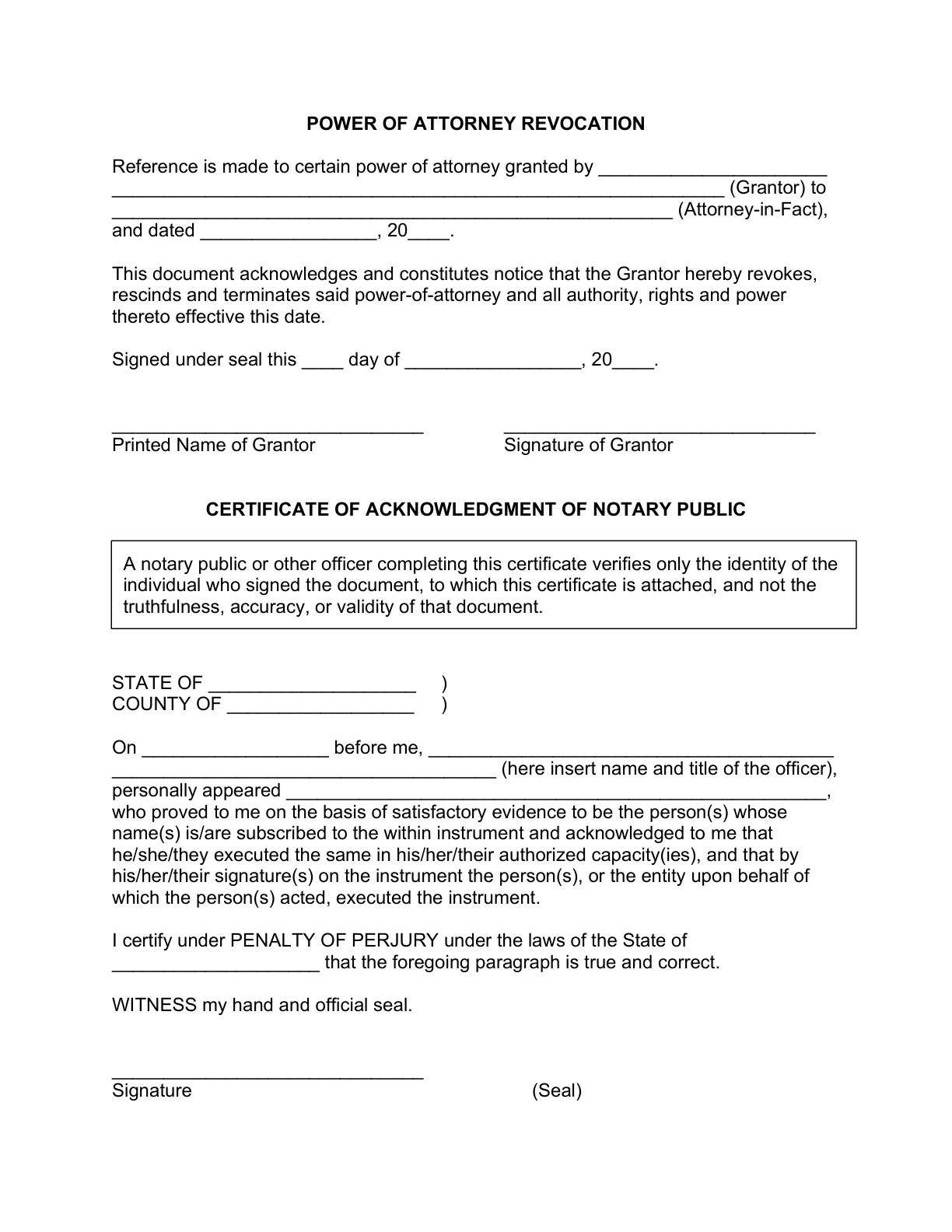
See the top of the actual one-page instrument below — the title and the identification of the prior power. Your complete editable download (Word and PDF) — the revocation clause, the dated signature line, and the notary acknowledgment — is delivered after checkout.
Legal currency, verified
A one-page instrument that revokes, rescinds, and terminates a power of attorney you previously granted — effective the date you sign. It identifies the original power by grantor, attorney-in-fact, and date, and closes with a notary acknowledgment — the formality many banks, brokers, and other third parties expect before they treat the old power as dead. The top of the actual one-page instrument is previewed above before purchase.
Signing is step one — delivery is what makes it work. A revocation binds the world only when the right people learn of it: deliver a copy to your former agent and to every bank, brokerage, or institution that has relied on the power of attorney, and keep proof of delivery (certified mail works well). Until they receive notice, third parties may keep honoring the old power. If the power of attorney was recorded — common when it was used for real estate — record the revocation in the same office. If you are replacing rather than simply ending the authority, sign the new power of attorney before or alongside the revocation so there is no gap; choose your state on our power-of-attorney page.
Identification of the prior power — grantor, attorney-in-fact, and date; the operative clause, which revokes, rescinds, and terminates the power and all authority under it, effective on the signing date; the dated signature line; and a certificate of acknowledgment of notary public with state and county venue.
The revocation instrument with its notary acknowledgment, in editable Word and print-ready PDF.
This form is not legal advice. It is a national instrument; health care directives usually carry their own revocation rules. Consult a licensed attorney in your state for advice about your situation.
ILRG is committed to top-quality legal forms. If you are not 100 percent satisfied after purchase, contact us for a full refund.
Sign a written revocation that identifies the original power — this form captures the grantor, the attorney-in-fact, and the date of the power being revoked — then deliver copies to the agent and to every institution that has relied on it. Keep proof of delivery (certified mail works well). If the power of attorney was recorded in county land records, record the revocation in the same office.
Between you and your agent, it takes effect when you sign — the form says “effective this date.” But third parties who never receive notice may keep honoring the old power of attorney, and in many states they are protected when they rely on it in good faith. That is why delivery to every bank, brokerage, and other institution is not optional.
Yes — notify the agent in writing and keep proof. Until the agent learns of the revocation, the agent may continue to act, and third parties dealing with the agent in good faith may be protected. Delivery to the agent plus every relying institution is what makes the revocation complete.
Requirements vary by state, but notarization is the sound practice everywhere — and effectively required when the revocation will be recorded (for example, when the original power of attorney was used for real estate and placed of record). This form closes with a notary acknowledgment for that reason.
It is drafted for general financial powers of attorney. Health care directives usually carry their own revocation rules — follow the revocation terms of the directive itself. And if you are replacing rather than simply ending the authority, sign the new power of attorney before or alongside the revocation so there is no gap.
No — not with this form. It revokes the identified power of attorney in full; if that instrument named two agents, both lose their authority. To drop one agent and keep another, or to trim specific powers while the rest survive, you need a tailored partial-revocation instrument — this general revocation is the wrong tool for surgery.