
Find legal forms, law schools, and legal resources
Try “residential lease” — forms for your state are shown first.
Try “Yale” or “University of Texas” — the full ABA directory is searchable as you type.
Arizona legal form
Download the Arizona general durable power of attorney for property and finances — effective immediately upon signing. Ready for instant secure access.
A durable power of attorney document for managing property and finances, prepared for Arizona.
Prepared for Arizona, granting broad financial authority effective immediately upon signing.
The authority continues through incapacity — the moment a power of attorney matters most. A non-durable document would end exactly then.
Download the file, complete it on your own device, then sign with the required notarization or witnesses. No online data entry.
This state packet includes 2 documents in editable Word and print-ready PDF formats. Use the Word version for editing and the PDF for print-ready reference.
About this packet
A general durable power of attorney lets you appoint an agent to manage your property and finances — banking, real estate, investments, and similar matters. This version takes effect immediately upon signing and continues even if you later become disabled or incapacitated.
The powers granted are broad. Choose your agent carefully, and consider consulting an attorney if your financial situation is complex.
Review representative packet content before purchasing. Your licensed download is delivered after checkout.
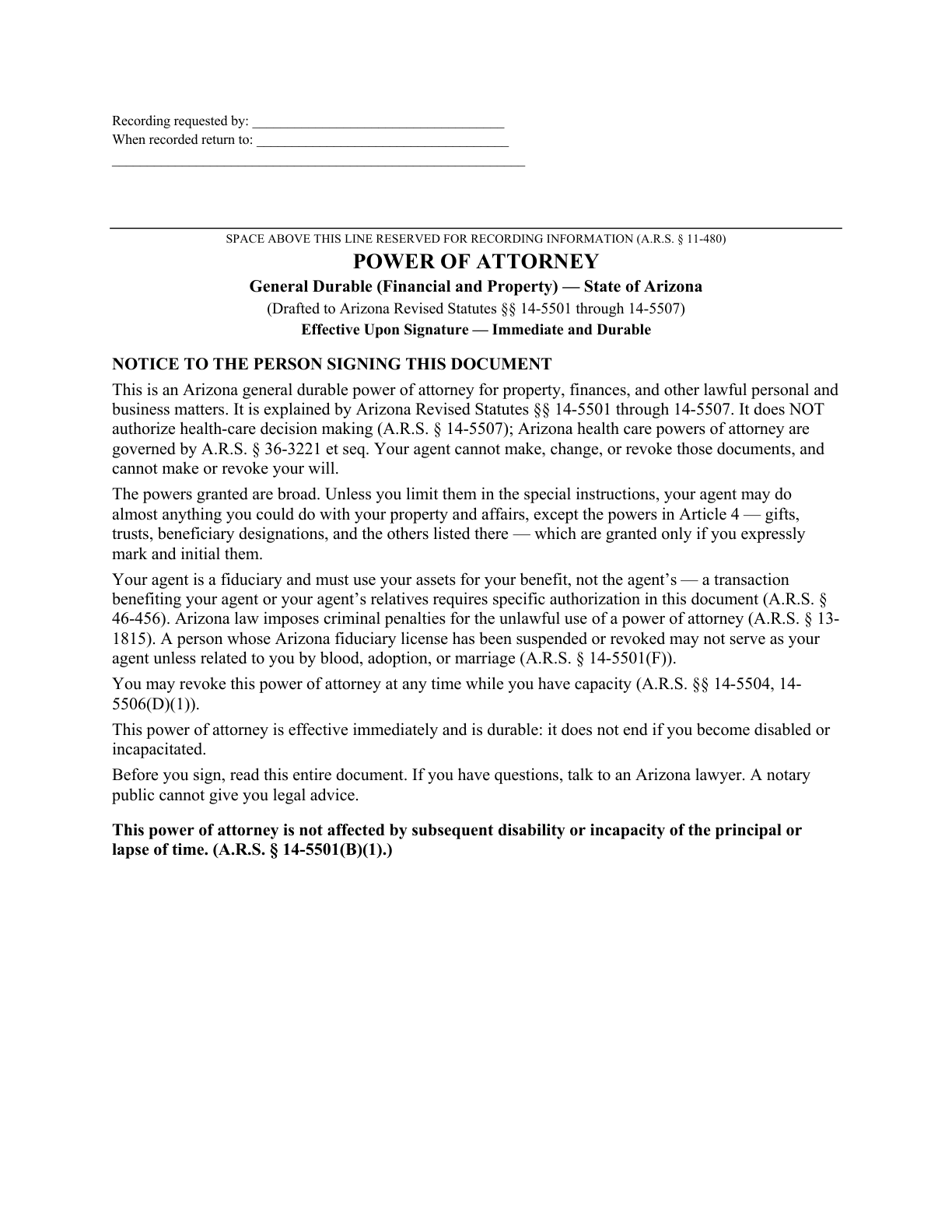
Recording requested by: ____________________________________
When recorded return to: ____________________________________
___________________________________________________________
(Arizona Revised Statutes, Title 14 — Trusts, Estates and Protective Proceedings)
SPACE ABOVE THIS LINE RESERVED FOR RECORDING INFORMATION (A.R.S. § 11-480)
POWER OF ATTORNEY
General Durable (Financial and Property) — State of Arizona
(Drafted to Arizona Revised Statutes §§ 14-5501 through 14-5507)
Effective Upon Signature — Immediate and Durable
NOTICE TO THE PERSON SIGNING THIS DOCUMENT
This is an Arizona general durable power of attorney for property, finances, and other lawful personal and business matters. It is explained by Arizona Revised Statutes §§ 14-5501 through 14-5507. It does NOT authorize health-care decision making (A.R.S. § 14-5507); Arizona health care powers of attorney are governed by A.R.S. § 36-3221 et seq. Your agent cannot make, change, or revoke those documents, and cannot make or revoke your will.
The powers granted are broad. Unless you limit them in the special instructions, your agent may do almost anything you could do with your property and affairs, except the powers in Article 4 — gifts, trusts, beneficiary designations, and the others listed there — which are granted only if you expressly mark and initial them.
Your agent is a fiduciary and must use your assets for your benefit, not the agent's — a transaction benefiting your agent or your agent's relatives requires specific authorization in this document (A.R.S. § 46-456). Arizona law imposes criminal penalties for the unlawful use of a power of attorney (A.R.S. § 13-1815). A person whose Arizona fiduciary license has been suspended or revoked may not serve as your agent unless related to you by blood, adoption, or marriage (A.R.S. § 14-5501(F)).
You may revoke this power of attorney at any time while you have capacity (A.R.S. §§ 14-5504, 14-5506(D)(1)).
This power of attorney is effective immediately and is durable: it does not end if you become disabled or incapacitated.
Before you sign, read this entire document. If you have questions, talk to an Arizona lawyer. A notary public cannot give you legal advice.
This power of attorney is not affected by subsequent disability or incapacity of the principal or lapse of time. (A.R.S. § 14-5501(B)(1).)
Article 1. Designation of Agent
I,
________________________________________________________________________
(Name of principal)
of
________________________________________________________________________
(Address of principal)
an adult, designate the following adult (age 18 or older) as my agent (attorney in fact) to make financial decisions on my behalf (A.R.S. § 14-5501(D)):
________________________________________________________________________
(Name and address of agent)
Telephone of agent (optional): ____________________________________________________
OPTIONAL SECOND AGENT. If you wish two persons to serve at the same time, complete the following (otherwise leave blank):
________________________________________________________________________
(Name and address of second agent — must be an adult)
Telephone of second agent (optional): ____________________________________________
If you named a second agent, YOU MUST MARK ONE of the following. Arizona law supplies no default rule, so this document does not appoint co-agents unless you choose how they are to act. Most people who name two choose to let them act severally (independently).
☐ SEVERALLY — each agent may exercise the powers conferred separately, without the consent of the other.
☐ JOINTLY — my agents shall exercise the powers conferred jointly, with the consent of both.
☐ If JOINTLY is marked — OPTIONAL: the remaining co-agent may act alone whenever the other co-agent is unable, unwilling, or unavailable to act.
OPTIONAL SUCCESSORS. If every agent named above dies, resigns, becomes disabled or incapacitated, is not qualified, or declines to serve, I name the following as successor agents, in the order named:
Successor agent 1 — name and address: ________________________________________________
Successor agent 2 — name and address: ________________________________________________
Article 2. When This Power of Attorney Is Effective
This power of attorney is effective when I sign it, and it remains effective even if I later become disabled or incapacitated (A.R.S. § 14-5502).
OPTIONAL — TERM LIMIT. If you want this document to end on a fixed date, complete the following (otherwise leave blank): This power of attorney terminates on ____________________ (date), unless sooner revoked (A.R.S. § 14-5501(A)(2)).
Article 3. Grant of General Authority
I grant my agent general authority to act for me with respect to all lawful subjects and purposes, INCLUDING the following enumerated subjects, and including any other lawful act in connection with a subject granted below. A power is GRANTED as to each subject UNLESS you initial the WITHHOLD line at the end of that subject's description. (Arizona has no statutory catalog of subjects; this document enumerates the powers itself.)
Real property — buy, sell, exchange, convey, mortgage or encumber, lease, grant options, release, and manage real estate and interests in real estate, and execute and acknowledge deeds and other recordable instruments for me. WARNING — COMMUNITY PROPERTY: if I am married, Arizona law requires BOTH spouses to join any transaction that acquires, disposes of, or encumbers an interest in real property (A.R.S. § 25-214(C)(1)); my spouse's joinder cannot be supplied by this document and must be given on the later conveyance itself. (initial here to WITHHOLD this power: _______ )
Tangible personal property — buy, sell, exchange, store, transport, and deal with goods, vehicles, and other personal property. (initial here to WITHHOLD this power: _______ )
Banking and financial accounts — open, use, and close accounts; sign checks, drafts, and withdrawal orders; access and rent safe-deposit boxes. (initial here to WITHHOLD this power: _______ )
Securities and investments — buy, sell, exchange, vote, and manage stocks, bonds, brokerage accounts, and other investments. (initial here to WITHHOLD this power: _______ )
Business operations — operate, buy, sell, or wind down business interests; sign partnership, limited liability company, and corporate documents for me. (initial here to WITHHOLD this power: _______ )
Insurance and annuities — purchase, maintain, borrow against, surrender, and collect on policies and annuities (beneficiary changes require the express election in Article 4). (initial here to WITHHOLD this power: _______ )
Estates and trusts — act for me as a beneficiary; demand, receive, and receipt for property; enforce my interests (creating, amending, or funding a trust requires the express election in Article 4). (initial here to WITHHOLD this power: _______ )
Claims and litigation — start, defend, settle, arbitrate, and collect on claims; hire attorneys, accountants, and other professionals. (initial here to WITHHOLD this power: _______ )
Government benefits — apply for, receive, appeal, and manage Social Security, Medicare, veterans', and other public benefits. (initial here to WITHHOLD this power: _______ )
Taxes — prepare, sign, and file federal, state, and local returns; represent me before tax authorities; receive refunds; settle tax liabilities. (initial here to WITHHOLD this power: _______ )
Retirement plans and IRAs — manage accounts, take distributions, make contribution and rollover decisions, and deal with plan administrators (beneficiary changes require the express election in Article 4). (initial here to WITHHOLD this power: _______ )
Digital assets — access, manage, and control my digital assets and the catalogue of my electronic communications under the Arizona Revised Uniform Fiduciary Access to Digital Assets Act (A.R.S. § 14-13110). Access to the CONTENT of my electronic communications is NOT granted here; it requires the express election in Article 4 (A.R.S. § 14-13109). (initial here to WITHHOLD this power: _______ )
THIS POWER OF ATTORNEY DOES NOT AUTHORIZE ANYONE TO: make, amend, or revoke my will; make, modify, or revoke a health care power of attorney, a mental health care power of attorney, a living will, or any other health-care directive (A.R.S. § 14-5507; § 36-3221 et seq.); require me to act against my will; or do any act I have specifically forbidden while I have capacity.
Under this general grant my agent may, among all other lawful acts, execute supplemental powers of attorney required by taxing or other authorities, which may not broaden the scope of this document.
The enumeration of specific powers in this document does not limit the general grant as to the subjects granted. All acts done by my agent under this durable power of attorney during any period of my disability or incapacity bind me and my successors in interest as if I were not disabled or incapacitated (A.R.S. § 14-5502).
Article 4. Powers Granted Only If Expressly Elected
The following powers can significantly change your estate plan or expose your property to claims of self-dealing. Arizona law allows an agent to use your assets for the agent or the agent's relatives only when this document specifically authorizes the transaction (A.R.S. § 46-456(A)(2)). MARK THE BOX AND PLACE YOUR INITIALS ON THE LINE IN FRONT OF each power you intend to grant. Unmarked powers are NOT granted.
☐ _______ (a) Gifts — make gifts of my property, outright or in trust, to persons or charities I have customarily supported or to others, in amounts my agent considers appropriate.
☐ _______ INCLUDING gifts to my agent personally (mark this inner box only if you intend to specifically authorize self-dealing under A.R.S. § 46-456(A)(2); otherwise your agent must avoid self-dealing as a fiduciary).
Arizona law allows an agent to make gifts of your property only when a valid durable power of attorney specifically authorizes the transaction (A.R.S. § 46-456(A)(2)). Arizona sets no dollar cap; any limit you want (for example, annual amounts or permitted recipients) belongs in the Special Instructions article.
☐ _______ (b) Trusts — create, amend, restate, or revoke a trust for my benefit, and fund a trust by transferring my property to it.
☐ _______ (c) Beneficiary designations — create or change beneficiary designations on life insurance, annuities, retirement plans, pay-on-death and transfer-on-death accounts, and other assets effective at my death.
☐ _______ (d) Survivorship — create or sever joint tenancies with right of survivorship and community property with right of survivorship (A.R.S. § 33-431).
☐ _______ (e) Delegation — delegate all or part of the authority granted by this power of attorney to another person.
☐ _______ (f) Disclaimers and renunciations — disclaim or renounce property or interests passing to me (A.R.S. § 14-10001 et seq.).
☐ _______ (g) Tax elections — exercise elections and options available to me under federal, state, or local tax law.
☐ _______ (h) Content of electronic communications — this power of attorney expressly grants my agent authority over the content of electronic communications sent or received by me (A.R.S. § 14-13109).
A direction you give a custodian through its online tool, if the tool lets you change it at any time, overrides this document (A.R.S. § 14-13104(A)). Custodians may require your agent's certification under penalty of perjury — Part 2 of the Agent's Affidavit file supplied with this document serves that purpose.
☐ _______ (i) Powers of appointment — exercise, create, or release a power of appointment I hold (other than a power I hold in a fiduciary capacity).
☐ _______ (j) Annuity and survivor-benefit waivers — waive my right to be a beneficiary of a joint and survivor annuity or survivor benefit under a retirement plan.
Article 5. My Nomination of Guardian or Conservator (Optional)
If protective proceedings are commenced for me or my estate (A.R.S. § 14-5101(12)), I nominate the following person as my conservator or guardian for consideration by the court (A.R.S. § 14-5503(B)):
________________________________________________________________________
(Name and address of nominee — leave blank if none)
If a court of my domicile appoints a conservator or other fiduciary charged with managing my property, my agent becomes accountable to that fiduciary as well as to me, and that fiduciary has the same power to revoke or amend this power of attorney that I would have if I were not disabled or incapacitated (A.R.S. § 14-5503(A)).
Article 6. Special Instructions (Optional)
Optional additions or limits. This is the place for any limits on the general grant, gift parameters (annual amounts, permitted recipients, or purposes — Arizona sets no statutory cap), and the divorce election below. If none, leave blank.
________________________________________________________________________
________________________________________________________________________
________________________________________________________________________
DIVORCE OR ANNULMENT. Under A.R.S. § 14-2804(A)(1)(c), if your marriage ends in divorce or annulment, the nomination of your FORMER SPOUSE (or of a relative of your former spouse) to serve in a fiduciary or representative capacity — including as your agent — is revoked by operation of law, as if that person had died immediately before the divorce (§ 14-2804(C)). (A decree of legal separation that does not end the marriage does not trigger this rule, and remarriage to that person revives the nomination — § 14-2804(D).) This revocation is automatic unless the express terms of this document provide otherwise. MARK the following box only if you want the nomination of your spouse (or your spouse's relative) as agent to CONTINUE despite divorce or annulment:
☐ NOTWITHSTANDING A.R.S. § 14-2804, the nomination of my spouse (or my spouse's relative) as my agent under this power of attorney shall NOT be revoked by divorce or annulment of my marriage.
Article 7. Compensation of Agent
Arizona law does not set a default compensation rule for an agent under a power of attorney. Unless you mark the box below, your agent is entitled to reimbursement of reasonable expenses incurred on your behalf but serves WITHOUT compensation. MARK the following box only if you want your agent to be paid:
☐ My agent is entitled to reasonable compensation for services rendered, in addition to reimbursement of reasonable expenses.
Article 8. Effect on Earlier Powers of Attorney
Signing this power of attorney does NOT by itself revoke any power of attorney you signed before. MARK the following box only if you intend to revoke them:
☐ I REVOKE all earlier GENERAL and FINANCIAL powers of attorney that I have signed. (Do not mark this box if you want a special-purpose power of attorney to remain in effect — for example, one held by a bank or title company, Arizona Department of Revenue Form 285, or MVD Form 48-1001.)
Notify every prior agent in writing. If you recorded an earlier power of attorney with a county recorder, record the revocation in the same county and state the date and recording reference of the earlier document (A.R.S. § 11-480(D)).
Article 9. Governing Law; Severability
This power of attorney is governed by the laws of the State of Arizona, including A.R.S. §§ 14-5501 through 14-5507. A power of attorney validly executed in another United States jurisdiction is valid in Arizona (A.R.S. § 14-5501(C)). If any provision is held invalid, the remainder continues in effect.
Article 10. Duties of the Agent
An agent acting under this document is a FIDUCIARY. Under Arizona law and this document, your agent must: follow your instructions and act in your best interest, loyally, in good faith, and with the care of a prudent person; use your assets for your benefit and not for the benefit of the agent or the agent's relatives unless this document specifically authorizes it (A.R.S. § 46-456); keep a record of all receipts, disbursements, and transactions; keep your property separate from the agent's own and not comingle them; and indicate representative capacity when signing for you (for example, "Jane Doe by John Roe, her attorney in fact").
CAPACITY AND ABUSE. A power of attorney executed by an adult who lacks capacity is invalid, and an agent who procures a power of attorney by intimidation or deception is subject to criminal prosecution and civil penalties, including under A.R.S. § 13-1815 and § 46-456 (A.R.S. § 14-5506).
COURT-APPOINTED FIDUCIARIES. If a court appoints a conservator or other fiduciary for you, your agent becomes accountable to that fiduciary, who has the same power to revoke or amend this document that you would have (A.R.S. § 14-5503). Your agent's authority ends at your death, and your agent must then account to your personal representative.
Article 11. Reliance by Third Parties
A person who in good faith either assists or deals with my agent is protected as if my agent properly exercised the agent's power, regardless of whether my agent's authority has terminated (A.R.S. § 14-5506(C)). As to an agent or other person acting in good faith without actual knowledge of my death, my death does not revoke or terminate the agency (A.R.S. § 14-5504(A)). Third parties may rely on a photocopy, electronic copy, or other reproduction of this document to the same extent as the original.
The separate AGENT'S AFFIDAVIT file supplied with this document contains two later-use instruments: Part 1 is the affidavit described in A.R.S. § 14-5505 (an agent's affidavit that the agent had no actual knowledge of revocation or of my death creates a rebuttable presumption of nonrevocation, and it is recordable when acknowledged if the transaction involves a recordable instrument); Part 2 is the certification under penalty of perjury that custodians of digital accounts may require (A.R.S. §§ 14-13109(3), 14-13110(3)). Each is completed and signed by the agent at the time of use, not when this power of attorney is signed. Neither is part of this document, and neither should be recorded with it.
Article 12. Execution
Arizona law (A.R.S. § 14-5501(D)) requires this power of attorney to be: (1) signed or marked by you, or signed in your name by another individual in your conscious presence and at your direction; (2) witnessed by ONE person who is NOT your agent, your agent's spouse, your agent's child, or the notary public — the witness must sign in your presence and hearing; and (3) executed and attested by your acknowledgment and by an affidavit of the witness before a notary public, in substantially the form below. The notary administers the oaths; read both affidavits carefully before swearing to them.
IN WITNESS WHEREOF, I have hereunto signed my name this ________ day of ____________________, 20______.
I, ____________________________________, the principal, sign my name to this power of attorney this __________ day of ____________________ and, being first duly sworn, do declare to the undersigned authority that I sign and execute this instrument as my power of attorney and that I sign it willingly, or willingly direct another to sign for me, that I execute it as my free and voluntary act for the purposes expressed in the power of attorney and that I am eighteen years of age or older, of sound mind and under no constraint or undue influence.
______________________________________________
(Signature of principal)
I, ____________________________________, the witness, sign my name to the foregoing power of attorney being first duly sworn and do declare to the undersigned authority that the principal signs and executes this instrument as the principal's power of attorney and that the principal signs it willingly, or willingly directs another to sign for the principal, and that I, in the presence and hearing of the principal, sign this power of attorney as witness to the principal's signing and that to the best of my knowledge the principal is eighteen years of age or older, of sound mind and under no constraint or undue influence.
______________________________________________
(Signature of witness)
Printed name of witness ___________________________________________________
Address of witness ________________________________________________________
The state of ____________________
County of ______________________
Subscribed, sworn to and acknowledged before me by ____________________________________, the principal, and subscribed and sworn to before me by ____________________________________, witness, this __________ day of ____________________.
_____________________________________________ [Seal]
(Signature of notary public)
My commission expires: ____________________
SIGNATURE BY ANOTHER PERSON AT THE PRINCIPAL'S DIRECTION — COMPLETE ONLY IF THE PRINCIPAL CANNOT PHYSICALLY SIGN
If the principal is physically unable to sign but is otherwise competent and conscious, another individual may sign the principal's name in the principal's conscious presence and at the principal's direction (A.R.S. § 14-5501(D)(2)). This signature is IN ADDITION TO the witness and notary ceremony above, which applies unchanged.
IN WITNESS WHEREOF, the undersigned signed the name of the principal in the principal's conscious presence and at the principal's specific direction this ________ day of ____________________, 20______.
_____________________________________________
(Signature of person signing at the direction of ________________________________, the principal)
Printed name of person signing ______________________________________________
Address of person signing ___________________________________________________
This document prepared by: ____________________________________________
Important Information About This Document
THIS PAGE IS NOT PART OF THE POWER OF ATTORNEY. REMOVE IT BEFORE SIGNING. DO NOT RECORD IT. KEEP IT WITH YOUR RECORDS.
What this document is. An Arizona general durable power of attorney for property and financial matters, independently drafted to comply with A.R.S. §§ 14-5501 through 14-5507. Arizona has no official statutory form for this instrument. This version is IMMEDIATE AND DURABLE: it takes effect when you sign it and continues even if you later become disabled or incapacitated.
How to complete. Fill in your name and address and your agent's name and address (your agent must be an adult). If you name a second agent, you must mark whether they act severally or jointly — this document does not appoint co-agents unless you choose. In Article 3, initial the WITHHOLD line for any subject you do NOT want to grant. In Article 4, mark and initial only the powers you intend to grant; the others are not granted.
How to sign. Arizona requires a specific ceremony (A.R.S. § 14-5501(D)): you sign (or another signs for you in your conscious presence and at your direction); ONE witness signs — the witness may NOT be your agent, your agent's spouse, your agent's child, or the notary public, and the witness must sign in your presence and hearing; and both you and the witness sign sworn affidavits before a notary public, using the statutory affidavit text printed in the execution section. Remote notarization does not remove the witness requirement.
Recording for real-estate use. You do not have to record this power of attorney for it to be valid. If it will be used in a real-estate transaction, Arizona practice is to record the ORIGINAL with the county recorder of the county where the land lies. Arizona recording rules require a caption (the title of this document is the caption), type no smaller than 10-point, margins of at least one-half inch, and a two-inch top margin on the first page reserved for recording information — this document reserves it, with the recording-request and return-address lines in the permitted left portion (A.R.S. § 11-480). NEVER put a Social Security number, account number, retirement account number, or credit/debit card number on a document that will be recorded — Arizona law restricts those identifiers on recorded documents (A.R.S. § 44-1373(G)). If you revoke a recorded power of attorney, the recorded revocation must state the prior recording date and recording reference (A.R.S. § 11-480(D)).
The Agent's Affidavit file contains two separate LATER-USE instruments. Part 1 (A.R.S. § 14-5505) is the affidavit banks and title companies commonly request: your agent swears the power has not been revoked and that your agent had no actual knowledge of revocation or of your death — in a real-estate transaction it can be recorded when acknowledged. Part 2 (A.R.S. §§ 14-13109(3), 14-13110(3)) is the certification under penalty of perjury that digital-account custodians require. Your agent completes and signs them at the time of use — do not sign them in advance, do not attach them to this document, and do not record them with it.
Acceptance by banks and others. Arizona law protects persons who deal with your agent in good faith (A.R.S. §§ 14-5504, 14-5506(C)), and the Agent's Affidavit is the standard tool for overcoming reluctance. Unlike some states, Arizona has no statute forcing a third party to accept a power of attorney — if a particular institution (for example, your bank, the Arizona Department of Revenue, which uses its own Form 285, or the Motor Vehicle Division, which uses Form 48-1001) requires its own form, use it alongside this document.
Gifts. No gift authority is granted unless you mark election (a) in Article 4. Once you become a "vulnerable adult," Arizona law forbids a person in a position of trust to use your assets for that person or the person's relatives unless the transaction is specifically authorized in this document — violations carry damages, doubled damages, and forfeiture of the wrongdoer's interests in your estate plan (A.R.S. § 46-456). Arizona sets no dollar cap on authorized gifts; add any limits you want in Special Instructions.
Community property. Arizona is a community-property state. If you are married, BOTH spouses must join any transaction that acquires, disposes of, or encumbers an interest in real property, and any guaranty, indemnity, or suretyship (A.R.S. § 25-214(C)); a conveyance or encumbrance of community real property must be executed and acknowledged by both spouses (A.R.S. § 33-452). Your spouse's joinder cannot be supplied by this document — your spouse signs the later deed or instrument itself. After a petition for dissolution, legal separation, or annulment is served, neither spouse (nor an agent) may bind the community if the petition results in a decree (A.R.S. § 25-214(C)(3)). Arizona's homestead exemption (A.R.S. § 33-1101 et seq.) is automatic creditor protection and needs no election.
Divorce. If your agent is your spouse (or your spouse's relative) and your marriage ends in divorce or annulment, Arizona law automatically revokes that nomination as if the person had died immediately before the divorce (A.R.S. § 14-2804) — Article 6 carries the optional continuation election. Naming a successor agent in Article 1 keeps this document working if that happens.
Health care is separate. This document grants no health-care authority (A.R.S. § 14-5507). Arizona's health care power of attorney (A.R.S. § 36-3221 et seq.) is the document for medical decisions; a mental health care power of attorney covers mental-health decisions (A.R.S. § 36-3281 et seq.); a living will covers end-of-life treatment.
Revocation. You may revoke this power of attorney at any time while you have capacity. Do it in writing, deliver it to every agent and to any institution holding a copy, and record it in any county where this document was recorded (with the prior recording date and reference — A.R.S. § 11-480(D)). Signing a new power of attorney does not by itself revoke this one — see Article 8.
If a court gets involved. A conservator or guardian appointed for you does not automatically end this power of attorney, but your agent becomes accountable to that fiduciary, who may revoke or amend it (A.R.S. § 14-5503).
Questions. If anything in this document is unclear, ask a licensed Arizona attorney before you sign. A notary public cannot give you legal advice.
ILRG is committed to top quality legal forms that are valid in all states. If you are not 100 percent satisfied after purchase, contact us for a full refund.
Yes. This product is the Arizona general durable power of attorney (immediate) packet tied to this state-specific page and the packet documents shown above.
Immediately upon signing. Because it is durable, the authority continues even if you later become disabled or incapacitated. If you prefer authority that begins only upon disability, use the springing (upon disability) version instead.
A durable power of attorney remains effective even if the principal becomes incapacitated. A non-durable power of attorney would end at incapacity — exactly when the document is most needed.
Requirements vary by state. Many states require notarization, some also require witnesses, and the document may need to be recorded if used in a real-estate transaction. Follow the execution instructions included with your Arizona packet.
Yes. You can revoke a power of attorney at any time while you have capacity, by signing a written revocation and notifying your agent and any institutions that rely on the document.
The included packet documents are listed on this page — 2 documents in total. Where the same document is provided in more than one format, it is grouped once with Word, PDF, or other format badges.
This packet currently includes editable Word and print-ready PDF. The document list above reflects the packet contents for this state without exposing internal fulfillment filenames.
These forms are designed for self-help use, but ILRG does not provide legal advice. Consult a licensed attorney if your situation involves unusual assets, blended-family or tax questions, contested issues, or questions about local requirements.
No. ILRG provides self-help legal forms and information, not legal advice. You are responsible for reviewing your state’s execution requirements before signing.