Find legal forms, law schools, and legal resources
Try “residential lease” — forms for your state are shown first.
Try “Yale” or “University of Texas” — the full ABA directory is searchable as you type.
Tennessee promissory note · balloon payment
Download the Tennessee balloon payment promissory note — lower monthly payments of principal with the remaining balance due in one final balloon payment, default and acceleration terms, and a usury-savings clause keyed to Tennessee law — in editable Word with a print-ready PDF, plus the Excel balloon amortization calculator.
Looking for a different loan structure? This page is the Tennessee balloon-payment note.
Every file below is included: the fillable Word instrument, a print-ready PDF, the Tennessee Instructions & Rider, and the Excel calculator.
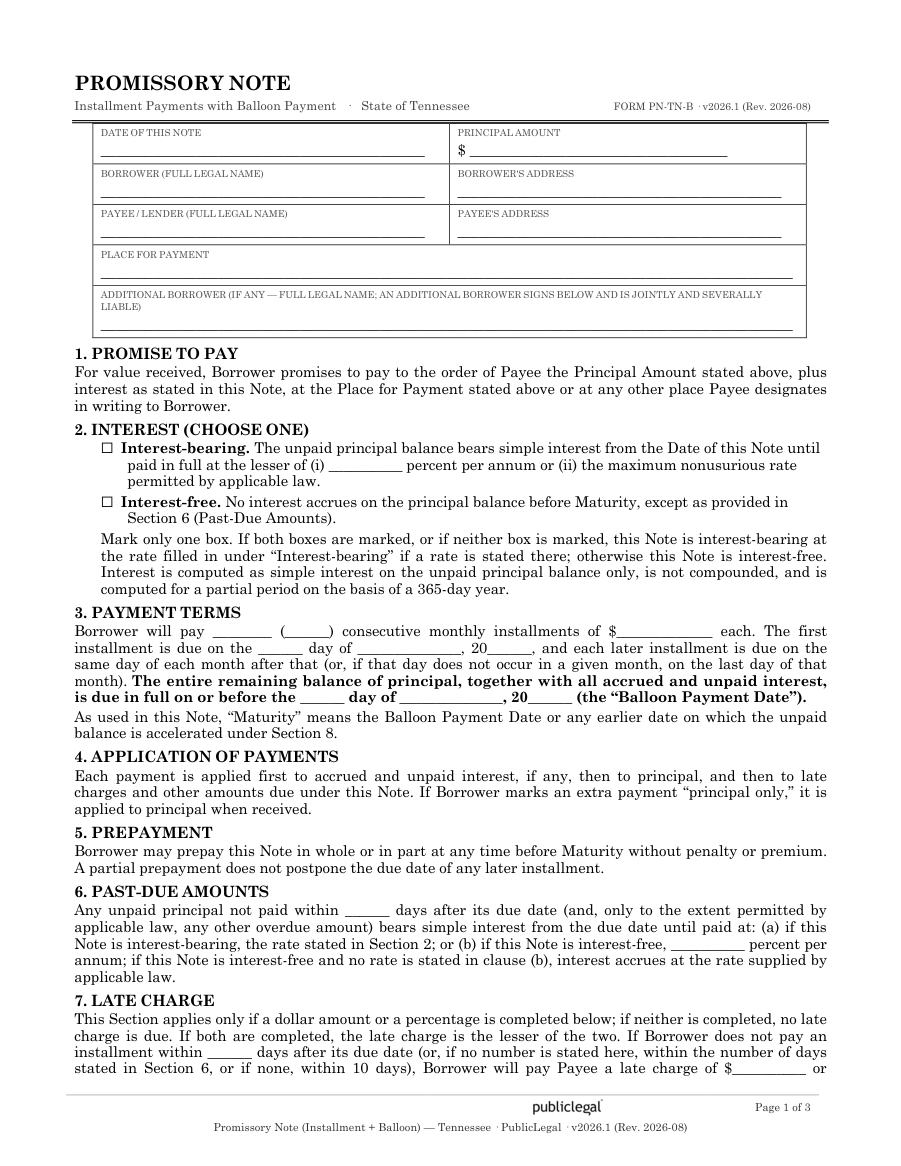
The real document — not a mockup. Page 1 of the form included in your download.
Every section in the instrument, in order — 14 numbered sections plus the signature page.
About this form
A written promissory note turns a loan into an enforceable obligation: it records the principal, the payment schedule, the consequences of missed payments, and the borrower’s promise to pay — signed evidence a court can act on if the loan goes bad. This is the balloon-payment version, drafted for loans repaid in smaller monthly payments with one final balloon payment.
With a balloon note, the borrower pays lower monthly payments of principal during the term and the remaining principal balance comes due in one final balloon payment. The bundled Excel balloon calculator computes a payment schedule and the balloon figure from your loan amount, rate, and term — a planning and record-keeping tool for both parties.
Your Tennessee Instructions & Rider covers the state specifics: interest-rate caps by loan type, collection rules, and signing formalities, with links to official state resources.
The instrument carries Tennessee governing-law language and a usury-savings clause keyed to Tennessee law, plus default and acceleration terms, a prepayment-without-penalty right, an attorney’s-fees collection clause, and a severability provision.
Sign in two originals — one for each party. A promissory note is generally enforceable on the borrower’s signature alone; witnesses or notarization are not required for validity in most states but add proof. Keep the signed note with the payment schedule it references.
ILRG provides self-help legal forms and download support. PublicLegal promissory note forms are provided for you to complete with your own loan information. Interest-rate limits and collection rules vary by state and loan type — the note includes a usury-savings clause keyed to your state’s law. If you are not 100 percent satisfied after purchasing from us, contact us for a refund.
The Tennessee balloon payment promissory note in fillable Word (.docx) with a print-ready PDF, the Tennessee Instructions & Rider (interest-rate limits, collection rules, signing guidance), and the Excel loan amortization calculator. A completed sample is available as an optional add-on.
A promissory note is a written, legally binding promise to repay a specific amount of money. Use one any time you lend or borrow money — personal loans between family members or friends, business loans, seller financing, or private-party vehicle sales. It documents the loan amount, payment schedule, and default consequences, prevents disputes over terms, and gives the lender enforceable evidence of the debt.
A balloon note is repaid in lower monthly payments of principal during the term, with the remaining principal balance due as one large final payment — the “balloon.” Sellers financing a property or vehicle sale and private lenders use balloon notes to keep monthly payments affordable while setting a definite payoff date. The risk is the final payment: if the borrower cannot pay or refinance it, the lender must enforce or renegotiate. The bundled Excel calculator shows the balloon figure from your loan amount, rate, and term before anyone signs.
No — interest-free loans are legal. This note is structured as payments of principal; interest at the rate you fill in applies to amounts that go past due. If you do charge interest, the rate must stay within Tennessee’s legal limits, which vary by loan type and lender — the note includes a usury-savings clause keyed to Tennessee law as a safeguard. For family loans over $10,000, IRS rules may treat forgone interest below the Applicable Federal Rate as a taxable gift.
In most states, yes — the borrower’s signature makes the note enforceable without notarization or witnesses. Notarization adds proof of signature and can matter in disputes, so it is a sensible precaution for large loans. Sign two identical originals so each party keeps one.
The note’s default and acceleration terms let the lender demand the full remaining balance when the borrower defaults — including a right to accelerate after a payment goes 15 days past due — and past-due amounts bear interest at the note’s rate. The lender can then sue — small claims court for smaller balances — and, on judgment, pursue wage garnishment, bank levies, or liens as Tennessee law allows. The attorney’s-fees clause shifts reasonable collection costs to the borrower.