
Find legal forms, law schools, and legal resources
Try “residential lease” — forms for your state are shown first.
Try “Yale” or “University of Texas” — the full ABA directory is searchable as you type.
Georgia landlord · tenant screening
Download the Georgia residential rental application — screens prospective tenants with application-money elections, a standalone screening-report authorization, and the disclosures federal and Georgia law require — in fillable Word and fillable PDF, with the Georgia Completion & Use Guide.
Renting out property in more than one state? This page is the Georgia application — each state's edition is built to its own screening and application-money law.
Bundle & save $19.97
Handle tenant screening, the lease, move-in condition records, and a Georgia nonpayment notice workflow if you need it.
Use each document only when appropriate. The notice packet is not a move-in document and should be used only when the facts and current law support it.
Every file below is included: the fillable Word application, a fillable PDF, the Georgia Completion and Use Guide, and the federal FCRA Summary of Your Rights.
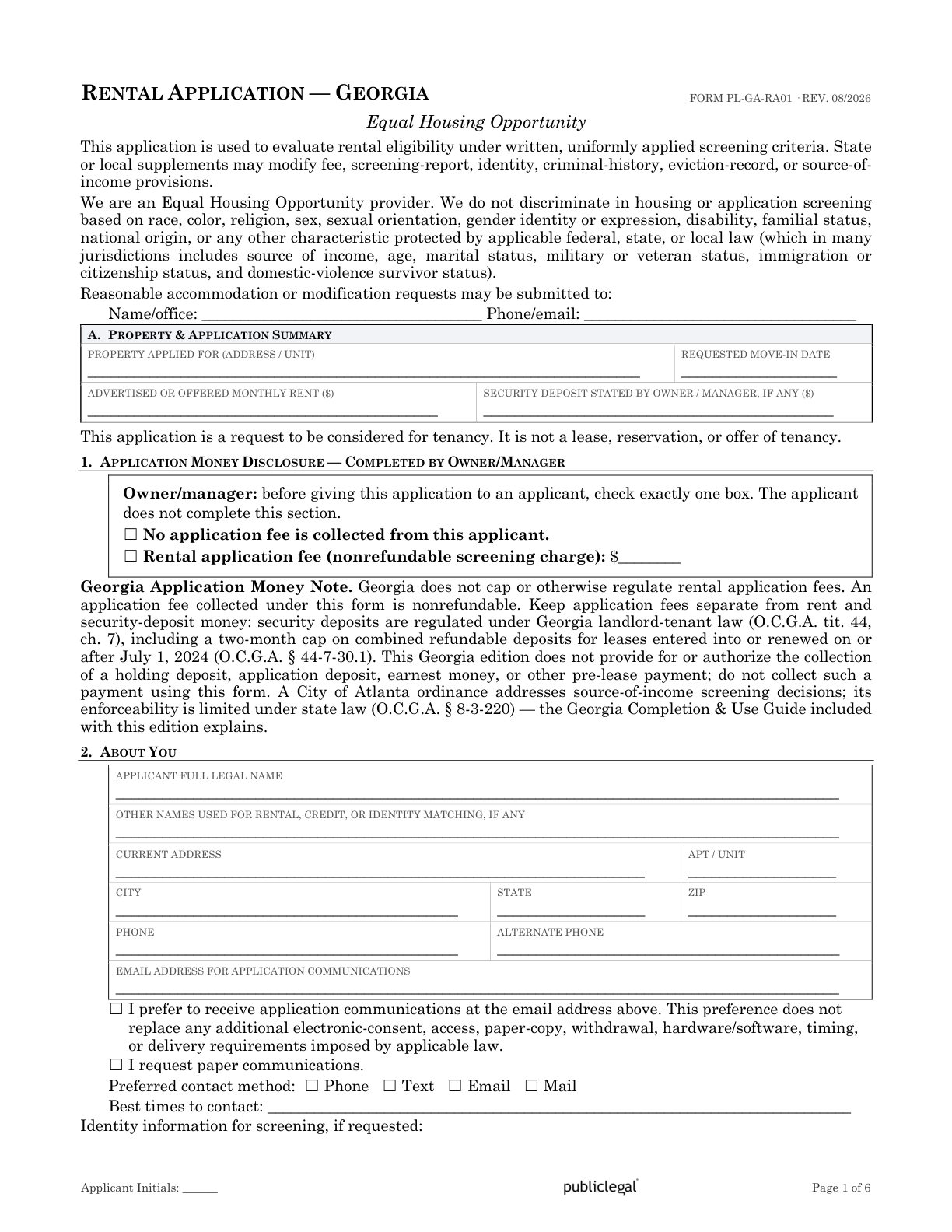
The real document — not a mockup. Page 1 of the form included in your download.
Every part of the form, in order — the application summary, 17 sections, and the office-use panel.
About this form
A residential rental application is the landlord's first line of protection: it collects the applicant's identity, household composition, rental history, employment and income, and references, and it carries the disclosures and signed authorizations that make lawful tenant screening possible before a lease is signed.
Georgia law shapes three things this edition builds in. First, money discipline: Georgia sets no cap, cost-basis rule, or refund duty for a rental application fee, so this edition authorizes only a nonrefundable application fee — never a holding deposit or earnest money. Georgia practice treats money taken to hold a unit before a lease differently than Ohio-style deposit states — the Georgia Landlord-Tenant Handbook treats pre-lease holding money as generally nonrefundable rather than recharacterizing it as a security deposit — but the lease-stage security-deposit regime (O.C.G.A. §§ 44-7-30 to 44-7-37, including the two-month refundable-deposit cap added by the 2024 Safe at Home Act) still binds once a tenancy exists, so the guide keeps the labeling warning. Second, protected-class alignment: the Georgia Fair Housing Law (O.C.G.A. §§ 8-3-200 to 8-3-223) mirrors the federal classes without additions, which is why this form never asks for dates of birth, ages, or adult/minor classifications. Third, Atlanta and preemption: Atlanta’s 2020 source-of-income ordinance (Ord. 20-O-1155) prohibits refusing applicants because of lawful income sources such as housing vouchers inside the city, but O.C.G.A. § 8-3-220 preempts local fair-housing rules broader than state law, and the ordinance’s enforceability has been widely doubted since 2022 with no enforcement record — the guide explains both layers rather than imposing a rider.
The Georgia Completion & Use Guide covers the money election and fee uniformity, the Atlanta source-of-income question and the state-preemption analysis, written screening criteria as a fair-housing defense, voluntary reusable-report practice, adverse-action notices, the lease-stage security-deposit primer, and recordkeeping — plus the statute watch on pending 2025–2026 session bills (SB 106, HB 1031, HB 707). The kit includes the federal FCRA Summary of Your Rights as a package insert.
ILRG provides self-help legal forms and download support. PublicLegal landlord forms are provided for you to complete with your own property and screening information. Screening rules vary by state and change frequently — the Completion & Use Guide explains the rules in your state and the steps that keep this application within them. If you are not 100 percent satisfied after purchasing from us, contact us for a refund.
The Georgia residential rental application in fillable Word (.docx) with a fillable PDF, the Georgia Completion & Use Guide (money election, the Atlanta source-of-income and preemption question, screening workflow, adverse action, the security-deposit primer, and recordkeeping), and the federal FCRA Summary of Your Rights. A completed sample is available as an optional add-on.
No. Georgia sets no maximum, no cost-basis rule, and no refund duty for a rental application fee — the Georgia Landlord-Tenant Handbook notes such fees are usually not refundable. Charge a uniform fee to every applicant and keep it separate from rent and deposit money. Once a lease is signed, the security-deposit regime of O.C.G.A. §§ 44-7-30 to 44-7-37 applies, including the two-month refundable-deposit cap for leases entered into on or after July 1, 2024.
Atlanta’s Ordinance 20-O-1155 (2020) prohibits refusing applicants because of lawful sources of income, including housing vouchers, within the city — but O.C.G.A. § 8-3-220 preempts local fair-housing rules broader than state law, and the ordinance’s enforceability has been widely doubted since 2022, with no reported enforcement. The Completion & Use Guide explains both layers and the conservative practice of applying criteria uniformly regardless of income source.
Georgia does not require acceptance and does not regulate the associated fees — acceptance is voluntary. If you accept an applicant’s report, verify it directly with the consumer reporting agency that prepared it and consider waiving the application fee.
If a consumer report contributed in whole or in part to the denial or to a conditional approval such as a higher deposit, federal law requires an adverse-action notice identifying the reporting agency, stating that the agency did not make the decision, and explaining the applicant’s free-report and dispute rights — the office-use panel checklist tracks each element. Georgia has no state denial-notice statute for rental applications, but a brief written reason kept consistent across applicants is strong fair-housing practice.