Find legal forms, law schools, and legal resources
Try “residential lease” — forms for your state are shown first.
Try “Yale” or “University of Texas” — the full ABA directory is searchable as you type.
North Carolina landlord · tenant screening
Download the North Carolina residential rental application — screens prospective tenants with application-money elections, a standalone screening-report authorization, and the disclosures federal and North Carolina law require — in fillable Word and fillable PDF, with the North Carolina Completion & Use Guide.
Renting out property in more than one state? This page is the North Carolina application — each state's edition is built to its own screening and application-money law.
Bundle & save $19.97
Handle tenant screening, the lease, move-in condition records, and a North Carolina nonpayment notice workflow if you need it.
Use each document only when appropriate. The notice packet is not a move-in document and should be used only when the facts and current law support it.
Every file below is included: the fillable Word application, a fillable PDF, the North Carolina Completion and Use Guide, and the federal FCRA Summary of Your Rights.
The real document — not a mockup. Page 1 of the form included in your download.
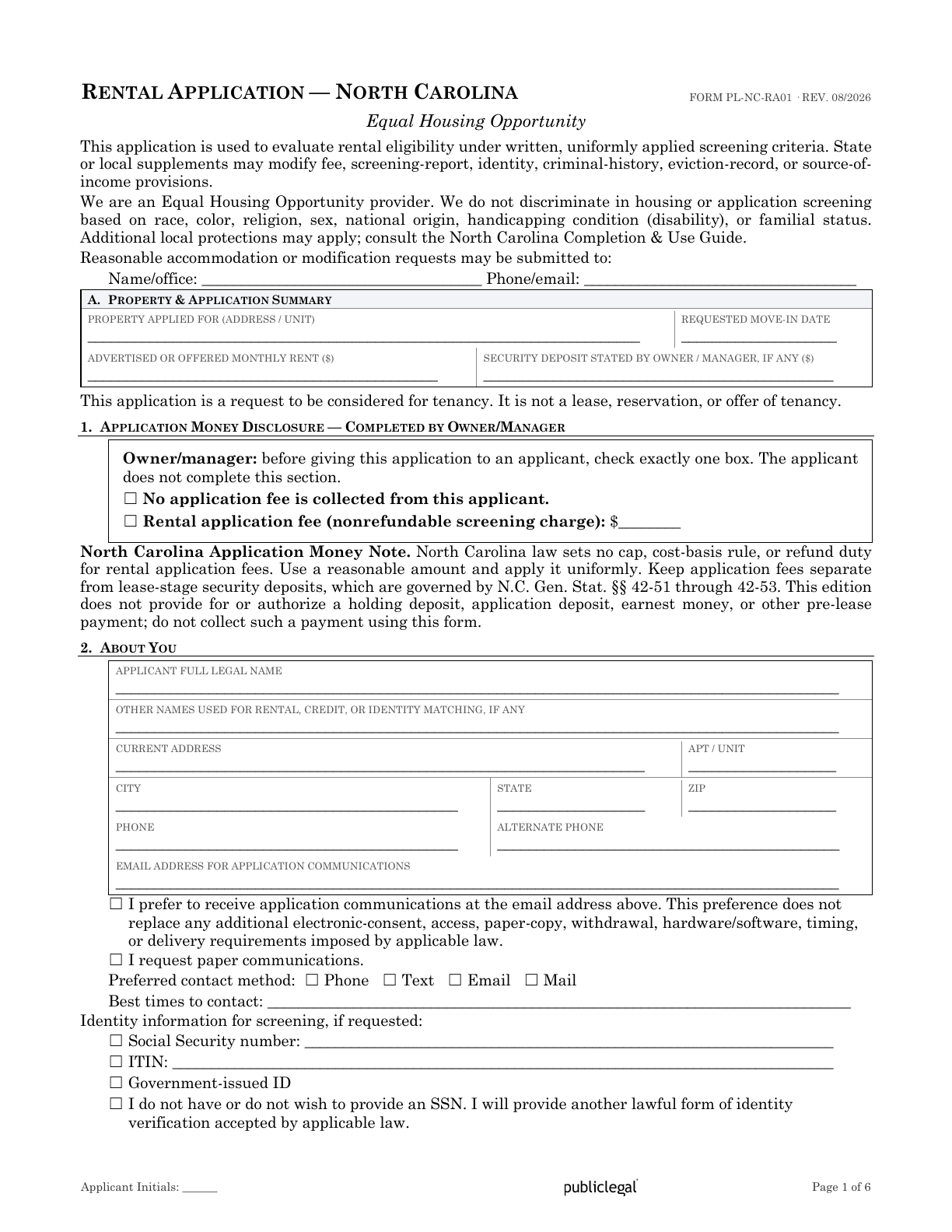
Every part of the form, in order — the application summary, 17 sections, and the office-use panel.
About this form
A residential rental application is the landlord's first line of protection: it collects the applicant's identity, household composition, rental history, employment and income, and references, and it carries the disclosures and signed authorizations that make lawful tenant screening possible before a lease is signed.
North Carolina sets no cap, cost-basis rule, or refund duty for rental application fees. The State Fair Housing Act, N.C. Gen. Stat. Chapter 41A, covers the federal seven classes without a statewide addition; local ordinances and funded-housing programs may add narrower protections, while a 1987 state rule preempts general local source-of-income mandates.
North Carolina imposes no statewide criminal-record screening sequence. The guide recommends consistent written criteria, covers the § 75-65 breach-notice duty and § 42-42.2 victim-status protection, explains lease-stage deposits under §§ 42-51 through 42-53, and watches S.B. 569 or any successor eviction-record bill.
ILRG provides self-help legal forms and download support. PublicLegal landlord forms are provided for you to complete with your own property and screening information. Screening rules vary by state and change frequently — the Completion & Use Guide explains the rules in your state and the steps that keep this application within them. If you are not 100 percent satisfied after purchasing from us, contact us for a refund.
No. State law sets no maximum, cost-basis rule, or refund duty. Disclose a reasonable amount before collection and apply it uniformly.
North Carolina has no statewide two-stage or lookback rule for private rental screening. Use written, business-related criteria consistently and obtain the applicant’s signed consumer-report authorization.
Chapter 41A covers race, color, religion, sex, national origin, handicapping condition, and familial status—the federal seven. Greensboro, Durham, Winston-Salem, and funded-housing programs may add local requirements.
North Carolina imposes no automatic refund duty merely because an application is denied. An FCRA adverse-action notice is still required when a consumer report contributed to the decision.
The six-page North Carolina application in fillable Word and PDF, a three-page Completion & Use Guide, and the federal FCRA Summary of Rights. A completed Charlotte sample is optional.