
Find legal forms, law schools, and legal resources
Try “residential lease” — forms for your state are shown first.
Try “Yale” or “University of Texas” — the full ABA directory is searchable as you type.
New York landlord · tenant screening
Download the New York residential rental application — screens prospective tenants with application-money elections, a standalone screening-report authorization, and the disclosures federal and New York law require — in fillable Word and fillable PDF, with the New York Tenant Selection Criteria sheet, the New York Completion & Compliance Guide.
Renting out property in more than one state? This page is the New York application — each state's edition is built to its own screening and application-money law.
Bundle & save $19.97
Handle tenant screening, the lease, move-in condition records, and a New York nonpayment notice workflow if you need it.
Use each document only when appropriate. The notice packet is not a move-in document and should be used only when the facts and current law support it.
Every file below is included: the fillable Word application, a fillable PDF, the New York Tenant Selection Criteria sheet, the New York Completion & Compliance Guide, the statewide criminal-history rider, and — for New York City properties — the Fair Chance Housing packet, the FARE fee disclosure, and the City’s official notice, plus the New York adverse-action notice.
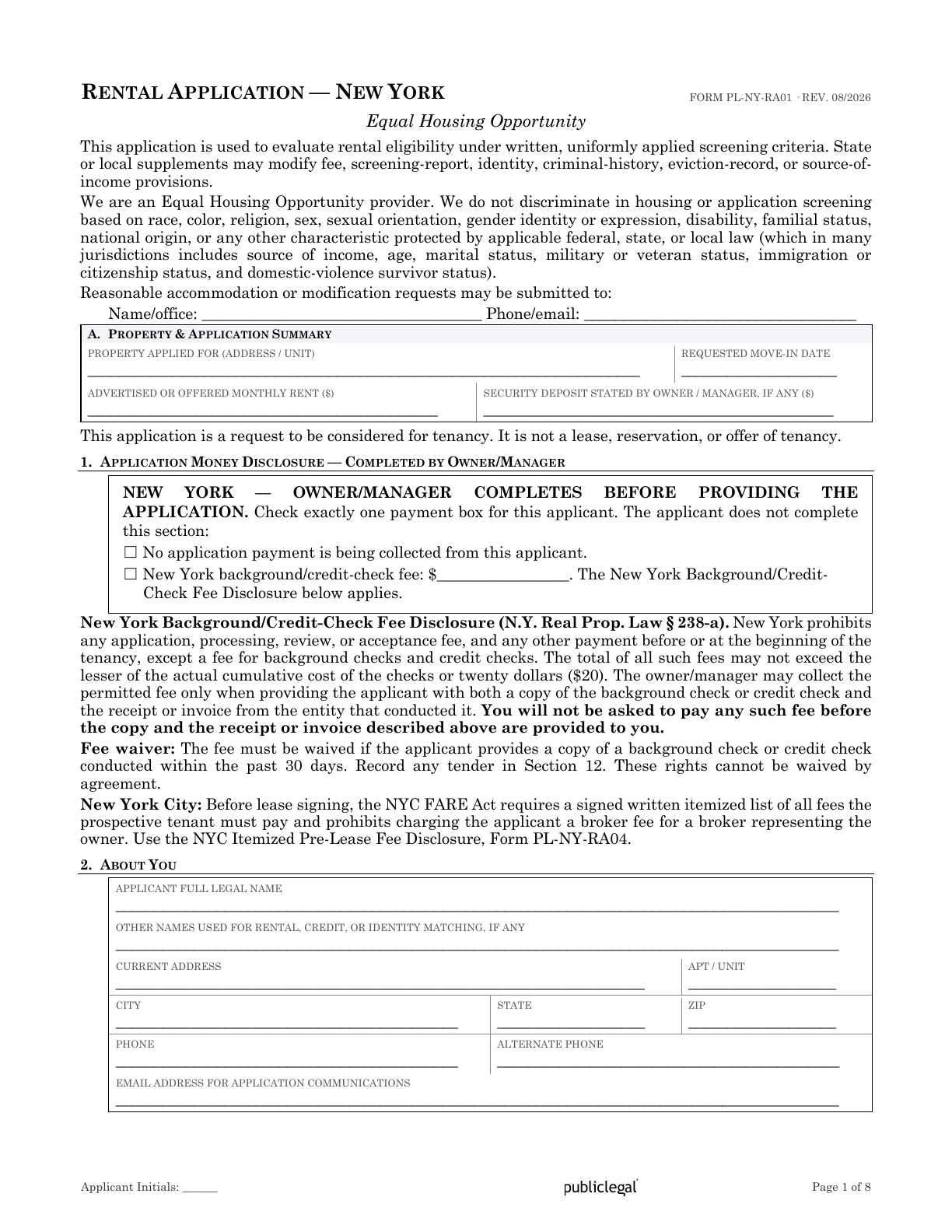
The real document — not a mockup. Page 1 of the form included in your download.
Every part of the form, in order — the application summary, 17 sections, and the office-use panel.
About this form
A residential rental application is the landlord's first line of protection: it collects the applicant's identity, household composition, rental history, employment and income, and references, and it carries the disclosures and signed authorizations that make lawful tenant screening possible before a lease is signed.
New York law shapes three things this edition builds in. First, the application-fee cap of Real Property Law § 238-a: the total of all application and background/credit-check fees may not exceed the lesser of the actual cost of the checks or twenty dollars, and the printed cap appears on the face of the form so the limit is unmistakable. Second, the sequencing duty the FARE Act and General Business Law article 25 create: an applicant who is charged for a report must receive a copy and the supporting receipt, and the office-use panel records delivery before collection. Third, New York’s source-of-income protections (Exec. Law § 296(2-a)) and the Real Property Law § 227-f limit on eviction-history inquiries, which the form reflects by never asking an applicant to self-report eviction history.
The New York Tenant Selection Criteria sheet in this kit supports consistent, documented screening, and the New York Completion & Compliance Guide covers the fee cap and refund duties, the delivery-before-collection rule, the security-deposit cap (Gen. Oblig. Law § 7-108), source-of-income and fair-chance limits, and recordkeeping. For New York City properties, the kit adds the Fair Chance Housing post-conditional packet, the FARE itemized fee disclosure, and the City’s official notice; a New York adverse-action notice rounds out the screening workflow.
ILRG provides self-help legal forms and download support. PublicLegal landlord forms are provided for you to complete with your own property and screening information. Screening rules vary by state and change frequently — the Completion & Compliance Guide explains the rules in your state and the steps that keep this application within them. If you are not 100 percent satisfied after purchasing from us, contact us for a refund.
The New York residential rental application in fillable Word (.docx) with a fillable PDF, the New York Tenant Selection Criteria sheet, the New York Completion & Compliance Guide, the statewide criminal-history screening rider, the New York adverse-action notice, and — for New York City properties — the Fair Chance Housing post-conditional packet, the FARE itemized fee disclosure, and the City’s official notice. A completed sample is available as an optional add-on.
Real Property Law § 238-a caps the total of all application and background/credit-check fees at the lesser of the actual cost of the checks or twenty dollars. The cap is printed on the face of the application so the limit is clear, and the office-use panel tracks the actual cost against it.
When an applicant is charged for a background or credit check, New York law and the FARE Act require that the applicant receive a copy of the report and the supporting receipt. The application’s office-use panel records the date and time the report and receipt were delivered and the date and time the fee was collected, so the compliant sequence is documented.
Real Property Law § 227-f limits eviction-history inquiries, so the application never asks an applicant to self-report eviction history. Criminal-history screening is handled separately and lawfully: the statewide rider governs non-NYC properties, and New York City properties use the Fair Chance Housing post-conditional packet, which defers any criminal-history review until after a conditional commitment.
If a consumer report contributed to the denial or a conditional approval such as a higher deposit, federal and New York law (Gen. Bus. Law § 380-i) require an adverse-action notice identifying the reporting agency and the applicant’s rights. This kit includes a combined New York adverse-action notice, and the guide explains the refund duties.