
Find legal forms, law schools, and legal resources
Try “residential lease” — forms for your state are shown first.
Try “Yale” or “University of Texas” — the full ABA directory is searchable as you type.
Illinois statutory health care form
Download the August 2026 Illinois Statutory Short Form Power of Attorney for Health Care packet, Illinois's prescribed form under 755 ILCS 45/4-10, for naming an agent to make health care decisions if you cannot. Get the statutory form in editable Word and true fillable PDF. Add the completed sample PDF if you want a filled-in reference.
A state-specific health care power of attorney packet, reviewed against the current Illinois statute and ready for instant secure access.
Reproduces the § 4-10 form verbatim, including the delayed-revocation election added in 2021 and the post-death government-benefits authority added in 2023.
The form opens with the multi-page consumer notice the statute requires (what your agent can do, when authority begins, and how revocation works) in plain language.
Download the files, complete them on your own device, then sign before one witness. Your personal details are never entered into an online form builder.
This download includes 1 document in editable Word and fillable PDF formats. Use the Word version for editing; the fillable PDF can be completed on screen, then printed and signed.
Review the complete form text below before purchasing. Your licensed download (editable Word and fillable PDF) is delivered after checkout.
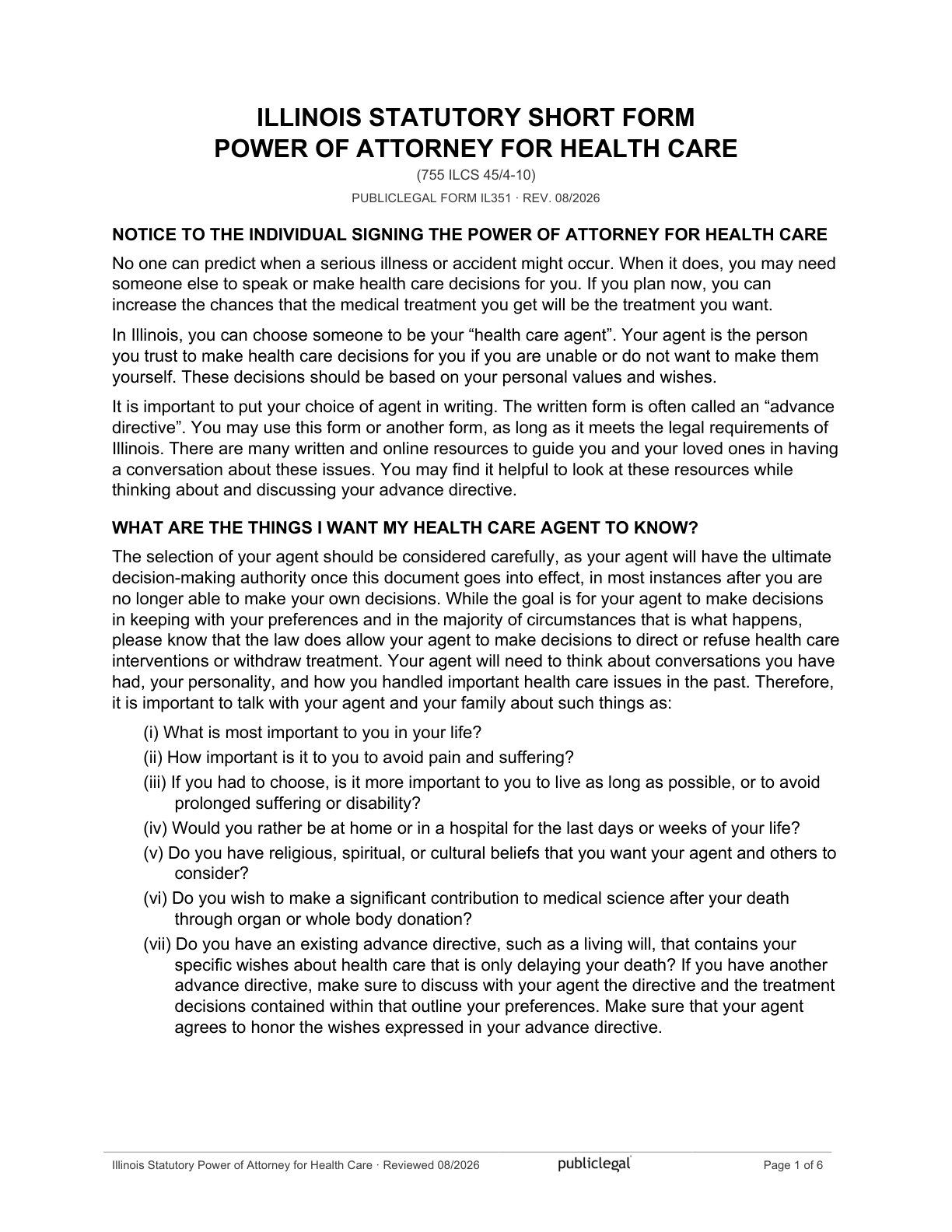
ILLINOIS STATUTORY SHORT FORM POWER OF ATTORNEY FOR HEALTH CARE
(755 ILCS 45/4-10)
NOTICE TO THE INDIVIDUAL SIGNING THE POWER OF ATTORNEY FOR HEALTH CARE
No one can predict when a serious illness or accident might occur. When it does, you may need someone else to speak or make health care decisions for you. If you plan now, you can increase the chances that the medical treatment you get will be the treatment you want.
In Illinois, you can choose someone to be your “health care agent”. Your agent is the person you trust to make health care decisions for you if you are unable or do not want to make them yourself. These decisions should be based on your personal values and wishes.
It is important to put your choice of agent in writing. The written form is often called an “advance directive”. You may use this form or another form, as long as it meets the legal requirements of Illinois. There are many written and online resources to guide you and your loved ones in having a conversation about these issues. You may find it helpful to look at these resources while thinking about and discussing your advance directive.
WHAT ARE THE THINGS I WANT MY HEALTH CARE AGENT TO KNOW?
The selection of your agent should be considered carefully, as your agent will have the ultimate decision-making authority once this document goes into effect, in most instances after you are no longer able to make your own decisions. While the goal is for your agent to make decisions in keeping with your preferences and in the majority of circumstances that is what happens, please know that the law does allow your agent to make decisions to direct or refuse health care interventions or withdraw treatment. Your agent will need to think about conversations you have had, your personality, and how you handled important health care issues in the past. Therefore, it is important to talk with your agent and your family about such things as:
(i) What is most important to you in your life?
(ii) How important is it to you to avoid pain and suffering?
(iii) If you had to choose, is it more important to you to live as long as possible, or to avoid prolonged suffering or disability?
(iv) Would you rather be at home or in a hospital for the last days or weeks of your life?
(v) Do you have religious, spiritual, or cultural beliefs that you want your agent and others to consider?
(vi) Do you wish to make a significant contribution to medical science after your death through organ or whole body donation?
(vii) Do you have an existing advance directive, such as a living will, that contains your specific wishes about health care that is only delaying your death? If you have another advance directive, make sure to discuss with your agent the directive and the treatment decisions contained within that outline your preferences. Make sure that your agent agrees to honor the wishes expressed in your advance directive.
WHAT KIND OF DECISIONS CAN MY AGENT MAKE?
If there is ever a period of time when your physician determines that you cannot make your own health care decisions, or if you do not want to make your own decisions, some of the decisions your agent could make are to:
(i) talk with physicians and other health care providers about your condition.
(ii) see medical records and approve who else can see them.
(iii) give permission for medical tests, medicines, surgery, or other treatments.
(iv) choose where you receive care and which physicians and others provide it.
(v) decide to accept, withdraw, or decline treatments designed to keep you alive if you are near death or not likely to recover. You may choose to include guidelines and/or restrictions to your agent’s authority.
(vi) agree or decline to donate your organs or your whole body if you have not already made this decision yourself. This could include donation for transplant, research, and/or education. You should let your agent know whether you are registered as a donor in the First Person Consent registry maintained by the Illinois Secretary of State or whether you have agreed to donate your whole body for medical research and/or education.
(vii) decide what to do with your remains after you have died, if you have not already made plans.
(viii) talk with your other loved ones to help come to a decision (but your designated agent will have the final say over your other loved ones).
Your agent is not automatically responsible for your health care expenses.
WHOM SHOULD I CHOOSE TO BE MY HEALTH CARE AGENT?
You can pick a family member, but you do not have to. Your agent will have the responsibility to make medical treatment decisions, even if other people close to you might urge a different decision. The selection of your agent should be done carefully, as he or she will have ultimate decision-making authority for your treatment decisions once you are no longer able to voice your preferences. Choose a family member, friend, or other person who:
(i) is at least 18 years old;
(ii) knows you well;
(iii) you trust to do what is best for you and is willing to carry out your wishes, even if he or she may not agree with your wishes;
(iv) would be comfortable talking with and questioning your physicians and other health care providers;
(v) would not be too upset to carry out your wishes if you became very sick; and
(vi) can be there for you when you need it and is willing to accept this important role.
WHAT IF MY AGENT IS NOT AVAILABLE OR IS UNWILLING TO MAKE DECISIONS FOR ME?
If the person who is your first choice is unable to carry out this role, then the second agent you chose will make the decisions; if your second agent is not available, then the third agent you chose will make the decisions. The second and third agents are called your successor agents and they function as back-up agents to your first choice agent and may act only one at a time and in the order you list them.
WHAT WILL HAPPEN IF I DO NOT CHOOSE A HEALTH CARE AGENT?
If you become unable to make your own health care decisions and have not named an agent in writing, your physician and other health care providers will ask a family member, friend, or guardian to make decisions for you. In Illinois, a law directs which of these individuals will be consulted. In that law, each of these individuals is called a “surrogate”.
There are reasons why you may want to name an agent rather than rely on a surrogate:
(i) The person or people listed by this law may not be who you would want to make decisions for you.
(ii) Some family members or friends might not be able or willing to make decisions as you would want them to.
(iii) Family members and friends may disagree with one another about the best decisions.
(iv) Under some circumstances, a surrogate may not be able to make the same kinds of decisions that an agent can make.
WHAT IF THERE IS NO ONE AVAILABLE WHOM I TRUST TO BE MY AGENT?
In this situation, it is especially important to talk to your physician and other health care providers and create written guidance about what you want or do not want, in case you are ever critically ill and cannot express your own wishes. You can complete a living will. You can also write your wishes down and/or discuss them with your physician or other health care provider and ask him or her to write it down in your chart. You might also want to use written or online resources to guide you through this process.
WHAT DO I DO WITH THIS FORM ONCE I COMPLETE IT?
Follow these instructions after you have completed the form:
(i) Sign the form in front of a witness. See the form for a list of who can and cannot witness it.
(ii) Ask the witness to sign it, too.
(iii) There is no need to have the form notarized.
(iv) Give a copy to your agent and to each of your successor agents.
(v) Give another copy to your physician.
(vi) Take a copy with you when you go to the hospital.
(vii) Show it to your family and friends and others who care for you.
WHAT IF I CHANGE MY MIND?
You may change your mind at any time. If you do, tell someone who is at least 18 years old that you have changed your mind, and/or destroy your document and any copies. If you wish, fill out a new form and make sure everyone you gave the old form to has a copy of the new one, including, but not limited to, your agents and your physicians. If you are concerned you may revoke your power of attorney at a time when you may need it the most, you may initial the box at the end of the form to indicate that you would like a 30-day waiting period after you voice your intent to revoke your power of attorney. This means if your agent is making decisions for you during that time, your agent can continue to make decisions on your behalf. This election is purely optional, and you do not have to choose it. If you do not choose this option, you can change your mind and revoke the power of attorney at any time.
WHAT IF I DO NOT WANT TO USE THIS FORM?
In the event you do not want to use the Illinois statutory form provided here, any document you complete must be executed by you, designate an agent who is over 18 years of age and not prohibited from serving as your agent, and state the agent’s powers, but it need not be witnessed or conform in any other respect to the statutory health care power.
If you have questions about the use of any form, you may want to consult your physician, other health care provider, and/or an attorney.
MY POWER OF ATTORNEY FOR HEALTH CARE
THIS POWER OF ATTORNEY REVOKES ALL PREVIOUS POWERS OF ATTORNEY FOR HEALTH CARE. (You must sign this form and a witness must also sign it before it is valid)
My name (Print your full name): ______________________________________________________
My address: _______________________________________________________________________
I WANT THE FOLLOWING PERSON TO BE MY HEALTH CARE AGENT
(an agent is your personal representative under state and federal law):
(Agent name) _____________________________________________________________________
(Agent address) ___________________________________________________________________
(Agent phone number) ______________________________________________________________
(Please check box if applicable)
If a guardian of my person is to be appointed, I nominate the agent acting under this power of attorney as guardian.
SUCCESSOR HEALTH CARE AGENT(S) (optional):
If the agent I selected is unable or does not want to make health care decisions for me, then I request the person(s) I name below to be my successor health care agent(s). Only one person at a time can serve as my agent (add another page if you want to add more successor agent names):
___________________________________________________________________________________
(Successor agent #1 name, address and phone number)
___________________________________________________________________________________
(Successor agent #2 name, address and phone number)
MY AGENT CAN MAKE HEALTH CARE DECISIONS FOR ME, INCLUDING:
(i) Deciding to accept, withdraw, or decline treatment for any physical or mental condition of mine, including life-and-death decisions.
(ii) Agreeing to admit me to or discharge me from any hospital, home, or other institution, including a mental health facility.
(iii) Having complete access to my medical and mental health records, and sharing them with others as needed, including after I die.
MY AGENT CAN MAKE HEALTH CARE DECISIONS FOR ME, INCLUDING — CONTINUED
(iv) Carrying out the plans I have already made, or, if I have not done so, making decisions about my body or remains, including organ, tissue or whole body donation, autopsy, cremation, and burial.
The above grant of power is intended to be as broad as possible so that my agent will have the authority to make any decision I could make to obtain or terminate any type of health care, including withdrawal of nutrition and hydration and other life-sustaining measures.
I AUTHORIZE MY AGENT TO (please check any one box):
Make decisions for me only when I cannot make them for myself. The physician(s) taking care of me will determine when I lack this ability.
(If no box is checked, then the box above shall be implemented.)
OR
Make decisions for me only when I cannot make them for myself. The physician(s) taking care of me will determine when I lack this ability. Starting now, for the purpose of assisting me with my health care plans and decisions, my agent shall have complete access to my medical and mental health records, the authority to share them with others as needed, and the complete ability to communicate with my personal physician(s) and other health care providers, including the ability to require an opinion of my physician as to whether I lack the ability to make decisions for myself.
OR
Make decisions for me starting now and continuing after I am no longer able to make them for myself. While I am still able to make my own decisions, I can still do so if I want to.
The subject of life-sustaining treatment is of particular importance. Life-sustaining treatments may include tube feedings or fluids through a tube, breathing machines, and CPR. In general, in making decisions concerning life-sustaining treatment, your agent is instructed to consider the relief of suffering, the quality as well as the possible extension of your life, and your previously expressed wishes. Your agent will weigh the burdens versus benefits of proposed treatments in making decisions on your behalf.
Additional statements concerning the withholding or removal of life-sustaining treatment are described below. These can serve as a guide for your agent when making decisions for you. Ask your physician or health care provider if you have any questions about these statements.
SELECT ONLY ONE STATEMENT BELOW THAT BEST EXPRESSES YOUR WISHES (optional):
The quality of my life is more important than the length of my life. If I am unconscious and my attending physician believes, in accordance with reasonable medical standards, that I will not wake up or recover my ability to think, communicate with my family and friends, and experience my surroundings, I do not want treatments to prolong my life or delay my death, but I do want treatment or care to make me comfortable and to relieve me of pain.
Staying alive is more important to me, no matter how sick I am, how much I am suffering, the cost of the procedures, or how unlikely my chances for recovery are. I want my life to be prolonged to the greatest extent possible in accordance with reasonable medical standards.
SPECIFIC LIMITATIONS TO MY AGENT’S DECISION-MAKING AUTHORITY:
The above grant of power is intended to be as broad as possible so that your agent will have the authority to make any decision you could make to obtain or terminate any type of health care. If you wish to limit the scope of your agent’s powers or prescribe special rules or limit the power to authorize autopsy or dispose of remains, you may do so specifically in this form.
__________________________________________________________________________________
__________________________________________________________________________________
My signature: _____________________________________________________________________
Today’s date: _______________________________________________________________________
DELAYED REVOCATION
(___) I elect to delay revocation of this power of attorney for 30 days after I communicate my intent to revoke it.
(___) I elect for the revocation of this power of attorney to take effect immediately if I communicate my intent to revoke it.
HAVE YOUR WITNESS AGREE TO WHAT IS WRITTEN BELOW, AND THEN COMPLETE THE SIGNATURE PORTION:
I am at least 18 years old. (check one of the options below):
I saw the principal sign this document, or
the principal told me that the signature or mark on the principal signature line is his or hers.
I am not the agent or successor agent(s) named in this document. I am not related to the principal, the agent, or the successor agent(s) by blood, marriage, or adoption. I am not the principal’s physician, advanced practice registered nurse, dentist, podiatric physician, optometrist, psychologist, or a relative of one of those individuals. I am not an owner or operator (or the relative of an owner or operator) of the health care facility where the principal is a patient or resident.
Witness printed name: ______________________________________________________________
Witness address: __________________________________________________________________
Witness signature: _________________________________________________________________
Today’s date: _______________________________________________________________________
Legal currency, verified
This Illinois power of attorney lets you name a person you trust — your agent — to make health care decisions for you if you cannot make them yourself. It is the official statutory short form published in the Illinois Power of Attorney Act, 755 ILCS 45/4-10, and it opens with the plain-language notice the statute requires, so you and your agent both understand the authority before anyone signs.
Illinois modernized this form twice in recent years: P.A. 102-181 (effective July 30, 2021) added the optional delayed-revocation election, and P.A. 102-794 (effective January 1, 2023) added your agent's authority to apply for government benefits or pursue appeals on your behalf after your death and confirmed electronic presentation. This packet reproduces the current form in full, including both additions, and it was reviewed and verified against the statute in August 2026.
You name your agent (and optional successors), choose when your agent's authority begins — only when you cannot decide for yourself, or starting now — and optionally record your wishes about life-sustaining treatment and any specific limits on your agent's authority. You may also nominate your agent as guardian if a court ever appoints one. The statutory notice walks through every choice before the operative form begins.
Illinois keeps execution simple: sign before one adult witness — no notary is required (755 ILCS 45/4-5.1). The witness must be at least 18 and cannot be your agent, a relative, your physician or certain other care providers, or an owner or operator of your health care facility; the full eligibility rules are printed in the form. If you initial the optional delayed-revocation election, revocation takes effect 30 days after you communicate it; otherwise you may revoke at any time.
Your purchase includes the complete form in two formats: an editable Word (.docx) file, and a fillable PDF you can complete on screen before printing and signing.
This form covers health care decisions only — it does not authorize property or financial decisions. For finances, Illinois publishes the Statutory Short Form Power of Attorney for Property. To record end-of-life treatment wishes in a standalone directive, see the Illinois Living Will.
This form is not legal advice and does not replace the advice of an Illinois attorney about your specific situation.
ILRG is committed to top quality legal forms that are valid in all states. If you are not 100 percent satisfied after purchase, contact us for a full refund.
Yes. This packet reproduces the statutory short form in 755 ILCS 45/4-10 as amended by P.A. 102-181 (effective July 30, 2021) and P.A. 102-794 (effective January 1, 2023), current through the 104th General Assembly. Reviewed and verified against the current statute in August 2026.
No. Illinois requires your signature plus one adult witness (755 ILCS 45/4-5.1). The witness eligibility rules (at least 18, not your agent, not a relative, not your physician or health-facility operator) are printed in the form itself.
Nearly everything you could decide yourself: accepting, withdrawing, or declining any treatment (including life-and-death decisions), admission to or discharge from facilities, full access to your medical records, anatomical gifts, autopsy, and disposition of remains, plus applying for government benefits or appeals after your death.
You choose. Check one box: your agent decides only when you cannot make decisions for yourself (with the physician-determination method you select), or starting immediately and continuing if you later cannot decide.
Both contain the same form text. Use the editable Word (.docx) file to type in your details, or the fillable PDF to complete the form on screen. Either way, print the finished document and sign it before your witness, initials and signatures belong on paper.