
Find legal forms, law schools, and legal resources
Try “residential lease” — forms for your state are shown first.
Try “Yale” or “University of Texas” — the full ABA directory is searchable as you type.
National health care privacy form
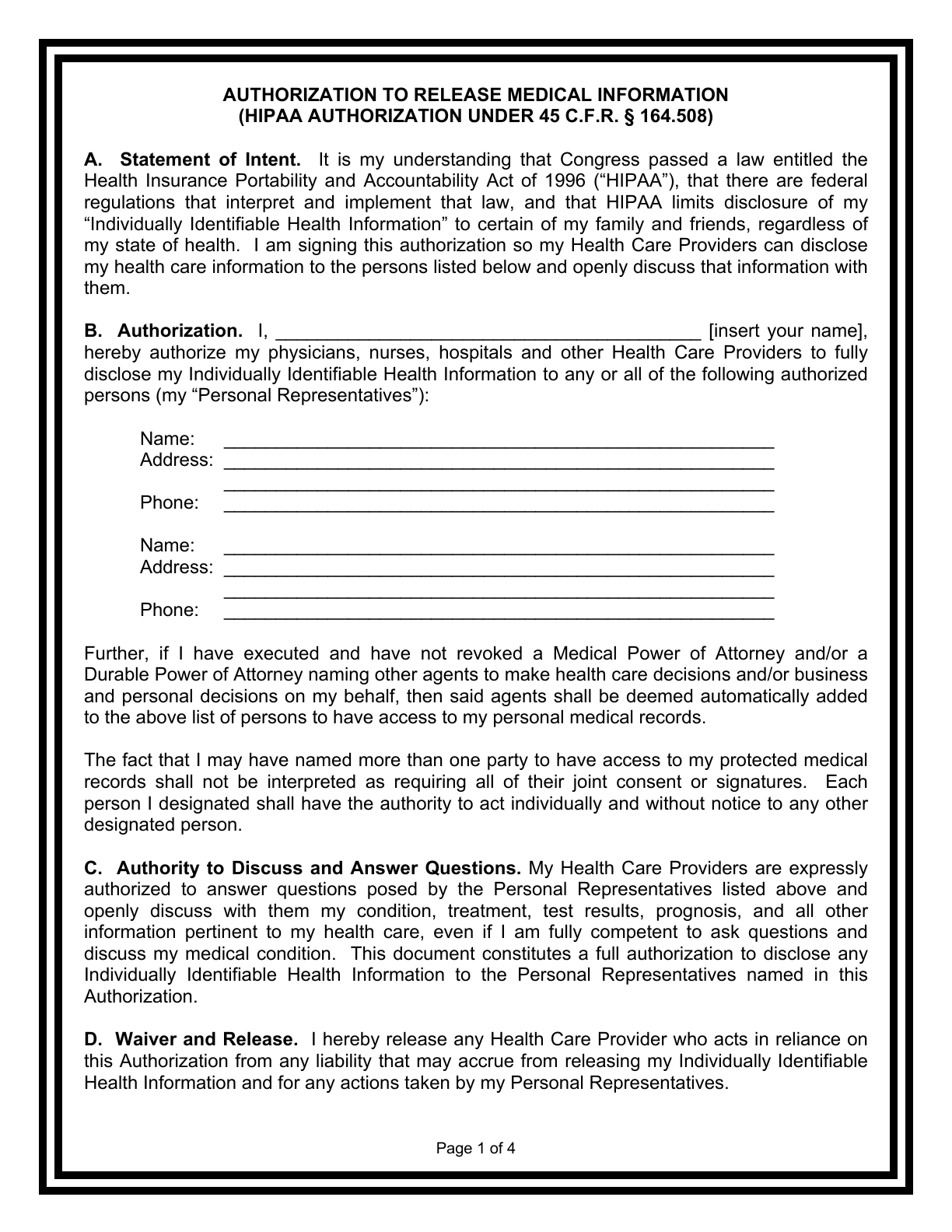
See page 1 of the actual form before you buy. Give your doctors, hospitals, and insurers written permission to share your medical information with the people you name — and to openly discuss your condition, treatment, and prognosis with them, even while you’re perfectly able to speak for yourself. Built around the federal HIPAA authorization rule (45 C.F.R. § 164.508), it names up to two personal representatives, automatically includes any agents under your medical or durable power of attorney, and stays effective even if you later become incapacitated. Fillable Word — click the blanks and type — plus a print-ready PDF.
This download includes the HIPAA authorization as a fillable Word file — click any blank and type, or print and complete by hand — plus a print-ready PDF for reference.
See page 1 of the actual form below. Your complete download — fillable Word plus print-ready PDF — is delivered after checkout.
Legal currency, verified
An authorization to release medical information, built around the federal HIPAA authorization rule (45 C.F.R. § 164.508). It gives your physicians, hospitals, insurers, and other health care providers written permission to disclose your individually identifiable health information to the people you name — and to openly discuss your condition, treatment, test results, and prognosis with them, even while you are fully competent. Use it as a standalone release or as a companion to a medical power of attorney.
Names up to two personal representatives and automatically includes any agents acting under your medical or durable power of attorney; each person you designate may act individually. It is effective when signed and is not affected by later disability or incapacity; it ends on the earlier of your written revocation actually received by the provider or two years after your death. It releases providers who rely on it in good faith, gives your representatives express enforcement rights, states that a copy or fax of the signed form is as effective as the original, and states plainly that information once shared may be re-disclosed and no longer protected by HIPAA. It grants access to information only — it is not a medical power of attorney and gives no one authority to make health care decisions for you. It omits the treatment-conditioning statement and some of the core elements § 164.508(c) lists for a fully compliant authorization — that is why we say “built around” the rule, not “compliant” with it. The document closes with a signature line and a notary acknowledgment certificate.
A — statement of intent; B — authorization naming up to two personal representatives, with agents under your medical or durable power of attorney included automatically; C — express authority to discuss your condition, treatment, test results, and prognosis, even while you are competent; D — release of liability for providers who rely in good faith; E — termination on your written revocation actually received, or two years after your death; F — re-disclosure warning and provider indemnity; G — enforcement rights for your representatives; H — relationship to other authorizations — it is not a medical power of attorney and grants no decision-making authority; I — copies and faxes accepted as the original; J — definitions — closing with a signature line and a notary acknowledgment.
A 2008 CNN health article on emergency planning, “If You Get Hit by a Bus Tomorrow”, featured this form as its sample HIPAA release, citing a Michigan estate-planning lawyer and describing it as pretty good and downloadable for $9.99.
The HIPAA authorization in editable Word and print-ready PDF. Page 1 of the actual form is previewed above before purchase.
This form is not legal advice. It is a national form; a provider’s own intake paperwork may still be required. Consult a licensed attorney in your state for advice about your situation.
ILRG is committed to top-quality legal forms. If you are not 100 percent satisfied after purchase, contact us for a full refund.
HIPAA’s privacy rule limits when health care providers and insurers may disclose your medical information without your written authorization — and while it lets providers share with family involved in your care, it doesn’t require it, and many refuse without a signed form. This form is written around that authorization: it lets the providers you see disclose your records — billing information included — to the people you name, and openly discuss your condition, treatment, test results, and prognosis with them. It works as a standalone release or as a companion to a medical power of attorney, and it remains effective if you later become incapacitated.
No — and it says so in the document. This form grants access to information, not decision-making authority. Authority to make health care decisions comes from a medical power of attorney or health care proxy. If you have already signed one, this form automatically treats your agents under it as authorized recipients of your information, so the two documents work together.
It is effective when you sign it and ends on the first of two events: your written revocation is actually received by the provider, or two years pass after your death. You can revoke it at any time — send the revocation in a way that gives you proof of receipt (the form names certified mail, registered mail, fax, or any other proof of actual receipt).
A 2008 CNN health article about emergency planning featured this form as its sample HIPAA release, with a Michigan estate-planning lawyer describing it as pretty good and noting it was downloadable for $9.99.
Providers may rely on a signed HIPAA authorization, and this form backs that up two ways: it releases providers who act on it in good faith from liability, and it gives your named representatives express enforcement rights if a provider refuses to recognize it. One honest limitation: the form does not recite every statement § 164.508(c) lists — it omits the treatment-conditioning statement — so a provider applying the rule strictly may also ask you to sign its own authorization; that is why we say “built around” the rule, not “compliant.” Under the form’s own terms a copy or fax is as good as the original — give each representative a copy to carry. And one trade-off, stated in the form itself: once your information is shared with the people you name, they can re-disclose it and it may no longer be protected by HIPAA.
HIPAA does not require notarization, but the form closes with a notary acknowledgment certificate because some institutions ask for one. Signing before a notary where available is the sound practice.