
Find legal forms, law schools, and legal resources
Try “residential lease” — forms for your state are shown first.
Try “Yale” or “University of Texas” — the full ABA directory is searchable as you type.
National confidentiality form
See the opening of the actual agreement before you buy. A two-way NDA for two businesses exploring a deal, partnership, or vendor relationship: both sides can disclose, both sides are bound the same way — including their parents, subsidiaries, and affiliates, who are inside the party definitions. Broad definition of confidential information, need-to-know sharing with bound representatives, compelled-disclosure protocol, return-or-destroy on request, and obligations that survive termination — five years from each disclosure, and for trade secrets, as long as the information remains a trade secret. Word for editing; PDF for printing.
This download includes the agreement in both Word and PDF. Use the Word version to complete the parties, purpose, governing law, and notice addresses; the PDF is formatted for printing and reference.
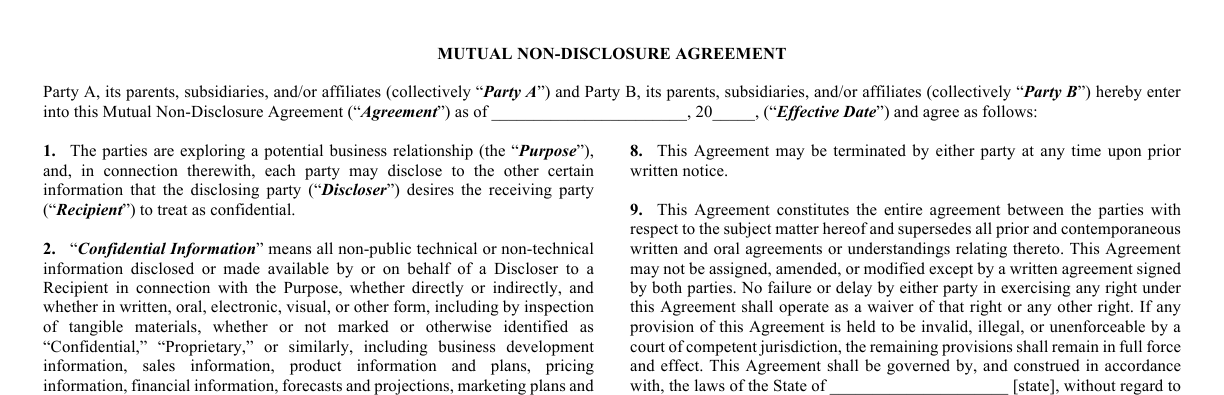
See the top of the actual two-column agreement below — the party definitions, the Purpose, and the start of the confidential-information definition. Your complete editable download (Word and PDF) is delivered after checkout.
Legal currency, verified
A mutual NDA for two businesses exploring a relationship: both sides can disclose confidential information and both are bound the same way — need-to-know sharing with bound representatives, the standard exclusions, a compelled-disclosure protocol, and return-or-destroy on written request. The top of the actual agreement is previewed above before purchase.
Either party may terminate this NDA at any time on written notice — there is no fixed term — but the confidentiality obligations survive: 5 years from each disclosure, and for trade secrets, as long as the information remains a trade secret. Signing commits neither side to any deal: no obligation to disclose, no license, no warranty — information is provided as-is. Fill in the governing-law and exclusive-jurisdiction blanks before signing; they control where a dispute is heard. If you are hiring the other party as a contractor, you also need the Independent Contractor Agreement — this NDA only covers the talks; the contractor agreement carries confidentiality plus invention assignment, payment terms, and termination provisions. And if only one side will ever disclose, a one-way NDA is the leaner structure — this file is mutual.
The Purpose and the party definitions — parents, subsidiaries, and affiliates included; the confidential-information definition; need-to-know sharing and the care standard; the four exclusions and the compelled-disclosure protocol; return-or-destruction on written request, compliance and backup copies excepted; no obligation, no license, no relationship created — information provided as-is; termination on written notice; the boilerplate — entire agreement, assignment, governing law, exclusive forum, injunctive relief; notice mechanics — email and certified mail, copy to General Counsel; counterparts with fax/PDF signatures; and survival — five years from each disclosure, and trade secrets for as long as they remain trade secrets under applicable law.
The mutual non-disclosure agreement in editable Word and print-ready PDF, with notice blocks (email and certified mail) and signature blocks for both parties. Counterpart and fax/PDF signatures are expressly accepted.
This form is not legal advice. It is a national instrument; consult a licensed attorney in your state for advice about your situation. NDAs cannot lawfully bar reporting to government agencies, and some states limit confidentiality clauses in employment or settlement contexts.
ILRG is committed to top-quality legal forms. If you are not 100 percent satisfied after purchase, contact us for a full refund.
Mutual. Both parties can disclose confidential information and both are bound by the same obligations — the right structure when two businesses are exploring a relationship and each side will be showing the other something non-public. If only one side will ever disclose, a one-way NDA is the leaner structure — this file is mutual.
The agreement itself has no fixed term — either party may terminate it at any time on written notice. Termination doesn’t lift the confidentiality obligations: they survive 5 years from each disclosure, and for trade secrets they continue for as long as the information remains a trade secret.
Broadly: non-public technical or business information in any form, whether or not it’s marked confidential — pricing, financials, forecasts, product plans, customer information, software, source code, designs, formulae, and algorithms — disclosed for the stated purpose of exploring a business relationship.
The standard four exclusions: information that is or becomes public through no breach, information the recipient develops independently with written records to prove it, information the recipient can show by written records it already knew, and information lawfully received from a third party. There is also a compelled-disclosure protocol — if a court or agency demands disclosure, the recipient gives notice and cooperates so the discloser can seek protection.
No. The agreement creates no obligation to disclose anything, grants no license, and commits neither party to any transaction. Information is provided as-is, without warranty. It is a confidentiality framework for talks — nothing more.
On written request, each party returns or destroys the other’s confidential materials and, on request, certifies the destruction. Copies kept for legal, compliance, or automated-backup reasons may be retained but remain bound by the agreement. And as noted, the confidentiality obligations themselves survive termination — 5 years per disclosure, longer for trade secrets.