
Find legal forms, law schools, and legal resources
Try “residential lease” — forms for your state are shown first.
Try “Yale” or “University of Texas” — the full ABA directory is searchable as you type.
Kansas legal form
Download the Kansas general durable power of attorney for property and finances — effective only upon disability or incapacity. Ready for instant secure access.
A durable power of attorney document for managing property and finances, prepared for Kansas.
Prepared for Kansas, granting broad financial authority effective only upon your disability or incapacity.
The authority continues through incapacity — the moment a power of attorney matters most. A non-durable document would end exactly then.
Download the file, complete it on your own device, then sign with the required notarization or witnesses. No online data entry.
This state packet includes 2 documents in editable Word and print-ready PDF formats. Use the Word version for editing and the PDF for print-ready reference.
About this packet
A general durable power of attorney lets you appoint an agent to manage your property and finances — banking, real estate, investments, and similar matters. This version takes effect only upon your disability or incapacity, keeping full control in your hands while you are able.
The powers granted are broad. Choose your agent carefully, and consider consulting an attorney if your financial situation is complex.
Review representative packet content before purchasing. Your licensed download is delivered after checkout.
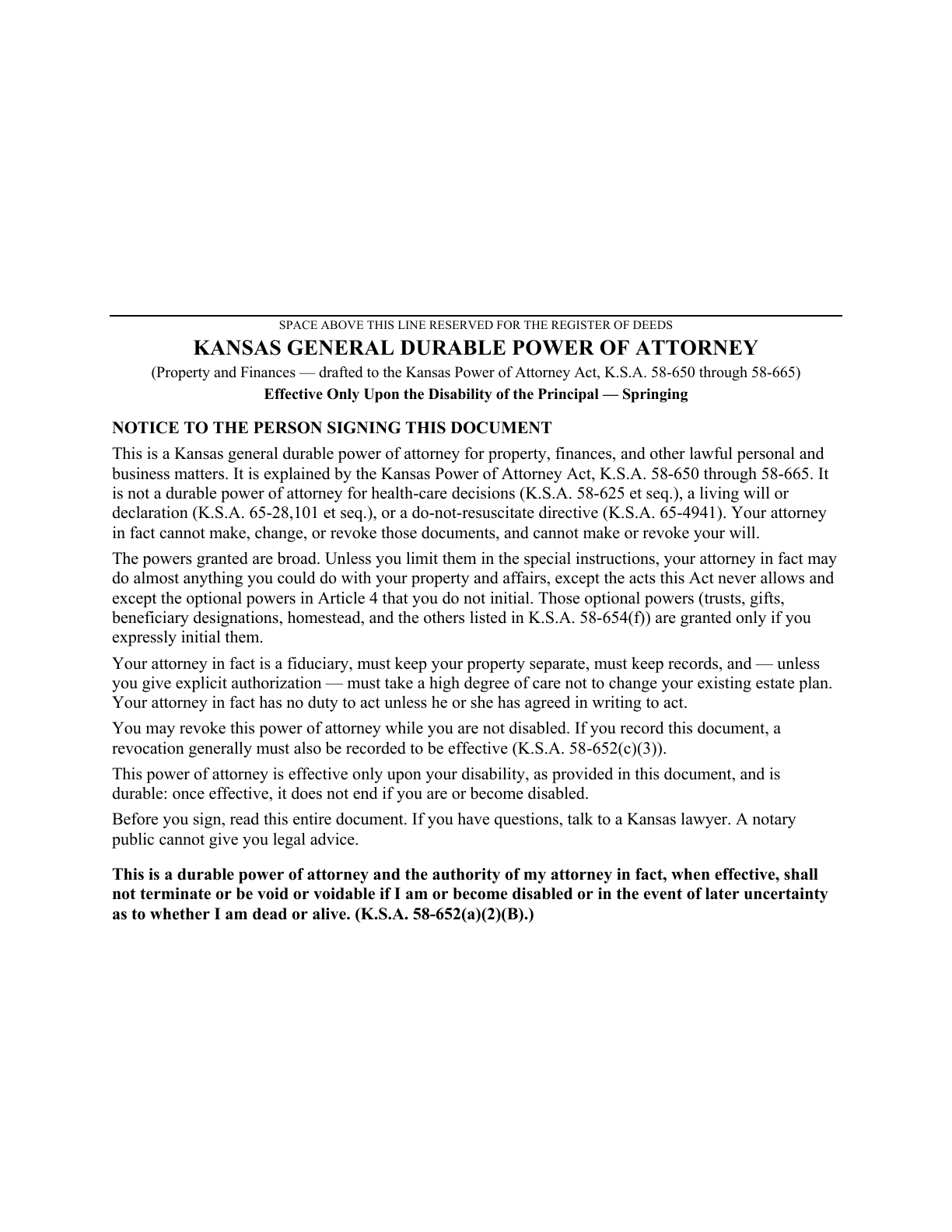
SPACE ABOVE THIS LINE RESERVED FOR THE REGISTER OF DEEDS
KANSAS GENERAL DURABLE POWER OF ATTORNEY
(Property and Finances — drafted to the Kansas Power of Attorney Act, K.S.A. 58-650 through 58-665)
(Kansas Statutes Annotated, Chapter 58, Article 6 — Kansas Power of Attorney Act)
Effective Only Upon the Disability of the Principal — Springing
NOTICE TO THE PERSON SIGNING THIS DOCUMENT
This is a Kansas general durable power of attorney for property, finances, and other lawful personal and business matters. It is explained by the Kansas Power of Attorney Act, K.S.A. 58-650 through 58-665. It is not a durable power of attorney for health-care decisions (K.S.A. 58-625 et seq.), a living will or declaration (K.S.A. 65-28,101 et seq.), or a do-not-resuscitate directive (K.S.A. 65-4941). Your attorney in fact cannot make, change, or revoke those documents, and cannot make or revoke your will.
The powers granted are broad. Unless you limit them in the special instructions, your attorney in fact may do almost anything you could do with your property and affairs, except the acts this Act never allows and except the optional powers in Article 4 that you do not initial. Those optional powers (trusts, gifts, beneficiary designations, homestead, and the others listed in K.S.A. 58-654(f)) are granted only if you expressly initial them.
Your attorney in fact is a fiduciary, must keep your property separate, must keep records, and — unless you give explicit authorization — must take a high degree of care not to change your existing estate plan. Your attorney in fact has no duty to act unless he or she has agreed in writing to act.
You may revoke this power of attorney while you are not disabled. If you record this document, a revocation generally must also be recorded to be effective (K.S.A. 58-652(c)(3)).
This power of attorney is effective only upon your disability, as provided in this document, and is durable: once effective, it does not end if you are or become disabled.
Before you sign, read this entire document. If you have questions, talk to a Kansas lawyer. A notary public cannot give you legal advice.
This is a durable power of attorney and the authority of my attorney in fact, when effective, shall not terminate or be void or voidable if I am or become disabled or in the event of later uncertainty as to whether I am dead or alive. (K.S.A. 58-652(a)(2)(B).)
Article 1. Designation of Attorney in Fact
I,
________________________________________________________________________
(Name of principal)
of
________________________________________________________________________
(Address of principal)
appoint the following person as my attorney in fact (agent):
________________________________________________________________________
(Name and address of attorney in fact)
Telephone of attorney in fact (optional): ____________________________________________________
OPTIONAL SECOND ATTORNEY IN FACT. If you wish two persons to serve at the same time, complete the following (otherwise leave blank):
________________________________________________________________________
(Name and address of second attorney in fact)
Telephone of second attorney in fact (optional): ____________________________________________
If you named a second attorney in fact, YOU MUST MARK ONE of the following. Kansas law is unusual here: if you name two attorneys in fact and mark neither box, they must act JOINTLY — both must participate in every act (K.S.A. 58-653(a)). Most people who name two choose to let them act severally (independently).
☐ SEVERALLY — each attorney in fact may exercise the powers conferred separately, without the consent of the other.
☐ JOINTLY — my attorneys in fact shall exercise the powers conferred jointly, with the consent of both.
OPTIONAL SUCCESSORS. If every attorney in fact named above dies, resigns, becomes disabled, is not qualified, or declines to serve, I name the following as successor attorneys in fact, in the order named (K.S.A. 58-660(b)(1)):
Successor attorney in fact 1 — name and address: ________________________________________
Successor attorney in fact 2 — name and address: ________________________________________
Article 2. When This Power of Attorney Is Effective
This power of attorney is NOT effective when I sign it. It becomes effective only upon my disability, determined in the manner prescribed in this Article (K.S.A. 58-652(e), 58-656(f)). Once effective, it is durable and is not terminated by my disability.
I am "disabled" when my ability to receive and evaluate relevant information, or to effectively communicate decisions, or both — even with the use of assistive technologies or other supports — is impaired to the degree that I lack capacity to manage my estate or to meet essential needs for my physical health, safety, or welfare, whether or not a guardian or conservator has been appointed for me (K.S.A. 58-651(c), 77-201).
MANNER OF DETERMINATION. My disability shall be determined by a written determination signed by my attending physician stating that I am disabled within the meaning above.
OPTIONAL — DETERMINER I NAME. Instead of my attending physician, I authorize the following person to determine in a signed writing that I am disabled (leave blank if none):
________________________________________________________________________
(Name and address of person authorized to determine disability)
ACCESS TO MY HEALTH INFORMATION. Each person authorized in this Article to determine my disability may act as my personal representative under the Health Insurance Portability and Accountability Act (42 U.S.C. § 1320d and applicable regulations) to obtain access to my health-care information and to communicate with my health-care providers for the purpose of making that determination and disclosing it to my attorney in fact.
Exhibit A is the affidavit of triggering event described in K.S.A. 58-652(e). It is completed and signed by the attorney in fact LATER, if and when disability must be established to a third party — not when you sign this power of attorney.
Article 3. Grant of General Authority
I grant my attorney in fact general powers to act for me with respect to ALL LAWFUL SUBJECTS AND PURPOSES. Under K.S.A. 58-654(b), this grant extends to and includes each and every action or power which an adult who is not disabled may carry out through an agent specifically authorized to do so, EXCEPT the acts listed in Article 4 (granted only if expressly initialed) and the acts in the next paragraph (which Kansas law never allows).
THIS POWER OF ATTORNEY DOES NOT AUTHORIZE ANYONE TO: make, amend, or revoke my will; make, modify, or revoke a health-care declaration (K.S.A. 65-28,101 et seq.), a do-not-resuscitate directive (K.S.A. 65-4941), or a durable power of attorney for health-care decisions (K.S.A. 58-625 et seq.); require me to act against my will; or do any act I have specifically forbidden while I am not disabled (K.S.A. 58-654(g)).
Under this general grant my attorney in fact may, among all other lawful acts: execute any deed, mortgage, lease, contract, tax return, or other instrument for me; sign indemnity and other agreements requested by third persons who rely on this power of attorney, binding me and my estate (K.S.A. 58-654(d)); employ and compensate attorneys, accountants, and other professionals; and execute supplemental powers of attorney required by taxing or other authorities, which may not broaden the scope of this document.
The enumeration of specific powers in this document does not limit the general grant (K.S.A. 58-654(b)). A third person may rely on this power of attorney without regard to whether the property or act is specifically described (K.S.A. 58-654(h)). Kansas policy: an attorney in fact acting under a general grant has the same rights and privileges as if the principal were personally present and acting; contrary waivers are void (K.S.A. 58-654(i)).
Article 4. Powers Granted Only If Expressly Elected (K.S.A. 58-654(f))
Kansas law does not allow an attorney in fact to do any of the following unless the power of attorney EXPRESSLY enumerates and authorizes it. MARK THE BOX AND PLACE YOUR INITIALS ON THE LINE IN FRONT OF each power you intend to grant. Unmarked powers are NOT granted.
☐ _______ (1) Trusts — execute, amend, or revoke any trust agreement (K.S.A. 58-654(f)(1)).
☐ _______ (2) Fund a trust not created by me (K.S.A. 58-654(f)(2)).
☐ _______ (3) Gifts — make or revoke a gift of my property, in trust or otherwise (K.S.A. 58-654(f)(3)).
☐ _______ INCLUDING gifts to my attorney in fact personally (mark this inner box only if you intend to permit self-dealing; otherwise your attorney in fact must avoid self-dealing as in the case of a trustee — K.S.A. 58-656(a)).
Marking this election is the explicit authorization that permits gifts even if they change your existing estate plan (K.S.A. 58-656(a)). Kansas sets no dollar cap; you may add limits in the Special Instructions article.
☐ _______ (4) Disclaimers — disclaim a gift or devise of property (K.S.A. 58-654(f)(4)).
☐ _______ (5) Survivorship — create or change rights of survivorship (K.S.A. 58-654(f)(5)).
You do NOT need this election for your attorney in fact to withdraw funds from a joint account to the extent you are lawfully entitled to withdraw them.
☐ _______ (6) Beneficiary designations — create or change beneficiary designations effective at my death (K.S.A. 58-654(f)(6)).
Marking this election is the explicit authorization that permits these changes even if they change your existing estate plan (K.S.A. 58-656(a)).
☐ _______ (9) Guardian or conservator — allow my attorney in fact to nominate a guardian or conservator for me (K.S.A. 58-654(f)(9)).
☐ _______ INCLUDING authority to nominate himself or herself as my guardian or conservator (effective only if so stated — K.S.A. 58-654(f)(9)).
Your OWN nomination belongs in the Nomination article below, which is always available and needs no election.
☐ _______ (11) Appointments — allow my attorney in fact to designate substitute, successor, or additional attorneys in fact (K.S.A. 58-654(f)(11)).
☐ _______ (12) Delegation — allow my attorney in fact to delegate powers granted under this document (K.S.A. 58-654(f)(12), 58-660(a)).
☐ _______ (13) Content of electronic communications — access the CONTENT of my email, messages, and other electronic communications under the Kansas revised uniform fiduciary access to digital assets act (K.S.A. 58-654(f)(13), 58-4809).
This is content access, not mere account access. Catalog and account information is covered by the general grant.
(10) HOMESTEAD — consent to the sale, gift, mortgage, or other alienation of my homestead (K.S.A. 58-654(f)(10)). This election is valid ONLY if this power of attorney specifically describes the homestead by legal description AND street address, and — if I am married — my spouse consents in a written, acknowledged document, below or on an attached sheet, stating that my spouse consents that my attorney in fact may alienate the homestead and that the consent of my attorney in fact will constitute my consent required by section 9 of article 15 of the Kansas Constitution. This grant covers ONLY the property described here:
☐ _______ HOMESTEAD election (described below).
Street address of homestead: ____________________________________________________
Legal description: ______________________________________________________________
(attach a continuation sheet if needed) ________________________________________
☐ _______ I am NOT married — no spousal consent is required for this homestead.
☐ _______ I AM married, and my spouse's written, acknowledged consent is attached (or appears in the execution section of this document).
DECISIONS EFFECTIVE AFTER MY DEATH. The following three powers, if elected, continue for a reasonable time after my death, for those limited purposes only (K.S.A. 58-657(b)(1)). They are not health-care authority and cannot be exercised while I am alive.
☐ _______ (7) Autopsy — consent to an autopsy or postmortem examination (K.S.A. 58-654(f)(7)).
☐ _______ (8) Anatomical gifts — make an anatomical gift of my body or body parts under the revised uniform anatomical gift act (K.S.A. 58-654(f)(8)).
☐ _______ (14) Funeral expenses — pay reasonable funeral and burial expenses for me (K.S.A. 58-654(f)(14)).
Article 5. My Nomination of Guardian or Conservator (Optional)
If a petition to appoint a guardian or conservator, or both, is filed for me, I nominate the following person for consideration by the court. The court shall appoint in accordance with my most recent nomination in this power of attorney, so long as the person nominated is fit and proper (K.S.A. 58-656(d)):
________________________________________________________________________
(Name and address of nominee — leave blank if none)
If a court appoints a conservator, guardian, or other fiduciary for me, my attorney in fact becomes accountable to that fiduciary as well as to me, and that fiduciary has the same power to revoke or amend this power of attorney that I would have had — but this power of attorney does not automatically terminate (K.S.A. 58-656(c)).
Article 6. Special Instructions (Optional)
Optional additions or limits. This is the place for any limits on the general grant, gift parameters (annual amounts, permitted recipients, or purposes — Kansas sets no statutory cap), and the divorce opt-out below. If none, leave blank.
________________________________________________________________________
________________________________________________________________________
________________________________________________________________________
DIVORCE OPT-OUT. Unless you provide otherwise, if an action for annulment, separate maintenance, or divorce is FILED between you and your attorney in fact (if married to each other at or after this document was created), your attorney in fact's authority terminates when the action is filed (K.S.A. 58-657(b)(3)). MARK the following box only if you do NOT want that automatic termination:
☐ My attorney in fact's authority shall NOT terminate upon the filing of an action for annulment, separate maintenance, or divorce between me and my attorney in fact.
Article 7. Compensation of Attorney in Fact
Under K.S.A. 58-661, your attorney in fact is entitled to reasonable compensation for services rendered AND to reimbursement for reasonable expenses incurred on your behalf, subject to this document and any separate agreement. MARK the following box only if you want to change that default:
☐ My attorney in fact is entitled to reimbursement of reasonable expenses but shall serve WITHOUT compensation.
Article 8. Effect on Earlier Powers of Attorney
Signing this power of attorney does NOT by itself revoke any power of attorney you signed before. MARK the following box only if you intend to revoke them:
☐ I REVOKE all earlier general and financial powers of attorney that I have signed. (Do not mark this box if you want a specialized power of attorney — for example, one held by a bank — to remain in effect.)
If you recorded an earlier power of attorney with a register of deeds, a revocation of it is not effective unless the revocation is also recorded (K.S.A. 58-652(c)(3)). Notify every prior attorney in fact as well.
Article 9. Governing Law; Severability
This power of attorney is governed by the laws of the State of Kansas, including the Kansas Power of Attorney Act (K.S.A. 58-650 through 58-665); its meaning and effect are determined by the law of Kansas (K.S.A. 58-663). If any provision is held invalid, the remainder continues in effect.
Article 10. Duties of the Attorney in Fact
An attorney in fact acting under this document is a FIDUCIARY. Under K.S.A. 58-655 and 58-656, your attorney in fact must: follow your instructions and act in your best interest, in good faith, and with the care of a prudent person; avoid self-dealing and conflicts of interest, as in the case of a trustee with respect to the trustee's beneficiaries; keep a record of all receipts, disbursements, and transactions; keep your property separate and not comingle it with the attorney in fact's own; indicate representative capacity when signing for you; keep in contact with you and follow your instructions while you are able to give them; exercise any special skills possessed; and invest under the Kansas uniform prudent investor act.
ESTATE-PLAN PRESERVATION. "In the absence of explicit authorization, the attorney in fact shall exercise a high degree of care in maintaining, without modification, any estate plan which the principal may have in place," including beneficiary designations, ownership by joint tenancy or tenancy by the entirety, trust arrangements, and your will or codicil (K.S.A. 58-656(a)). The express elections you initial in Article 4 — gifts, survivorship, beneficiary designations — are the explicit authorizations that relax this duty as to those acts.
NO DUTY TO ACT. An attorney in fact has no duty to act under this document unless the attorney in fact has expressly agreed in writing to act; such an agreement is enforceable without consideration. Acting on one occasion does not obligate acting on any later occasion (K.S.A. 58-652(d)). An attorney in fact may resign as provided in K.S.A. 58-657(h).
ACCOUNTING AND OVERSIGHT. The district court may require an accounting and may declare disability, modify, suspend, or terminate this power of attorney, or remove the attorney in fact, as provided in K.S.A. 58-662. After my death, my attorney in fact must follow the instructions of the court, is accountable to my personal representative, and must deliver property and records as required by K.S.A. 58-656(g).
Article 11. Acceptance by Third Parties
A person asked to accept this acknowledged power of attorney MUST accept it unless a statutory exception applies, and may NOT require an additional or different form of power of attorney for authority granted in this one (K.S.A. 58-658(f), (g)). A person may request signature specimens, a certification by the attorney in fact under penalty of perjury of factual matters, an opinion of counsel (with a written reason), or an indemnity agreement (K.S.A. 58-658(e)) — for a durable power of attorney executed by a Kansas resident of at least two years, an indemnity agreement may be required in lieu of a bond. A person that improperly refuses is subject to a court order mandating acceptance and to liability for court costs and attorney fees (K.S.A. 58-658(h)).
Persons dealing with my attorney in fact in good faith have no duty to inquire into — among other things — whether a triggering event for effectiveness has occurred, whether an action for divorce, annulment, or separate maintenance has been filed, or whether I am alive (K.S.A. 58-658(a)). The separate CERTIFICATION BY ATTORNEY IN FACT file supplied with this document is the certification a third party may request; it is completed and signed by the attorney in fact at the time of use, not when this power of attorney is signed.
Article 12. Execution
Sign this document before a notary public or other officer authorized to take acknowledgments. Kansas law requires that a durable power of attorney be signed, dated, and acknowledged under the revised uniform law on notarial acts (K.S.A. 58-652(a)(3)); witnesses are not required. Acknowledgment makes your signature presumed genuine and makes the document recordable with the register of deeds.
IN WITNESS WHEREOF, I have hereunto signed my name this ________ day of ____________________, 20______.
___________________________________________
(Signature of principal)
State of ____________________
County of __________________
This record was acknowledged before me on ____________________ (date) by _________________________________________________ (name(s) of person(s)).
_____________________________________________
(Signature of notarial officer)
Title of office: ____________________ [Official Stamp]
My commission expires: ____________________
SIGNATURE BY ANOTHER PERSON AT THE PRINCIPAL'S DIRECTION — COMPLETE ONLY IF THE PRINCIPAL CANNOT PHYSICALLY SIGN
If the principal is physically unable to sign but is otherwise competent and conscious, an adult designee of the principal may sign the principal's name in the presence of the principal and at the specific direction of the principal, expressed in the presence of a notary public; the document is then acknowledged to the same extent and effect as if physically signed by the principal (K.S.A. 58-652(a)(3)).
IN WITNESS WHEREOF, the undersigned, an adult designee, signed the name of the principal in the principal's presence and at the principal's specific direction, expressed in the presence of the notary public below, this ________ day of ____________________, 20______.
_____________________________________________
(Signature of person signing at the direction of ________________________________, the principal)
Printed name of person signing ______________________________________________
Address of person signing ___________________________________________________
State of ____________________
County of __________________
This record was acknowledged before me on ____________________ (date) by _________________________________________________ (name(s) of person(s)).
_____________________________________________
(Signature of notarial officer)
Title of office: ____________________ [Official Stamp]
My commission expires: ____________________
This document prepared by: ____________________________________________
SPOUSE'S CONSENT TO HOMESTEAD ALIENATION — COMPLETE ONLY IF THE HOMESTEAD ELECTION IN ARTICLE 4 IS MARKED AND THE PRINCIPAL IS MARRIED
This certificate may be completed below or on a separate attached sheet (K.S.A. 58-654(f)(10)).
I, the spouse of the principal, consent that the attorney in fact named in this power of attorney may sell, gift, mortgage, or otherwise alienate the homestead specifically described in Article 4, and I state that the consent of the attorney in fact will constitute the consent of the principal required by section 9 of article 15 of the constitution of the state of Kansas (K.S.A. 58-654(f)(10)).
___________________________________________
(Signature of spouse) Date: ____________________
State of ____________________
County of __________________
This record was acknowledged before me on ____________________ (date) by _________________________________________________ (name(s) of person(s)).
_____________________________________________
(Signature of notarial officer)
Title of office: ____________________ [Official Stamp]
My commission expires: ____________________
Exhibit A — Agent's Affidavit of Triggering Event
Complete this exhibit ONLY when first acting under the springing power of attorney. DO NOT complete it when the principal signs the power of attorney. Any third person, absent actual knowledge to the contrary, may rely on this affidavit of the attorney in fact that the triggering condition exists (K.S.A. 58-652(e)). Attach or reference the written determination of disability made as prescribed in Article 2.
Principal: ____________________________________________
Date of power of attorney: ____________________
I, the undersigned attorney in fact named in the above power of attorney, being first duly sworn (or affirmed), state:
(1) The condition on which the power of attorney becomes effective EXISTS: the principal is disabled within the meaning of the power of attorney (K.S.A. 58-651(c), 77-201).
(2) The determination of disability was made in the manner prescribed in the power of attorney: (MARK ONE)
☐ Written determination of the principal's attending physician, dated ____________________, attached or referenced here.
☐ Written determination of the person named in the power of attorney, dated ____________________, attached or referenced here.
Name of person making the determination: ____________________________________________
Relationship or capacity (attending physician / named determiner): ________________________________
___________________________________________
(Signature of attorney in fact)
Printed name of attorney in fact ____________________________________________
State of ____________________
County of __________________
Signed and sworn to (or affirmed) before me on ____________________ (date) by _________________________________________________ (name(s) of person(s)).
_____________________________________________
(Signature of notarial officer)
Title of office: ____________________ [Official Stamp]
My commission expires: ____________________
Important Information About This Document
THIS PAGE IS NOT PART OF THE POWER OF ATTORNEY. REMOVE IT BEFORE SIGNING. DO NOT RECORD IT. KEEP IT WITH YOUR RECORDS.
What this document is. A Kansas general durable power of attorney for property and financial matters, independently drafted to comply with the Kansas Power of Attorney Act (K.S.A. 58-650 through 58-665). Kansas has no official statutory form for the instrument itself; the Kansas Judicial Council publishes a form that is free for non-commercial use — this is an independently drafted commercial instrument. This version is SPRINGING: it takes effect only upon your disability, determined as provided in Article 2.
How to complete. Fill in your name and address and your attorney in fact's name and address. If you name a second attorney in fact, you must mark whether they act severally or jointly — if you mark neither, Kansas law makes them act jointly (K.S.A. 58-653(a)). In Article 4, mark and initial only the powers you intend to grant; the others are not granted.
How to sign. Sign before a notary public or other officer authorized to take acknowledgments. No witnesses are required. If you are physically unable to sign but competent and conscious, an adult you designate may sign your name in your presence and at your specific direction, expressed in the notary's presence, using the directed-signer block. Remote online notarization is available in Kansas (K.S.A. 53-5a15).
Recording for real-estate use. You do not have to record this power of attorney for it to be valid (K.S.A. 58-652(c)(1)). If it will be used in a real-estate transaction, record the ORIGINAL with the register of deeds of the county where the land lies — some counties (for example, Johnson County) will not accept a certified copy for recording. Kansas counties commonly require about a 3-inch blank space at the top of the first page; this document reserves it, and the clerk will add a cover sheet if more space is needed. Do not put a Social Security number on the document. If you record this power of attorney, a later revocation must also be recorded to be effective (K.S.A. 58-652(c)(3)).
The Certification by Attorney in Fact is a separate, LATER-USE document. A bank or other third party may ask your attorney in fact to certify facts about you and this power of attorney when it is used (K.S.A. 58-658(e)(2)). The attorney in fact completes and signs it at that time — do not attach a signed certification to this document, and do not sign it in advance. The optional notary block on the certification is there because banks often expect it; the statute requires only the penalty-of-perjury declaration.
Acceptance by banks and others. Once acknowledged, this power of attorney carries Kansas's acceptance rules: a third party must accept it unless a statutory exception applies, and may not demand a different form (K.S.A. 58-658(f), (g)). A court can order acceptance and award attorney fees for an improper refusal (K.S.A. 58-658(h)). A financial institution may not refuse a durable power of attorney merely because the principal is incapacitated when it is presented (Maenhoudt v. Stanley Bank, 34 Kan. App. 2d 150 (2005)).
Gifts. No gift authority is granted unless you mark election (3) in Article 4. Kansas sets no dollar cap on gifts; the operative checks are the fiduciary duty, the bar on self-dealing (unless you mark the inner self-gift box), and the duty to preserve your existing estate plan absent explicit authorization (K.S.A. 58-656(a)). You may add your own limits in Special Instructions.
Homestead. Kansas's constitution requires the joint consent of both spouses to sell, gift, or mortgage a homestead (Kan. Const. art. 15, § 9). The homestead election in Article 4 works only for the property specifically described there, with your spouse's written, acknowledged consent if you are married. Property you acquire later will almost certainly require a new power of attorney describing it.
Health care is separate. This document grants no health-care authority. Kansas's durable power of attorney for health-care decisions (K.S.A. 58-625 et seq.) is the document for medical decisions; a separate living will or declaration covers end-of-life treatment (K.S.A. 65-28,101 et seq.).
Revocation. You may revoke this power of attorney while you are not disabled. As between you and your attorney in fact, revocation is effective on oral or written notice to the attorney in fact (written notice from your legal representative), or by recording notice with the register of deeds (K.S.A. 58-657(a)). If this document was recorded, record the revocation too. Signing a new power of attorney does not by itself revoke this one — see Article 8.
If a court gets involved. A conservator or guardian appointed for you does not automatically end this power of attorney, but your attorney in fact becomes accountable to that fiduciary, who may revoke or amend it (K.S.A. 58-656(c)). The district court may also order accountings and oversee the attorney in fact (K.S.A. 58-662).
How your attorney in fact signs later documents. In a representative capacity, the Kansas short-form certificate is the one "for power of attorney in a representative capacity" (K.A.R. 7-43-17(a)(6)); your attorney in fact signs as, for example, "Jane Doe by John Roe, her attorney in fact."
Questions. If anything in this document is unclear, ask a licensed Kansas attorney before you sign. A notary public cannot give you legal advice.
ILRG is committed to top quality legal forms that are valid in all states. If you are not 100 percent satisfied after purchase, contact us for a full refund.
Yes. This product is the Kansas general durable power of attorney (upon disability) packet tied to this state-specific page and the packet documents shown above.
Only upon your disability or incapacity, as defined in the document. This springing structure keeps full control in your hands while you are able. If you prefer authority that starts right away, use the immediate version instead.
A durable power of attorney remains effective even if the principal becomes incapacitated. A non-durable power of attorney would end at incapacity — exactly when the document is most needed.
Requirements vary by state. Many states require notarization, some also require witnesses, and the document may need to be recorded if used in a real-estate transaction. Follow the execution instructions included with your Kansas packet.
Yes. You can revoke a power of attorney at any time while you have capacity, by signing a written revocation and notifying your agent and any institutions that rely on the document.
The included packet documents are listed on this page — 2 documents in total. Where the same document is provided in more than one format, it is grouped once with Word, PDF, or other format badges.
This packet currently includes editable Word and print-ready PDF. The document list above reflects the packet contents for this state without exposing internal fulfillment filenames.
These forms are designed for self-help use, but ILRG does not provide legal advice. Consult a licensed attorney if your situation involves unusual assets, blended-family or tax questions, contested issues, or questions about local requirements.
No. ILRG provides self-help legal forms and information, not legal advice. You are responsible for reviewing your state’s execution requirements before signing.