
Find legal forms, law schools, and legal resources
Try “residential lease” — forms for your state are shown first.
Try “Yale” or “University of Texas” — the full ABA directory is searchable as you type.
Massachusetts legal form
Download the Massachusetts general durable power of attorney for property and finances — effective only upon disability or incapacity. Ready for instant secure access.
A durable power of attorney document for managing property and finances, prepared for Massachusetts.
Prepared for Massachusetts, granting broad financial authority effective only upon your disability or incapacity.
The authority continues through incapacity — the moment a power of attorney matters most. A non-durable document would end exactly then.
Download the file, complete it on your own device, then sign with the required notarization or witnesses. No online data entry.
This state packet includes 1 document in editable Word and print-ready PDF formats. Use the Word version for editing and the PDF for print-ready reference.
About this packet
A general durable power of attorney lets you appoint an agent to manage your property and finances — banking, real estate, investments, and similar matters. This version takes effect only upon your disability or incapacity, keeping full control in your hands while you are able.
The powers granted are broad. Choose your agent carefully, and consider consulting an attorney if your financial situation is complex.
Review representative packet content before purchasing. Your licensed download is delivered after checkout.
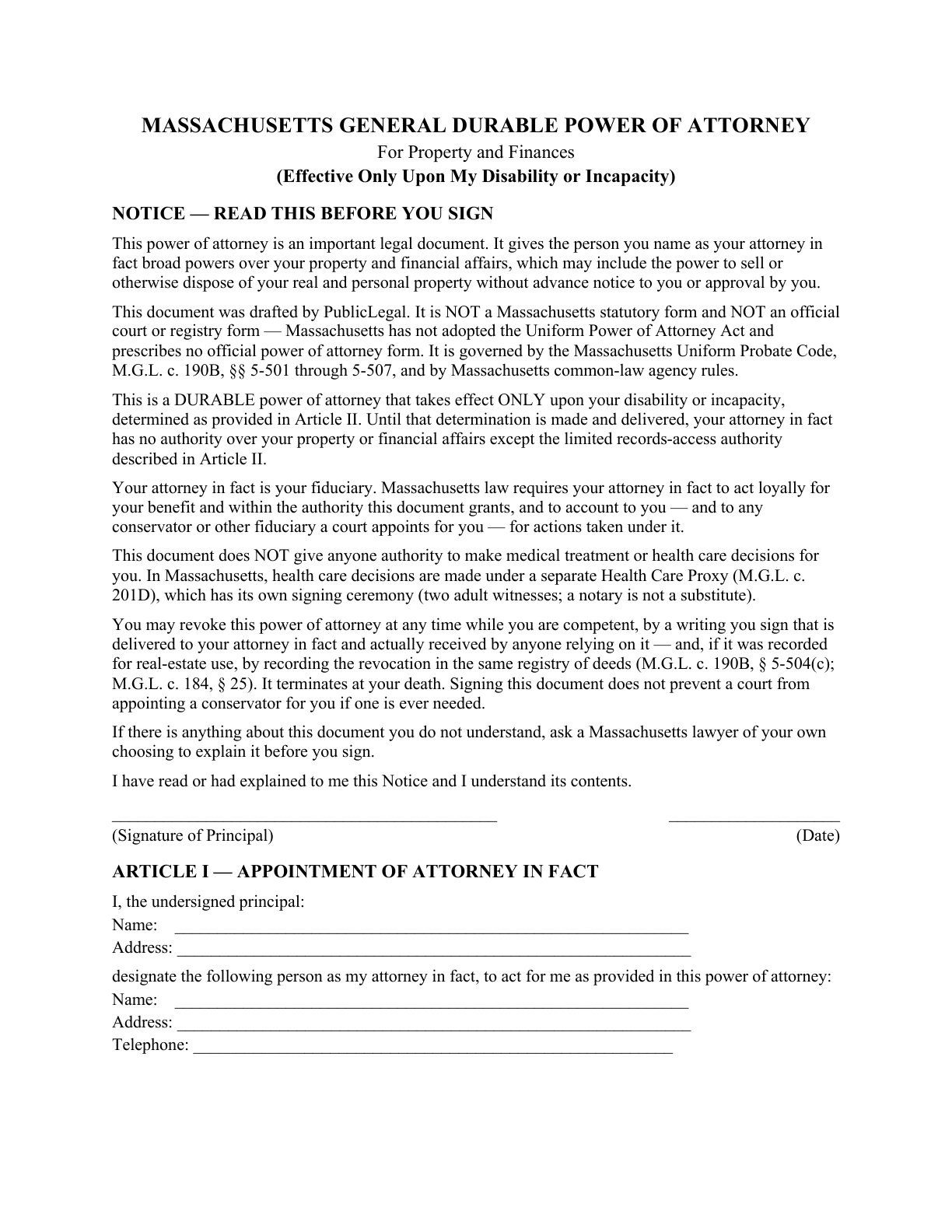
MASSACHUSETTS GENERAL DURABLE POWER OF ATTORNEY
For Property and Finances
(Effective Only Upon My Disability or Incapacity)
(Mass. Gen. Laws ch. 190B, § 5-501)
NOTICE — READ THIS BEFORE YOU SIGN
This power of attorney is an important legal document. It gives the person you name as your attorney in fact broad powers over your property and financial affairs, which may include the power to sell or otherwise dispose of your real and personal property without advance notice to you or approval by you.
This document was drafted by PublicLegal. It is NOT a Massachusetts statutory form and NOT an official court or registry form — Massachusetts has not adopted the Uniform Power of Attorney Act and prescribes no official power of attorney form. It is governed by the Massachusetts Uniform Probate Code, M.G.L. c. 190B, §§ 5-501 through 5-507, and by Massachusetts common-law agency rules.
This is a DURABLE power of attorney that takes effect ONLY upon your disability or incapacity, determined as provided in Article II. Until that determination is made and delivered, your attorney in fact has no authority over your property or financial affairs except the limited records-access authority described in Article II.
Your attorney in fact is your fiduciary. Massachusetts law requires your attorney in fact to act loyally for your benefit and within the authority this document grants, and to account to you — and to any conservator or other fiduciary a court appoints for you — for actions taken under it.
This document does NOT give anyone authority to make medical treatment or health care decisions for you. In Massachusetts, health care decisions are made under a separate Health Care Proxy (M.G.L. c. 201D), which has its own signing ceremony (two adult witnesses; a notary is not a substitute).
You may revoke this power of attorney at any time while you are competent, by a writing you sign that is delivered to your attorney in fact and actually received by anyone relying on it — and, if it was recorded for real-estate use, by recording the revocation in the same registry of deeds (M.G.L. c. 190B, § 5-504(c); M.G.L. c. 184, § 25). It terminates at your death. Signing this document does not prevent a court from appointing a conservator for you if one is ever needed.
If there is anything about this document you do not understand, ask a Massachusetts lawyer of your own choosing to explain it before you sign.
I have read or had explained to me this Notice and I understand its contents.
_____________________________________________ ____________________
(Signature of Principal) (Date)
ARTICLE I — APPOINTMENT OF ATTORNEY IN FACT
I, the undersigned principal:
Name: ____________________________________________________________
Address: ____________________________________________________________
designate the following person as my attorney in fact, to act for me as provided in this power of attorney:
Name: ____________________________________________________________
Address: ____________________________________________________________
Telephone: ________________________________________________________
Successor attorneys in fact (optional, recommended). If the attorney in fact named by me dies, resigns in a signed writing delivered to me or to the next-named successor, becomes incapacitated, or declines or is unable to serve, I designate the following successor attorney(s) in fact, each to act alone and successively in the order named, with the same authority:
First successor: ____________________________________________________
Second successor: ____________________________________________________
ARTICLE II — DURABILITY AND EFFECTIVENESS
This power of attorney shall become effective upon the disability or incapacity of the principal.
It is a durable power of attorney under M.G.L. c. 190B, § 5-501(a) with postponed effectiveness. Unless I state a time of termination in this document, once it has become effective the authority conferred is exercisable notwithstanding the lapse of time since its execution (M.G.L. c. 190B, §§ 5-501(a), 5-502). Until the determination described below is made and delivered to my attorney in fact, my attorney in fact has NO authority over my property or financial affairs except the limited records-access authority described in this Article.
Determination of disability or incapacity (initial ONE; if I make no election, the first option applies). For purposes of this power of attorney, I am "disabled" or "incapacitated" when, because of mental illness or other disability recognized under the General Laws (M.G.L. c. 190B, § 5-501(b)), I have become incapable of managing my property and financial affairs in a sensible and efficient manner:
_______ (DEFAULT) Upon the written certification of ONE licensed physician who has personally examined me, stating that I am disabled or incapacitated as defined above, delivered to my attorney in fact. A certification form is attached as Exhibit A.
_______ Upon the joint written concurrence of the following TWO persons, delivered to my attorney in fact: ____________________________________________ and ____________________________________________ [name two individuals I trust — for example, my physician and my spouse, family member, or lawyer]. If the two disagree, no determination is made until they concur.
Records access before this power takes effect. This power of attorney is effective at signing for the LIMITED purpose of authorizing my attorney in fact — and the physician or other person(s) making the determination — to obtain and discuss my health information to the extent needed to determine whether I am disabled or incapacitated, and for that limited purpose my attorney in fact is my personal representative under the HIPAA rules (45 C.F.R. § 164.502(g)). A limited HIPAA authorization is attached as Exhibit B.
Reliance. Any person may rely in good faith on a certification or concurrence that is regular on its face and on my attorney in fact's affidavit under M.G.L. c. 190B, § 5-505, a form of which is included with this document.
If I recover. If a determination of disability or incapacity has been made but I later regain capacity, I may revoke this power of attorney or resume acting for myself by a signed writing delivered to my attorney in fact and to anyone relying on this document, notwithstanding any prior certification.
A note about registered (Land Court) land. If I own Massachusetts registered land and my attorney in fact may need to deal with it, be aware that Land Court examiners expect the certification activating a springing power to be recorded or registered with the power of attorney itself; until it is of record, this springing document may not be accepted for registered-land transactions. The Exhibit A certification is designed to be recorded or registered together with this document.
ARTICLE III — GRANT OF ORDINARY AUTHORITY
EVERY ORDINARY POWER BELOW IS GRANTED UNLESS YOU INITIAL ITS "WITHHOLD" BOX. A BLANK BOX MEANS THE POWER IS GRANTED.
Massachusetts has no statutory catalog of power-of-attorney subjects, and powers of attorney are strictly construed under Massachusetts law — so this document describes each grant in its own text. Read each power. If you do NOT want your attorney in fact to have a power, initial that power's WITHHOLD box. You may also limit or modify any power in the Special Instructions in Article V.
WITHHOLD _______ (1) Real property — buy, sell, convey, mortgage, lease, option, exchange, partition, release, improve, maintain, insure, and otherwise deal with any real property I own or have an interest in, wherever located; sign, seal, execute, acknowledge, and deliver deeds, mortgages, deeds of trust, closing statements, options, purchase-and-sale agreements, notes, and discharges; and declare, release, subordinate, or convey any homestead estate under M.G.L. c. 188. IMPORTANT — if I am married and my spouse is not an owner but resides in the property as a principal residence, my spouse's signature may also be required to convey or release the homestead (M.G.L. c. 188, § 10(a)(1)); this document cannot act for my spouse.
WITHHOLD _______ (2) Tangible personal property — buy, sell, lease, exchange, store, ship, insure, repair, and otherwise deal with tangible personal property I own, including vehicles, boats, furniture, jewelry, art, and collectibles, and sign titles, bills of sale, and registrations.
WITHHOLD _______ (3) Banking and financial institutions — open, use, manage, and close checking, savings, money-market, certificate, safe-deposit, and other accounts at banks, credit unions, brokerages, and other financial institutions; sign checks, drafts, withdrawal orders, and wire instructions; receive and disburse money; and access any safe-deposit box registered in my name, including drilling the box if necessary.
WITHHOLD _______ (4) Securities and investments — invest and reinvest my money and property; buy, sell, exchange, surrender, redeem, and otherwise deal with stocks, bonds, mutual funds, and other securities and investments; vote securities in person or by proxy; and lend money or property and renew, extend, or modify loans.
WITHHOLD _______ (5) Business operations — operate, manage, buy, sell, or liquidate any business I own or have an interest in, whether as sole proprietor, partner, member, or shareholder; sign business documents, tax filings, and contracts; and represent me before any business entity.
WITHHOLD _______ (6) Insurance and annuities — acquire, maintain, cancel, surrender, borrow against, and deal with life, health, disability, long-term-care, casualty, and other insurance policies and annuity contracts, and prosecute and settle claims for benefits. (This does NOT include changing beneficiary designations — see Article IV.)
WITHHOLD _______ (7) Estates, trusts, and beneficial interests — receive, administer, and deal with any interest I have in any estate, trust, guardianship, conservatorship, escrow, or other fund; demand and receive accountings; and sign receipts and releases. (This does NOT include creating, amending, revoking, or terminating a trust, or exercising powers I hold under a trust — see Article IV.)
WITHHOLD _______ (8) Claims and litigation — commence, prosecute, defend, compromise, settle, arbitrate, and satisfy lawsuits, claims, and legal actions in my name; employ and pay attorneys; and sign court and settlement documents.
WITHHOLD _______ (9) Personal and family maintenance — provide for the support, maintenance, health, education, and customary standard of living of me and of my spouse and dependents, including housing, food, clothing, medical and dental care, recreation, and travel, and continue customary gifts of a personal or family nature that are not taxable gifts.
WITHHOLD _______ (10) Government benefits — apply for, receive, receipt for, and deal with benefits, payments, and entitlements from any federal, state, or local government or agency, including Social Security, Medicare, MassHealth (as my representative for applications and administration), veterans', unemployment, and pension benefits; and act as my representative payee.
WITHHOLD _______ (11) Retirement plans — deal with employee benefit plans, pension and profit-sharing plans, 401(k) plans, IRAs, and similar arrangements for my benefit; select payment options; make rollovers and contributions; borrow from plans; and apply for and receive payments. (This does NOT include changing beneficiary designations — see Article IV.)
WITHHOLD _______ (12) Taxes — prepare, sign, verify, and file federal, state, and local tax returns, declarations, and claims for refund, including Massachusetts Form M-706 estate-tax filings and elections; represent me before the IRS, the Massachusetts Department of Revenue, and other tax authorities; sign powers of attorney on their prescribed forms (such as IRS Form 2848); receive confidential tax information; and pay taxes, assessments, and penalties.
WITHHOLD _______ (13) Digital assets and electronic communications — access, manage, control, download, delete, transfer, and terminate my digital assets and electronic accounts — including email, social media, cloud storage, photographs, financial accounts, and domain names — AND access the content of my electronic communications. This is my express authorization and lawful consent to custodians and service providers for purposes of the Stored Communications Act (18 U.S.C. § 2701 et seq.) and each provider's terms of service. NOTE: Massachusetts has not enacted a uniform fiduciary-access-to-digital-assets statute, so a provider may still refuse or limit access; I should keep a separate secure record of my accounts and credentials.
WITHHOLD _______ (14) Borrowing and credit — borrow money in my name and on my credit; sign promissory notes and security agreements; use, manage, and close credit cards and lines of credit held in my name; and pledge my property as security for my obligations (not for my attorney in fact's obligations).
WITHHOLD _______ (15) Records and professionals — request, receive, review, and copy my personal, financial, legal, tax, and business records; sign releases to obtain them; and hire, pay, and direct accountants, attorneys, investment advisers, care managers, and other professionals and service providers, paying their reasonable fees from my assets. My attorney in fact may also obtain health information about me to the extent it is relevant to the financial authority granted here, as my personal representative under the HIPAA rules (45 C.F.R. § 164.502(g)).
WITHHOLD _______ (16) Funeral and burial arrangements — make advance arrangements for my funeral, burial, or cremation, including purchase of a burial plot and marker, if I have not already done so; this power does not override any written instructions I leave.
IMPORTANT: Even with no WITHHOLD boxes initialed, this Article does NOT grant the estate-changing powers listed in Article IV. Each of those powers is granted only if you separately initial it in Article IV.
ARTICLE IV — ESTATE-CHANGING POWERS (DENIED UNLESS YOU INITIAL)
Under Massachusetts common-law agency, NONE of the following powers is within your attorney in fact's authority unless you expressly grant it. INITIAL EACH POWER YOU INTEND TO GRANT. IF YOU DO NOT INITIAL A POWER, YOUR ATTORNEY IN FACT DOES NOT HAVE IT.
INITIAL _______ (1) Gifts — to make gifts, grants, or other transfers of my property without consideration. If I initial this power, the following election applies (initial ONE; if I make no election, option (i) applies):
_______ (i) gifts consistent with my personal history of making or joining in lifetime gifts;
_______ (ii) gifts limited, per recipient per calendar year, to the federal gift-tax annual exclusion amount in effect for that year (Internal Revenue Code § 2503(b));
_______ (iii) gifts unlimited as to amount and recipient.
NO GIFTS TO MY ATTORNEY IN FACT. Even if I grant the gift power, my attorney in fact may NOT make gifts to himself or herself, to anyone my attorney in fact has a legal duty to support, or to benefit my attorney in fact or his or her family in any way — UNLESS I also initial this separate line: INITIAL _______ I expressly authorize gifts to or for the benefit of my attorney in fact and persons my attorney in fact is legally obligated to support. (I understand this lets my attorney in fact benefit from my assets. Even with this initial, my attorney in fact remains my fiduciary and must be able to show that each transaction was in my interest and consistent with my known estate plan or gift-giving pattern.)
My attorney in fact must keep records of every gift made (recipient, amount, date, purpose). Be aware that gifts and transfers for less than fair market value can affect eligibility for MassHealth long-term-care benefits for up to five years; consult an elder-law attorney before making gifts for that purpose.
INITIAL _______ (2) Trust powers — to create one or more trusts on my behalf and transfer my property into them, and to amend, revoke, or terminate any trust I have created or exercise powers of appointment or withdrawal I hold under any trust, in each case only to the extent the trust's own terms and Massachusetts law permit an attorney in fact to act for me.
INITIAL _______ (3) Beneficiary designations — to create, change, or revoke beneficiary designations on life insurance policies, annuities, retirement plans, IRAs, payable-on-death and transfer-on-death accounts, and similar arrangements. (Naming my attorney in fact as beneficiary requires the separate self-benefit initial in paragraph (1) above.)
INITIAL _______ (4) Survivorship and joint accounts — to create, change, add, or terminate rights of survivorship and joint-ownership arrangements on any property or account, including adding or removing a joint owner of a bank or brokerage account. (Adding my attorney in fact as a joint owner or survivor requires the separate self-benefit initial in paragraph (1) above.)
INITIAL _______ (5) Disclaimers — to renounce or disclaim any property, interest in property, or power to which I may become entitled, whether by gift, testate or intestate succession, or contract.
INITIAL _______ (6) Delegation — to delegate discretionary authority granted under this power of attorney to one or more persons my attorney in fact selects, remaining responsible for supervising the delegate.
INITIAL _______ (7) My fiduciary powers — to exercise fiduciary powers I personally hold (for example, as trustee, executor, or guardian), but only to the extent the governing instrument and Massachusetts law permit delegation of the particular power, and never to exercise a power that is personal to me by law or by the instrument's terms.
Powers this document never grants: no one may use this document to make medical treatment or health care decisions for me (that requires a Health Care Proxy under M.G.L. c. 201D); to act for my spouse or any other person; to convey or release a homestead or tenancy-by-the-entirety interest belonging to my spouse; or to make a, or change my, will. Nothing in this document excuses my attorney in fact from the fiduciary duties Massachusetts law imposes, and no provision of this document limits my attorney in fact's liability for breaching them.
ARTICLE V — SPECIAL INSTRUCTIONS
On the following lines I may limit, extend, delete, or modify the powers granted to my attorney in fact:
________________________________________________________________
________________________________________________________________
________________________________________________________________
________________________________________________________________
ARTICLE VI — OTHER PROVISIONS
Fiduciary duty; binding effect. My attorney in fact is my fiduciary, must act loyally for my benefit and within the authority this document grants, must keep my property separate, and must account to me — and to any conservator or other fiduciary a court appoints for me — for actions taken under it. All acts done by my attorney in fact under this durable power of attorney during any period of my disability or incapacity have the same effect and bind me and my successors in interest as if I were competent and not disabled (M.G.L. c. 190B, § 5-502).
Compensation. My attorney in fact is entitled to reimbursement for reasonable costs and expenses actually incurred on my behalf, and may hire and pay professionals and service providers from my assets under Article III.
_______ (Initial only if desired) My attorney in fact is also entitled to reasonable compensation for services actually performed as my attorney in fact.
Nomination of conservator and guardian (optional). If a court proceeding is ever commenced to appoint a conservator for my estate, I nominate ________________________________________________ (alternate: ________________________________________________). If a guardian of my person is ever needed, I nominate ________________________________________________. I request that any required sureties on a bond be waived, understanding the court may require a bond in its discretion. Under M.G.L. c. 190B, § 5-503(b) and § 5-409(a)(1), the court gives first priority to, and appoints in accordance with, my most recent nomination in this durable power of attorney except for good cause or disqualification. If a conservator or other fiduciary is appointed for me, my attorney in fact will be accountable to that fiduciary as well as to me, and the fiduciary will have the same power to revoke or amend this power of attorney that I would have if I were not disabled or incapacitated (M.G.L. c. 190B, § 5-503(a)).
Revocation. I may revoke this power of attorney at any time while I am competent: (1) sign a written revocation; (2) deliver it to my attorney in fact; (3) deliver it to every bank, registry, and other person that received or relied on this document — as to persons other than my attorney in fact, revocation is not effective against a person acting in good faith without actual knowledge, and actual knowledge requires a written revocation actually received (M.G.L. c. 190B, § 5-504(c)); and (4) if this power of attorney was recorded for real-estate use, record the revocation in the same registry of deeds (M.G.L. c. 184, § 25). This power of attorney terminates at my death; persons acting in good faith without actual knowledge of my death are protected (M.G.L. c. 190B, § 5-504(a)).
_______ (Initial only if desired) I revoke every general financial power of attorney I previously signed. This does not revoke any Health Care Proxy or advance directive.
Reliance by third parties; proof of continuation. No third party acting in good-faith reliance on this durable power of attorney is liable for action taken in that reliance (M.G.L. c. 190B, § 5-507). An affidavit by my attorney in fact under M.G.L. c. 190B, § 5-505, stating no actual knowledge of termination of this power by revocation or by my death, disability, or incapacity, is conclusive proof of its nonrevocation or nontermination as to acts undertaken in good-faith reliance, and is recordable when authenticated for record — a form is included with this document. If a third party unreasonably refuses to honor this valid durable power of attorney, my attorney in fact may bring a legal action for damages (M.G.L. c. 190B, § 5-506). As a matter of practice, a photocopy or electronic copy of this document is ordinarily accepted to the same extent as the original, except that an original may be required for recording at a registry of deeds.
Governing law. This power of attorney is governed by and construed under the laws of the Commonwealth of Massachusetts. Other states may require their own forms. If any provision is held invalid, the remainder continues in effect (severability).
ARTICLE VII — EXECUTION
I am fully informed as to all the contents of this power of attorney and understand the full import of this grant of powers to my attorney in fact.
Signed this _______ day of ____________________, 20_____.
_____________________________________________
(Signature of Principal)
_____________________________________________
(Printed Name and Address of Principal)
Witnesses (optional). Massachusetts does not require witnesses for this document; their signatures provide additional proof of execution if it is ever questioned. If used, choose two adults who are not named as your attorney in fact, have them watch you sign, and have each sign below.
Witness 1 signature: _______________________________ Printed name: _______________________________
Address: ____________________________________________________________________________
Witness 2 signature: _______________________________ Printed name: _______________________________
Address: ____________________________________________________________________________
CERTIFICATE OF ACKNOWLEDGMENT (MASSACHUSETTS)
Commonwealth of Massachusetts
County of ____________________ , ss.
On this _______ day of ____________________, 20_____, before me, the undersigned notary public, personally appeared ________________________________________________ (name of principal), proved to me through satisfactory evidence of identification, which were ________________________________________________, to be the person whose name is signed on the preceding document, and acknowledged to me that the principal signed it voluntarily for its stated purpose (M.G.L. c. 222, § 15(b)).
(Seal, if any)
_____________________________________________
(Signature of Notary Public)
_____________________________________________
(Printed Name of Notary Public)
My commission expires: ____________________
PREPARATION STATEMENT
This document was prepared by the following individual:
________________________________________________ [Typed or printed name]
________________________________________________ [Address]
ATTORNEY IN FACT'S ACCEPTANCE AND SPECIMEN SIGNATURE (OPTIONAL)
This acceptance is NOT required for the power of attorney to be effective. It is provided because banks and other institutions often ask the attorney in fact to confirm acceptance of the role and to supply a specimen signature.
I, ________________________________________________ [name of attorney in fact], have read the attached power of attorney and am the person identified as attorney in fact for the principal. I accept the appointment. I understand that when I act under the power of attorney I am the principal's fiduciary: I must act loyally for the principal's benefit, only within the authority granted, keep the principal's property separate from my own, keep records, and account to the principal and to any conservator or other fiduciary a court appoints for the principal. I understand that if a conservator or other fiduciary is appointed, that fiduciary will have the principal's power to revoke or amend the power of attorney (M.G.L. c. 190B, § 5-503).
_____________________________________________
(Attorney in Fact's Signature)
_____________________________________________
(Attorney in Fact's Printed Name)
_____________________
(Date)
ATTORNEY IN FACT'S AFFIDAVIT OF NON-REVOCATION OR NON-TERMINATION
For use after this power of attorney is in effect, when a bank, registry of deeds, or other person asks for proof that it is still in force. Under M.G.L. c. 190B, § 5-505, this affidavit is conclusive proof of the nonrevocation or nontermination of the power of attorney as to acts undertaken in good-faith reliance on it. When authenticated for record, it is recordable — record it in the same registry as the power of attorney if the power of attorney was recorded.
Commonwealth of Massachusetts
County of ____________________ , ss.
I, ________________________________________________ [name of attorney in fact], being duly sworn, depose and state:
1. I am the attorney in fact designated in the attached Massachusetts General Durable Power of Attorney executed by ________________________________________________ [name of principal] on ____________________ [date].
2. That power of attorney has become effective: the principal's disability or incapacity has been determined in the manner specified in Article II of that document, and the written certification or concurrence is attached to or accompanies this affidavit.
3. At the time of the exercise of the power described, I do not have actual knowledge of the termination of the power of attorney by revocation or by the principal's death.
_____________________________________________
(Attorney in Fact's Signature)
Sworn to (or affirmed) and subscribed before me by ________________________________ [name of attorney in fact] on ____________________ [date] (M.G.L. c. 222, § 15(c)).
(Seal, if any)
_____________________________________________
(Signature of Notary Public)
My commission expires: ____________________
EXHIBIT A — CERTIFICATION OF DISABILITY OR INCAPACITY
This certification activates the attached Massachusetts General Durable Power of Attorney. It must be completed by the licensed physician who personally examined the principal, or jointly by the two persons named in Article II of that document, and delivered to the attorney in fact. It is designed to be recorded or registered together with the power of attorney. Persons may rely in good faith on a certification that is regular on its face.
I / we, the undersigned, state:
_______ I am a physician licensed to practice in ____________________ [state], license no. ____________________, and I personally examined ________________________________________________ [name of principal] on ____________________ [date].
_______ We are the two persons named in Article II of the attached power of attorney to make this determination, and we concur.
On the basis of that examination or evaluation, the undersigned certify that the principal is disabled or incapacitated as defined in Article II of the attached power of attorney — that is, because of mental illness or other disability recognized under the General Laws, the principal has become incapable of managing the principal's property and financial affairs in a sensible and efficient manner.
_____________________________________________
(Signature)
_____________________________________________
(Printed name, and professional license identification if a physician)
_____________________________________________
(Address and telephone)
_____________________
(Date)
_____________________________________________
(Signature of second certifier, if the two-person election applies)
_____________________
(Date)
EXHIBIT B — LIMITED HIPAA AUTHORIZATION FOR INCAPACITY DETERMINATION
This authorization permits my health care providers to disclose my health information ONLY for the purpose of determining whether I am disabled or incapacitated under Article II of my Massachusetts General Durable Power of Attorney. It is not a general medical-records release and gives no one authority to make health care decisions for me.
I authorize each of my physicians and other health care providers to disclose to (i) the physician or other person(s) designated to make the determination described in Article II of my power of attorney, and (ii) my attorney in fact named in that document, such of my protected health information as is reasonably necessary to determine whether I have become disabled or incapacitated as defined there, including relevant examination findings, diagnoses, and cognitive assessments.
This authorization is effective on the date my power of attorney is signed and expires when the determination described in that document has been made and delivered (or upon my revocation of the power of attorney, if earlier). I understand that I may revoke this authorization in writing at any time except to the extent action has been taken in reliance on it; that information disclosed may be subject to redisclosure; that my providers may not condition treatment on my signing this authorization; and that a copy of this authorization may be accepted as the original.
_____________________________________________ ____________________
(Signature of Principal) (Date)
ILRG is committed to top quality legal forms that are valid in all states. If you are not 100 percent satisfied after purchase, contact us for a full refund.
Yes. This product is the Massachusetts general durable power of attorney (upon disability) packet tied to this state-specific page and the packet documents shown above.
Only upon your disability or incapacity, as defined in the document. This springing structure keeps full control in your hands while you are able. If you prefer authority that starts right away, use the immediate version instead.
A durable power of attorney remains effective even if the principal becomes incapacitated. A non-durable power of attorney would end at incapacity — exactly when the document is most needed.
Requirements vary by state. Many states require notarization, some also require witnesses, and the document may need to be recorded if used in a real-estate transaction. Follow the execution instructions included with your Massachusetts packet.
Yes. You can revoke a power of attorney at any time while you have capacity, by signing a written revocation and notifying your agent and any institutions that rely on the document.
The included packet documents are listed on this page — 1 document in total. Where the same document is provided in more than one format, it is grouped once with Word, PDF, or other format badges.
This packet currently includes editable Word and print-ready PDF. The document list above reflects the packet contents for this state without exposing internal fulfillment filenames.
These forms are designed for self-help use, but ILRG does not provide legal advice. Consult a licensed attorney if your situation involves unusual assets, blended-family or tax questions, contested issues, or questions about local requirements.
No. ILRG provides self-help legal forms and information, not legal advice. You are responsible for reviewing your state’s execution requirements before signing.