
Find legal forms, law schools, and legal resources
Try “residential lease” — forms for your state are shown first.
Try “Yale” or “University of Texas” — the full ABA directory is searchable as you type.
California statutory legal form
Download the August 2026 California Uniform Statutory Form Power of Attorney packet — California's prescribed property and finances form under Probate Code § 4401 — plus packet inserts, a Signing & Use Guide, and an Agent Handbook. Durable by default, with the required consumer warnings, a witness page, and the current Civil Code § 1189 notary certificate built in. The instrument ships in editable Word and fillable PDF; companions ship as print-ready PDFs.
A California statutory POA operating kit: the prescribed durable form, ceremony and recording inserts, and separate guides for the principal and the agent.
The document text is the statutory form in California Probate Code § 4401 (the 14 powers you initial to grant, the special instructions area, and the durability election) plus the Probate Code § 4128 consumer warnings and a Civil Code § 1189 notary certificate with the identity notice California has required since 2015.
Packet inserts cover the preferred notary signing path (and the two-witness alternative), a third-party presentation sheet, and real-property recording guidance. California does not publish a separate statutory agent-certification form like some other states; your authority is the executed § 4401 instrument. No form can guarantee every institution will accept the power.
A Signing & Use Guide is for the principal; an Agent Handbook covers fiduciary duties, gift limits, and practical use. Guides and inserts are not part of the legal instrument and are not recorded. The packet will be updated when the AB 2199 form takes effect January 1, 2027.
This download includes 4 documents. The statutory form ships in editable Word and fillable PDF; the packet inserts, Signing & Use Guide, and Agent Handbook ship as print-ready PDFs.
Review the complete statutory text below before purchasing. Your licensed download — instrument plus companion guides — is delivered after checkout.
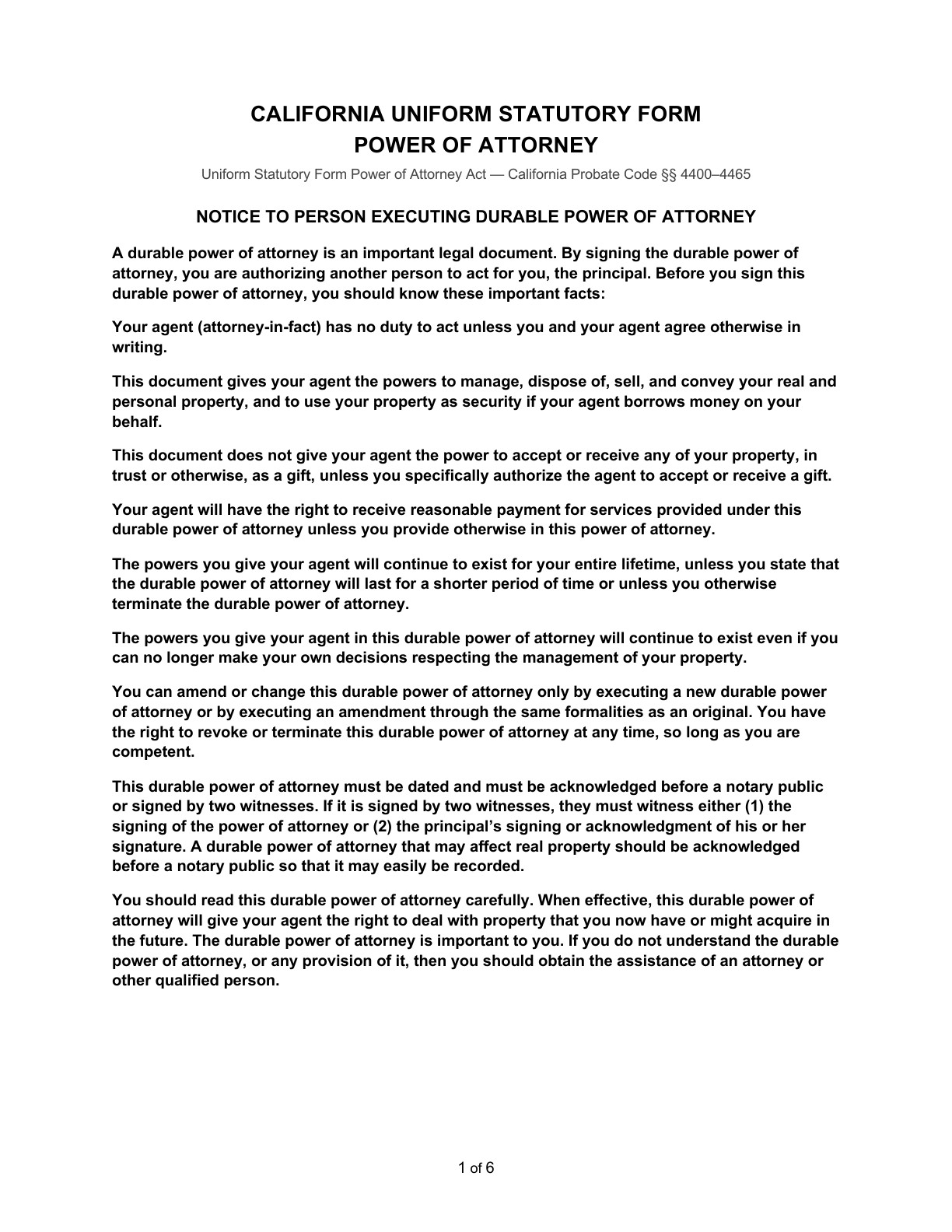
CALIFORNIA UNIFORM STATUTORY FORM
POWER OF ATTORNEY
Uniform Statutory Form Power of Attorney Act — California Probate Code §§ 4400–4465
NOTICE TO PERSON EXECUTING DURABLE POWER OF ATTORNEY
A durable power of attorney is an important legal document. By signing the durable power of attorney, you are authorizing another person to act for you, the principal. Before you sign this durable power of attorney, you should know these important facts:
Your agent (attorney-in-fact) has no duty to act unless you and your agent agree otherwise in writing.
This document gives your agent the powers to manage, dispose of, sell, and convey your real and personal property, and to use your property as security if your agent borrows money on your behalf.
This document does not give your agent the power to accept or receive any of your property, in trust or otherwise, as a gift, unless you specifically authorize the agent to accept or receive a gift.
Your agent will have the right to receive reasonable payment for services provided under this durable power of attorney unless you provide otherwise in this power of attorney.
The powers you give your agent will continue to exist for your entire lifetime, unless you state that the durable power of attorney will last for a shorter period of time or unless you otherwise terminate the durable power of attorney.
The powers you give your agent in this durable power of attorney will continue to exist even if you can no longer make your own decisions respecting the management of your property.
You can amend or change this durable power of attorney only by executing a new durable power of attorney or by executing an amendment through the same formalities as an original. You have the right to revoke or terminate this durable power of attorney at any time, so long as you are competent.
This durable power of attorney must be dated and must be acknowledged before a notary public or signed by two witnesses. If it is signed by two witnesses, they must witness either (1) the signing of the power of attorney or (2) the principal’s signing or acknowledgment of his or her signature. A durable power of attorney that may affect real property should be acknowledged before a notary public so that it may easily be recorded.
You should read this durable power of attorney carefully. When effective, this durable power of attorney will give your agent the right to deal with property that you now have or might acquire in the future. The durable power of attorney is important to you. If you do not understand the durable power of attorney, or any provision of it, then you should obtain the assistance of an attorney or other qualified person.
UNIFORM STATUTORY FORM POWER OF ATTORNEY
(California Probate Code Section 4401)
NOTICE: THE POWERS GRANTED BY THIS DOCUMENT ARE BROAD AND SWEEPING. THEY ARE EXPLAINED IN THE UNIFORM STATUTORY FORM POWER OF ATTORNEY ACT (CALIFORNIA PROBATE CODE SECTIONS 4400-4465). THE POWERS LISTED IN THIS DOCUMENT DO NOT INCLUDE ALL POWERS THAT ARE AVAILABLE UNDER THE PROBATE CODE. ADDITIONAL POWERS AVAILABLE UNDER THE PROBATE CODE MAY BE ADDED BY SPECIFICALLY LISTING THEM UNDER THE SPECIAL INSTRUCTIONS SECTION OF THIS DOCUMENT. IF YOU HAVE ANY QUESTIONS ABOUT THESE POWERS, OBTAIN COMPETENT LEGAL ADVICE. THIS DOCUMENT DOES NOT AUTHORIZE ANYONE TO MAKE MEDICAL AND OTHER HEALTH-CARE DECISIONS FOR YOU. YOU MAY REVOKE THIS POWER OF ATTORNEY IF YOU LATER WISH TO DO SO.
I ____________________________________________________________________________
(your name and address)
appoint _______________________________________________________________________
(name and address of the person appointed, or of each person appointed if you want to designate more than one)
as my agent (attorney-in-fact) to act for me in any lawful way with respect to the following initialed subjects:
TO GRANT ALL OF THE FOLLOWING POWERS, INITIAL THE LINE IN FRONT OF (N) AND IGNORE THE LINES IN FRONT OF THE OTHER POWERS.
TO GRANT ONE OR MORE, BUT FEWER THAN ALL, OF THE FOLLOWING POWERS, INITIAL THE LINE IN FRONT OF EACH POWER YOU ARE GRANTING.
TO WITHHOLD A POWER, DO NOT INITIAL THE LINE IN FRONT OF IT. YOU MAY, BUT NEED NOT, CROSS OUT EACH POWER WITHHELD.
INITIAL
________ (A) Real property transactions.
________ (B) Tangible personal property transactions.
________ (C) Stock and bond transactions.
________ (D) Commodity and option transactions.
________ (E) Banking and other financial institution transactions.
________ (F) Business operating transactions.
________ (G) Insurance and annuity transactions.
________ (H) Estate, trust, and other beneficiary transactions.
________ (I) Claims and litigation.
________ (J) Personal and family maintenance.
________ (K) Benefits from social security, medicare, medicaid, or other governmental programs, or civil or military service.
________ (L) Retirement plan transactions.
________ (M) Tax matters.
________ (N) ALL OF THE POWERS LISTED ABOVE.
YOU NEED NOT INITIAL ANY OTHER LINES IF YOU INITIAL LINE (N).
SPECIAL INSTRUCTIONS:
ON THE FOLLOWING LINES YOU MAY GIVE SPECIAL INSTRUCTIONS LIMITING OR EXTENDING THE POWERS GRANTED TO YOUR AGENT.
______________________________________________________________________________
______________________________________________________________________________
______________________________________________________________________________
______________________________________________________________________________
______________________________________________________________________________
______________________________________________________________________________
______________________________________________________________________________
______________________________________________________________________________
______________________________________________________________________________
______________________________________________________________________________
UNLESS YOU DIRECT OTHERWISE ABOVE, THIS POWER OF ATTORNEY IS EFFECTIVE IMMEDIATELY AND WILL CONTINUE UNTIL IT IS REVOKED.
This power of attorney will continue to be effective even though I become incapacitated.
STRIKE THE PRECEDING SENTENCE IF YOU DO NOT WANT THIS POWER OF ATTORNEY TO CONTINUE IF YOU BECOME INCAPACITATED.
EXERCISE OF POWER OF ATTORNEY WHERE MORE THAN ONE AGENT DESIGNATED
If I have designated more than one agent, the agents are to act ____________________________.
IF YOU APPOINTED MORE THAN ONE AGENT AND YOU WANT EACH AGENT TO BE ABLE TO ACT ALONE WITHOUT THE OTHER AGENT JOINING, WRITE THE WORD “SEPARATELY” IN THE BLANK SPACE ABOVE. IF YOU DO NOT INSERT ANY WORD IN THE BLANK SPACE, OR IF YOU INSERT THE WORD “JOINTLY”, THEN ALL OF YOUR AGENTS MUST ACT OR SIGN TOGETHER.
I agree that any third party who receives a copy of this document may act under it. A third party may seek identification. Revocation of the power of attorney is not effective as to a third party until the third party has actual knowledge of the revocation. I agree to indemnify the third party for any claims that arise against the third party because of reliance on this power of attorney.
Signed this ________ day of ____________, 20______.
________________________________________________
(your signature)
State of ________________________ County of ________________________
BY ACCEPTING OR ACTING UNDER THE APPOINTMENT, THE AGENT ASSUMES THE FIDUCIARY AND OTHER LEGAL RESPONSIBILITIES OF AN AGENT.
[Include certificate of acknowledgment of notary public in compliance with Section 1189 of the Civil Code or other applicable law — see the acknowledgment page of this packet.]
NOTICE TO PERSON ACCEPTING THE APPOINTMENT AS ATTORNEY-IN-FACT
By acting or agreeing to act as the agent (attorney-in-fact) under this power of attorney you assume the fiduciary and other legal responsibilities of an agent. These responsibilities include:
1. The legal duty to act solely in the interest of the principal and to avoid conflicts of interest.
2. The legal duty to keep the principal’s property separate and distinct from any other property owned or controlled by you. You may not transfer the principal’s property to yourself without full and adequate consideration or accept a gift of the principal’s property unless this power of attorney specifically authorizes you to transfer property to yourself or accept a gift of the principal’s property. If you transfer the principal’s property to yourself without specific authorization in the power of attorney, you may be prosecuted for fraud and/or embezzlement. If the principal is 65 years of age or older at the time that the property is transferred to you without authority, you may also be prosecuted for elder abuse under Penal Code Section 368. In addition to criminal prosecution, you may also be sued in civil court.
I have read the foregoing notice and I understand the legal and fiduciary duties that I assume by acting or agreeing to act as the agent (attorney-in-fact) under the terms of this power of attorney.
Date: ________________________
________________________________________________
(Signature of agent)
________________________________________________
(Print name of agent)
If a second agent is appointed — optional:
Date: ________________________
________________________________________________
(Signature of second agent, if applicable)
________________________________________________
(Print name of second agent)
STATEMENT OF WITNESSES
Complete this page only if the power of attorney is signed by two witnesses instead of acknowledged before a notary public (Probate Code §§ 4121–4122). Each witness must be an adult; the person appointed as attorney-in-fact may not act as a witness; and each witness must watch the principal sign or hear the principal acknowledge the signature. Note: acknowledgment before a notary public is required for this Uniform Statutory Form Power of Attorney to be legally sufficient as a statutory form (§ 4402(c)) and is strongly recommended — the notary page of this packet is the preferred execution path.
On the date written above, I declare under penalty of perjury under the laws of the State of California that the person who signed or acknowledged this power of attorney is personally known to me (or proved to me on the basis of convincing evidence) to be the principal, that the principal signed or acknowledged this power of attorney in my presence, that the principal appears to be of sound mind and under no duress, fraud, or undue influence, and that I am not the person appointed as attorney-in-fact by this document.
Witness 1:
____________________________________________________
(Signature of Witness 1)
____________________________________________________
(Printed or typed name of Witness 1)
____________________________________________________
(Address of Witness 1, line 1)
____________________________________________________
(Address of Witness 1, line 2)
Witness 2:
____________________________________________________
(Signature of Witness 2)
____________________________________________________
(Printed or typed name of Witness 2)
____________________________________________________
(Address of Witness 2, line 1)
____________________________________________________
(Address of Witness 2, line 2)
A notary public or other officer completing this certificate verifies only the identity of the individual who signed the document to which this certificate is attached, and not the truthfulness, accuracy, or validity of that document.
CERTIFICATE OF ACKNOWLEDGMENT OF NOTARY PUBLIC
State of California )
County of ________________________ )
On __________________ before me, __________________________________________,
(here insert name and title of the officer)
personally appeared __________________________________________________________, who proved to me on the basis of satisfactory evidence to be the person(s) whose name(s) is/are subscribed to the within instrument and acknowledged to me that he/she/they executed the same in his/her/their authorized capacity(ies), and that by his/her/their signature(s) on the instrument the person(s), or the entity upon behalf of which the person(s) acted, executed the instrument.
I certify under PENALTY OF PERJURY under the laws of the State of California that the foregoing paragraph is true and correct.
WITNESS my hand and official seal.
________________________________________ (Seal)
Signature
— OPTIONAL —
Though the information below is not required by law, it may prove valuable to persons relying on the document and could prevent fraudulent removal and reattachment of this form to another document.
Description of Attached Document
Title or Type of Document: _______________________________________________
Document Date: ______________________________ Number of Pages: ____________
Signer(s) Other Than Named Above: ___________________________________________
Capacity(ies) Claimed by Signer
Signer’s Name: ____________________________________________________________
Individual
Corporate Officer — Title(s): ______________________________
Partner — Limited General
Attorney-in-Fact
Trustee
Guardian or Conservator
Other: ________________________________________
Signer is Representing: ____________________________________________________
Legal currency, verified
This California power of attorney lets you name a person you trust — your agent — to handle your property and financial matters: real estate, bank accounts, investments, business interests, taxes, and more. It is the official statutory form published in the California Probate Code, § 4401, and it is durable by default, so your agent's authority continues even if you later become incapacitated (you may strike that sentence if you prefer). The packet includes the statutory consumer warnings, a witness statement page, and the current California notary acknowledgment certificate — everything needed to complete and execute the document correctly.
California's Uniform Statutory Form Power of Attorney has been unchanged since January 1, 2012, and it remains the operative form today. On June 30, 2026, the Governor signed AB 2199, which replaces the statutory form with a revised version — adding successor agents, digital-asset authority, and a conservator nomination — effective January 1, 2027. A power of attorney properly executed under the current form before that date remains valid and enforceable; the revision changes the blank form going forward, not documents already executed. This packet reproduces the operative § 4401 form in full and will be updated when the revised form takes effect. Reviewed and verified against the current statute in August 2026.
You name your agent and initial the authority you want to grant — real property, banking, business operations, insurance, taxes, and more — or initial line (N) once to grant all of the listed powers. Special instructions let you limit or extend the powers, and a separate clause controls whether multiple agents act jointly or separately. The instrument also includes the Probate Code § 4128 Notice to Person Executing and Notice to Person Accepting the Appointment (including the elder-abuse warning of Penal Code § 368) with a dated agent acknowledgment, a Statement of Witnesses page, and a Certificate of Acknowledgment with the boxed identity notice California has required on notary certificates since 2015. Companion packet inserts add an execution checklist, a third-party presentation sheet, and recording guidance; a Signing & Use Guide is for the principal and an Agent Handbook is for the agent. Guides and inserts are not part of the legal instrument and should not be recorded.
Notarization is strongly recommended: acknowledgment before a notary public is required for the document to qualify as a legally sufficient Uniform Statutory Form Power of Attorney (Probate Code § 4402(c)) — the status that lets a court compel an institution to honor it — and it allows the document to be recorded for real-estate transactions. As an alternative, California also accepts signing before two adult witnesses (§§ 4121–4122), which creates a valid durable power of attorney; the witness must be an adult, and the person you appoint as agent may not serve as a witness. Use the included execution checklist at the signing table. The power of attorney is effective immediately unless you direct otherwise, and it remains effective during incapacity unless you strike the durability sentence.
Your purchase is a four-document California statutory POA operating kit. The Uniform Statutory Form Power of Attorney ships in editable Word (.docx) and fillable PDF. The packet also includes print-ready PDF companions: packet inserts (execution checklist, third-party presentation sheet, and recording instructions), a Signing & Use Guide for the principal, and an Agent Handbook. Guides and inserts are not part of the legal instrument and should not be recorded. An optional completed sample of the power of attorney is available separately.
This form covers property and financial decisions only — it does not authorize health care decisions. For medical decision-making, California uses the California Advance Health Care Directive under Probate Code § 4701.
This form is not legal advice and does not replace the advice of a California attorney about your specific situation.
ILRG is committed to top quality legal forms that are valid in all states. If you are not 100 percent satisfied after purchase, contact us for a full refund.
Yes. The packet reproduces the Uniform Statutory Form Power of Attorney in California Probate Code § 4401, the form in effect since January 1, 2012 and unchanged through today. We verified it against the current statute in August 2026.
Yes. AB 2199 (signed June 30, 2026) replaces the statutory form effective January 1, 2027, with a revised version that adds successor agents and digital-asset authority. A power of attorney properly executed under the current form before that date remains valid and enforceable under California law; the revision changes the blank form going forward, not documents already executed. This packet will be updated when the new form takes effect.
Notarization is strongly recommended. Acknowledgment before a notary public is required for the document to qualify as a legally sufficient Uniform Statutory Form Power of Attorney (Probate Code § 4402(c)) — the status that lets a court compel a third party to honor it — and it allows the document to be recorded for real-estate use. As an alternative, California also accepts signing before two adult witnesses (§§ 4121 to 4122), which creates a valid durable power of attorney. The packet includes both a witness statement page and the current Civil Code § 1189 notary certificate. Use the included execution checklist at the signing table.
Yes, by default. The form’s own sentence (“This power of attorney will continue to be effective even though I become incapacitated”) keeps your agent’s authority in place during incapacity. If you do not want that, you strike the sentence before signing, as the form instructs.
No. A California statutory form power of attorney covers property and financial matters only. For health care decisions, California provides the Advance Health Care Directive under Probate Code § 4701.
The packet inserts are companion sheets: an execution checklist, a financial-institution / third-party presentation page, and recording instructions. The Signing & Use Guide is written for the principal; the Agent Handbook is written for the person named as agent. These materials are not part of the legal instrument and should not be recorded.
The 4 packet documents are the statutory form in editable Word and fillable PDF, plus packet inserts, a Signing & Use Guide, and an Agent Handbook as print-ready PDFs. The optional completed sample is a separate PDF showing the power of attorney filled with fictional information; it is available for $4.99.
The statutory form contains the same text in both formats. Use the editable Word (.docx) file to type in your details, or the fillable PDF to complete the form on screen. Either way, print the finished instrument and sign it before a notary public or two adult witnesses — a power of attorney is not valid until properly executed. The packet inserts and guides ship as print-ready PDFs only.