
Find legal forms, law schools, and legal resources
Try “residential lease” — forms for your state are shown first.
Try “Yale” or “University of Texas” — the full ABA directory is searchable as you type.
New Hampshire statutory health care form
Download the August 2026 New Hampshire Advance Directive packet, the statutory form under RSA 137-J:20, with the required RSA 137-J:19 disclosure, for naming a health care agent and recording living-will guidance in one document. Get the complete packet in editable Word and true fillable PDF. Add the completed sample PDF if you want a filled-in reference.
A state-specific advance directive packet, reviewed against the current New Hampshire statute and ready for instant secure access.
Reproduces RSA 137-J:20 (Durable Power of Attorney for Health Care and Living Will in one instrument) plus the disclosure statement RSA 137-J:13 and RSA 137-J:19 require you to receive before signing.
Name your agent and alternate, write any limits or additional instructions, and initial living-will item A or B with the nested statements the statute provides under item B.
Download the files, complete them on your own device, then sign before two qualified witnesses or a notary / justice of the peace. Your personal details are never entered into an online form builder.
This download includes 1 document in editable Word and fillable PDF formats. Use the Word version for editing; the fillable PDF can be completed on screen, then printed and signed.
Review the complete disclosure statement and statutory form text below before purchasing. Your licensed download (editable Word and fillable PDF) is delivered after checkout.
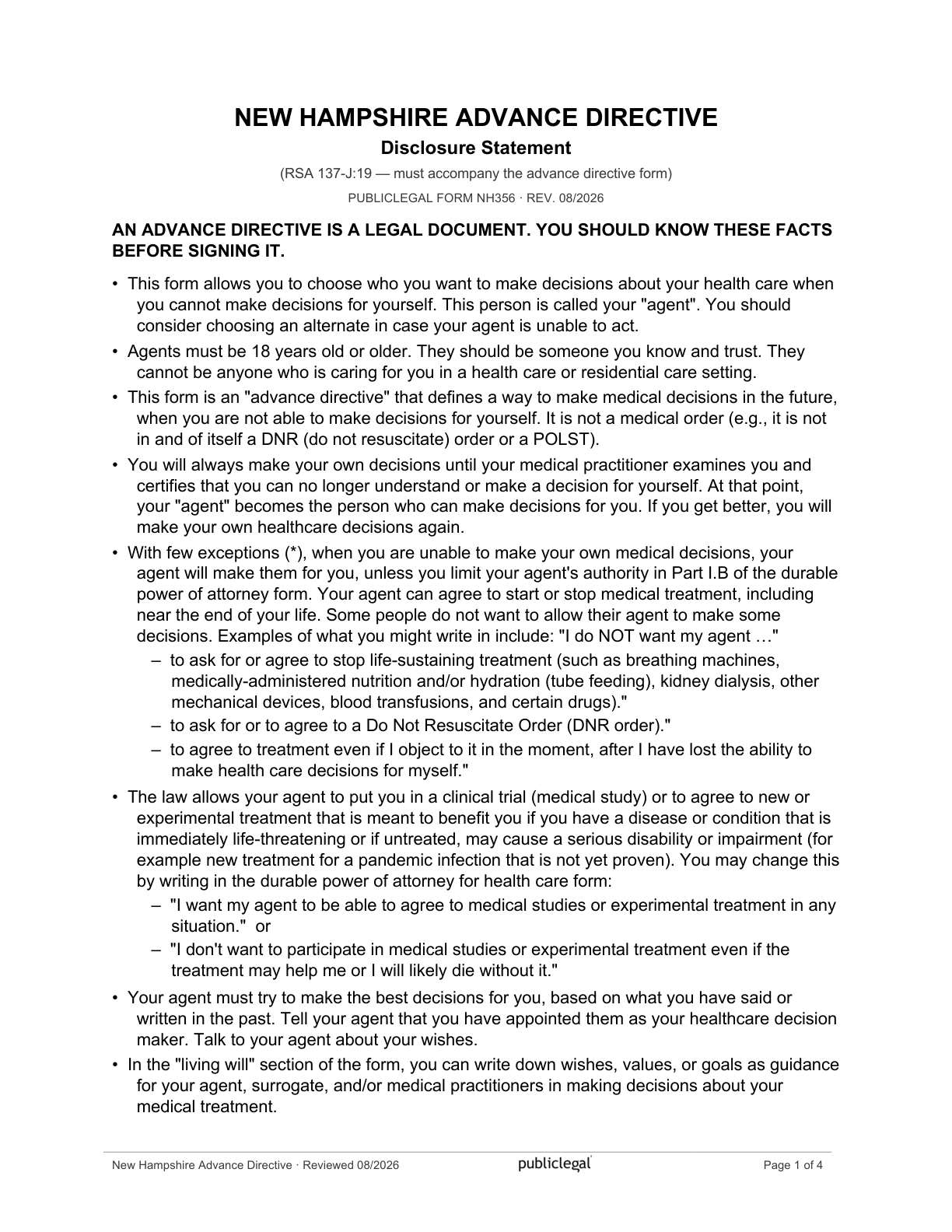
NEW HAMPSHIRE ADVANCE DIRECTIVE
Disclosure Statement
(RSA 137-J:19 — must accompany the advance directive form)
AN ADVANCE DIRECTIVE IS A LEGAL DOCUMENT. YOU SHOULD KNOW THESE FACTS BEFORE SIGNING IT.
• This form allows you to choose who you want to make decisions about your health care when you cannot make decisions for yourself. This person is called your "agent". You should consider choosing an alternate in case your agent is unable to act.
• Agents must be 18 years old or older. They should be someone you know and trust. They cannot be anyone who is caring for you in a health care or residential care setting.
• This form is an "advance directive" that defines a way to make medical decisions in the future, when you are not able to make decisions for yourself. It is not a medical order (e.g., it is not in and of itself a DNR (do not resuscitate) order or a POLST).
• You will always make your own decisions until your medical practitioner examines you and certifies that you can no longer understand or make a decision for yourself. At that point, your "agent" becomes the person who can make decisions for you. If you get better, you will make your own healthcare decisions again.
• With few exceptions (*), when you are unable to make your own medical decisions, your agent will make them for you, unless you limit your agent's authority in Part I.B of the durable power of attorney form. Your agent can agree to start or stop medical treatment, including near the end of your life. Some people do not want to allow their agent to make some decisions. Examples of what you might write in include: "I do NOT want my agent …"
– to ask for or agree to stop life-sustaining treatment (such as breathing machines, medically-administered nutrition and/or hydration (tube feeding), kidney dialysis, other mechanical devices, blood transfusions, and certain drugs)."
– to ask for or to agree to a Do Not Resuscitate Order (DNR order)."
– to agree to treatment even if I object to it in the moment, after I have lost the ability to make health care decisions for myself."
• The law allows your agent to put you in a clinical trial (medical study) or to agree to new or experimental treatment that is meant to benefit you if you have a disease or condition that is immediately life-threatening or if untreated, may cause a serious disability or impairment (for example new treatment for a pandemic infection that is not yet proven). You may change this by writing in the durable power of attorney for health care form:
– "I want my agent to be able to agree to medical studies or experimental treatment in any situation." or
– "I don't want to participate in medical studies or experimental treatment even if the treatment may help me or I will likely die without it."
• Your agent must try to make the best decisions for you, based on what you have said or written in the past. Tell your agent that you have appointed them as your healthcare decision maker. Talk to your agent about your wishes.
• In the "living will" section of the form, you can write down wishes, values, or goals as guidance for your agent, surrogate, and/or medical practitioners in making decisions about your medical treatment.
DISCLOSURE STATEMENT — CONTINUED
• You do not need a lawyer to complete this form, but feel free to talk to a lawyer if you have questions about it.
• You must sign this form in the physical presence of 2 witnesses or a notary or justice of the peace for it to be valid. The witnesses cannot be your agent, spouse, heir, or anyone named in your will, trust or who may otherwise receive your property at your death, or your attending medical practitioner or anyone who works directly under them. Only one witness can be employed by your health or residential care provider.
• Give copies of the completed form to your agent, your medical providers, and your lawyer.
* Exceptions: Your agent may not stop you from eating or drinking as you want. They also cannot agree to voluntary admission to a state institution; voluntary sterilization; withholding life-sustaining treatment if you are pregnant, unless it will severely harm you; or psychosurgery.
NEW HAMPSHIRE ADVANCE DIRECTIVE FORM
(RSA 137-J:20 — Durable Power of Attorney for Health Care and Living Will)
Name (Principal’s Name): _____________________________________________________________
DOB: ____________________________
Address: __________________________________________________________________________
I. DURABLE POWER OF ATTORNEY FOR HEALTH CARE
The durable power of attorney for healthcare form names your agent(s) and, if you wish, sets limits on what your agent can decide.
I choose the following person(s) as agent(s) if I have lost capacity to make health care decisions (cannot make health care decisions for myself).
(If you choose more than one person, they will become your agent in the order written, unless you indicate otherwise.)
A. Choosing Your Agent:
Agent: I appoint ____________________________________________________________________
of ________________________________________________________________________________
and whose phone number is _________________________________________________________
to be my agent to make health care decisions for me.
Alternate Agent: If the person above is not able, willing, or available, I appoint ______________
of ________________________________________________________________________________
and whose phone number is _________________________________________________________
to be my alternate agent.
If no one listed above can make decisions for you, a surrogate will be assigned in the order written in law (spouse, adult child, parent, sibling, etc.), and will have the same powers as an agent. If there is no surrogate, a court appointed guardian may be assigned.
I. DURABLE POWER OF ATTORNEY FOR HEALTH CARE — CONTINUED
B. Limiting Your Agent’s Authority or Providing Additional Instructions
When you can no longer make your own health care decisions, your agent will be able to make decisions for you. Please review the Disclosure Statement that is attached to this advance directive for examples of how you may want to advise your agent. You may write in limits or additional instructions below or attach additional pages.
I have attached ________ additional pages titled “Additional wishes for my Durable Power of Attorney for Health Care” to express my wishes.
II. LIVING WILL
If you would like to provide written guidance to your agent, surrogate, and/or medical practitioners in making decisions about life sustaining medical treatment if you cannot make your own decisions, you may complete the options below.
CHOOSE ITEM A OR B. Initial your choice:
If I suffer from an advanced life-limiting, incurable and progressive condition:
☐ A. I wish to have all attempts at life-sustaining treatment (within the limits of generally accepted health care standards) to try to extend my life as long as possible, no matter what burdens, costs or complications may occur.
OR
☐ B. I do NOT wish to have any life-sustaining treatment attempted that I would consider to be excessively burdensome or that would not have a reasonable hope of benefit for me. I wish to receive only those forms of life-sustaining treatment that I would not consider to be excessively burdensome AND that have a reasonable hope of benefit for me. The following are situations that I would consider excessively burdensome: (Cross out and initial any of the below statements # 1-4 if you disagree.)
1. I do not wish to have life-sustaining treatment attempted if I am actively dying (medical treatment will only prolong my dying).
2. I do not wish to have life-sustaining treatment attempted if I become permanently unconscious with no reasonable hope of recovery.
3. I do not wish to have life-sustaining treatment attempted if I suffer from an advanced life-limiting, incurable and progressive condition and if the likely risks and burdens of treatment would outweigh the expected benefits.
4. Other situations that I would consider excessively burdensome if I suffer from an advanced life-limiting, incurable and progressive condition: (I have attached __________ additional pages titled “Living Will Burdens”):
II. LIVING WILL — CONTINUED
In these situations, I wish for comfort care only. I understand that stopping or starting treatments to achieve my comfort, including stopping medically-administered nutrition and hydration, may be a way to allow me to die when the treatments would be excessively burdensome for me.
III. SIGNATURE
I have received, reviewed, and understood the disclosure statement, and I have completed the durable power of attorney for health care and/or living will consistent with my wishes. I have attached __________ pages to better express my wishes.
Signed this ________ day of _________________________, 20________
Principal’s Signature: _________________________________________________________________
(If you are physically unable to sign, this advance directive may be signed by someone else writing your name in your physical presence at your direction.)
THIS ADVANCE DIRECTIVE MUST BE SIGNED BY TWO WITNESSES OR A NOTARY PUBLIC OR A JUSTICE OF THE PEACE.
Witnesses (alternative to notary)
We declare that the principal appears to be of sound mind and free from duress at the time this advance directive is signed and that the principal affirms that the principal is aware of the nature of the directive and is signing it freely and voluntarily.
Witness 1 Signature: _______________________________________________________________
Witness 1 Printed Name: ____________________________________________________________
Witness 1 Address (city/state): _______________________________________________________
Witness 2 Signature: _______________________________________________________________
Witness 2 Printed Name: ____________________________________________________________
Witness 2 Address (city/state): _______________________________________________________
Notary Public / Justice of the Peace (alternative to witnesses)
STATE OF NEW HAMPSHIRE
COUNTY OF ________________________________
The foregoing advance directive was acknowledged before me this _____ day of ______________, 20____, by ______________________________ (the “Principal”).
Notary Public / Justice of the Peace Signature: _________________________________________
Printed Name: _____________________________________________________________________
My commission expires: ____________________________
Legal currency, verified
This New Hampshire Advance Directive lets you do two things in one statutory document: name a health care agent under a Durable Power of Attorney for Health Care, and record living-will guidance about life-sustaining treatment. It reproduces the form in RSA 137-J:20, together with the disclosure statement that RSA 137-J:13 and RSA 137-J:19 require to accompany the form.
New Hampshire combined the durable power of attorney for health care and the living will into a single advance-directive form in 2021 (SB 74 / 2021, 176, effective July 30, 2021). An advance directive executed on or after that date must be substantially in the RSA 137-J:20 form. Earlier directives remain enforceable under RSA 137-J:16. The form text was verified against the current RSA chapter 137-J (including the 2025 session) in August 2026.
The disclosure statement explains what an agent can and cannot decide, how capacity is certified, clinical-trial consent rules, and witness disqualifications. The form itself has three parts: (I) Durable Power of Attorney for Health Care — agent, alternate, and any limits or additional instructions; (II) Living Will — choose item A (all life-sustaining treatment) or item B (comfort care / not excessively burdensome), with nested statements you may cross out; and (III) Signature — acknowledgment that you received the disclosure, then two qualified witnesses or a notary public / justice of the peace (RSA 137-J:14).
You must sign in the physical presence of two qualified witnesses or a notary public or justice of the peace (RSA 137-J:14). Witnesses cannot be your agent, spouse, heir, or anyone who may take under your will or by operation of law, or your attending practitioner or anyone acting under that practitioner’s direction. Only one witness may be employed by your health or residential care provider. If you cannot physically sign, another person may sign your name in your physical presence at your express direction.
Your purchase includes the complete advance-directive packet (disclosure + form) in two formats: an editable Word (.docx) file, and a fillable PDF you can complete on screen before printing and signing.
This packet is the same statutory instrument offered from the living-will entry page: the New Hampshire Living Will (Advance Directive). For property and finances, pair it with a New Hampshire durable power of attorney for property.
This form is not legal advice and does not replace the advice of a New Hampshire attorney about your specific situation.
ILRG is committed to top quality legal forms that are valid in all states. If you are not 100 percent satisfied after purchase, contact us for a full refund.
Yes. This packet reproduces the RSA 137-J:20 Advance Directive and the RSA 137-J:19 disclosure statement. New Hampshire combined the durable power of attorney for health care and the living will into one form effective July 30, 2021 (SB 74). Directives properly signed under prior law remain valid. Reviewed and verified against current RSA chapter 137-J in August 2026.
Not necessarily. RSA 137-J:14 gives you a choice: sign in the physical presence of two qualified witnesses, or acknowledge your signature before a notary public or justice of the peace. Witnesses cannot be your agent, spouse, heir, or anyone who may take under your will or by operation of law, or your attending practitioner or anyone acting under that practitioner. Only one witness may be employed by your health or residential care provider.
When you lack capacity, your agent makes health care decisions for you, subject to any limits you write in Part I.B and to the statutory exceptions (for example, the agent may not stop you from eating or drinking normally, consent to voluntary sterilization, or withhold life-sustaining treatment if you are pregnant unless the statute’s harm exception applies). The disclosure statement explains the full list.
No. The statute lets you complete the Durable Power of Attorney for Health Care component, the Living Will component, or both. The signature block acknowledges whichever parts you complete.
Both contain the same packet text. Use the editable Word (.docx) file to type in your details, or the fillable PDF to complete the form on screen. Either way, print the finished document, initial your living-will choice, and sign before your witnesses or notary, initials and signatures belong on paper.