
Find legal forms, law schools, and legal resources
Try “residential lease” — forms for your state are shown first.
Try “Yale” or “University of Texas” — the full ABA directory is searchable as you type.
National business-sale form
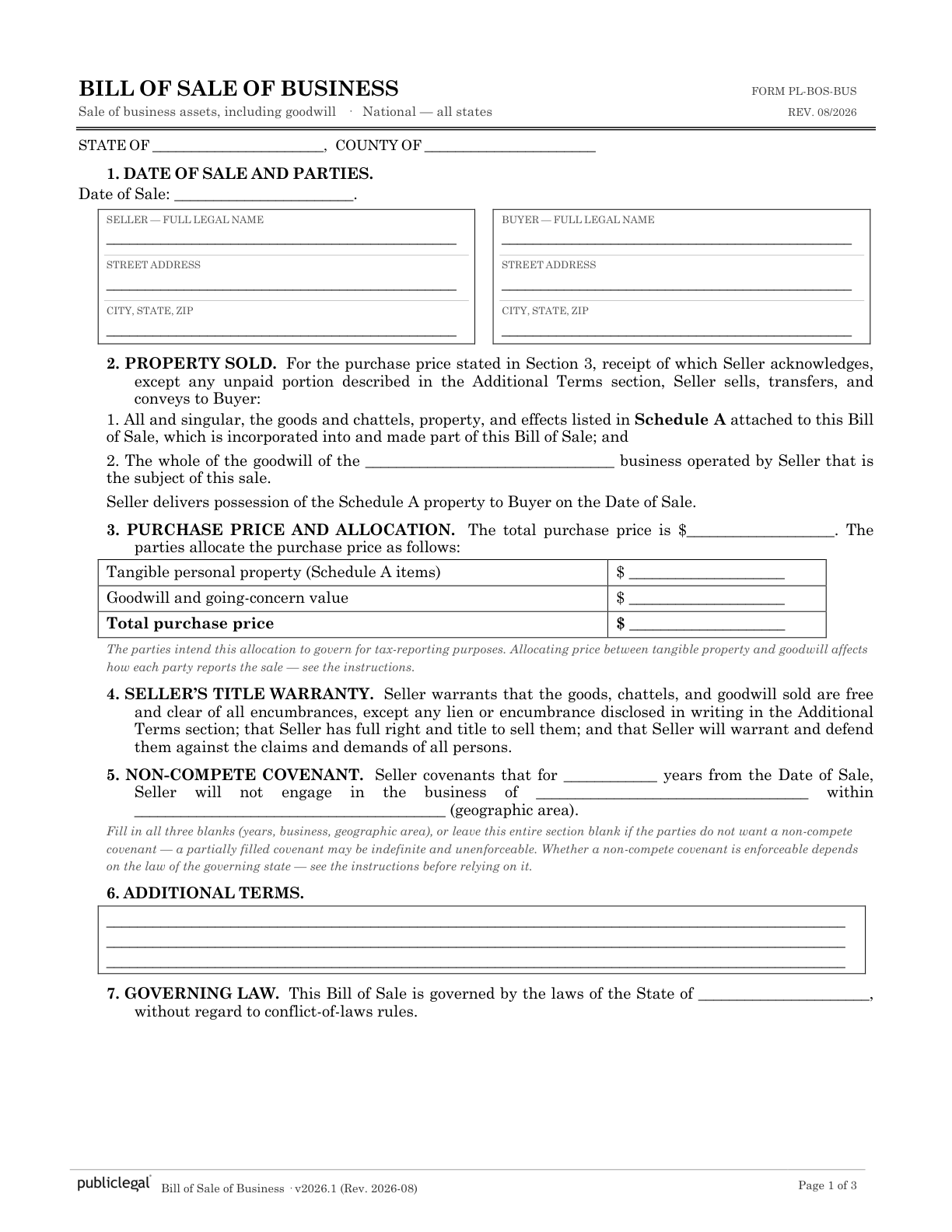
See page 1 of the actual bill of sale before you buy. This is the conveyance itself, signed at closing: the Schedule A tangible property — furniture, equipment, inventory — plus the business’s goodwill, with the price allocated between them, the seller’s warranty of title, and an optional non-compete covenant. A plain-English Instructions & Legal Notes guide is included. Fillable Word — click the blanks and type.
Everything included with your bill of sale of business (assets and goodwill) download, ready for instant secure access.
A bill of sale is the transfer document signed at closing — not a promise to close. It conveys the Schedule A property and the goodwill, states the price and its allocation, and records the seller’s title warranty.
Goodwill and going-concern value pass alongside the tangible assets, and Section 3 allocates the price between the two — the allocation both parties use for tax reporting, explained in the guide.
A seller non-compete covenant (years, business, and geographic area blanks) is built in — fill in all three blanks or leave the section entirely blank, per the guide’s enforceability notes.
This download includes the bill of sale instrument and a companion Instructions & Legal Notes guide covering completion steps, price allocation, the title warranty, the non-compete election, and signing, witness, and notary practice. Both are fillable Word files. If the buyer is paying over time, pair this bill of sale with our Promissory Note and Security Agreement — the instructions explain the options.
See page 1 of the actual bill of sale below. Your complete editable download — the instrument and the instructions, both Word — is delivered after checkout.
Legal currency, verified
A bill of sale for the assets of a small business: the Schedule A tangible property (furniture, equipment, inventory) plus the business’s goodwill, with the price allocated between them and the seller’s warranty of title on the face. It does not transfer stock or membership interests, real estate, contracts that require counterparty consent, licenses, leases, government-registered intellectual property, or the seller’s debts — the instructions explain what needs its own document. If the buyer is paying over time, pair this bill of sale with our Promissory Note and Security Agreement.
ILRG is committed to top-quality legal forms. If you are not 100 percent satisfied after purchase, contact us for a full refund.
The business’s assets: the tangible personal property listed on Schedule A (furniture, equipment, inventory) plus the business’s goodwill and going-concern value. It does not transfer stock or membership interests, real estate, contracts that require counterparty consent, licenses, government-registered intellectual property, or the seller’s debts — debts stay with the seller unless the buyer assumes them in a separate written agreement. The instructions walk through what needs its own document.
This bill of sale is the conveyance itself, signed at closing to transfer the assets and goodwill. The Agreement to Sell Business is the earlier contract that sets the deposit, closing contingencies, and seller-financing terms before closing — and its sale is assets-only, with no goodwill. Many closings use both: the agreement first, this bill of sale at the closing table.
Section 3 splits the price between the Schedule A tangible property and goodwill/going-concern value, and states that the parties intend the allocation to govern for tax-reporting purposes. The allocation affects how each party reports the sale; the instructions explain why it matters.
The seller warrants title: the assets and goodwill are free of encumbrances except any lien disclosed in the Additional Terms section, the seller has full right and title to sell, and the seller will defend against the claims of others. That is a warranty of title, not of condition — if the assets are sold as-is, with no promises about condition or working order, say so in Additional Terms; the instructions explain how.
Fill in all three blanks — the number of years, the business covered, and the geographic area — or leave the entire section blank if the parties do not want a non-compete. A partially filled covenant may be indefinite and unenforceable, and enforceability depends on the governing state’s law, so check the instructions before relying on it.
Both parties sign two identical originals and each keeps one. A witness is recommended because, for property with no government title certificate, the bill of sale is the primary evidence of the transfer; the notary panel is optional but recommended for high-value sales. An entity seller signs through one authorized officer, manager, or partner with their title on the signature line.