
Find legal forms, law schools, and legal resources
Try “residential lease” — forms for your state are shown first.
Try “Yale” or “University of Texas” — the full ABA directory is searchable as you type.
National estate-planning form
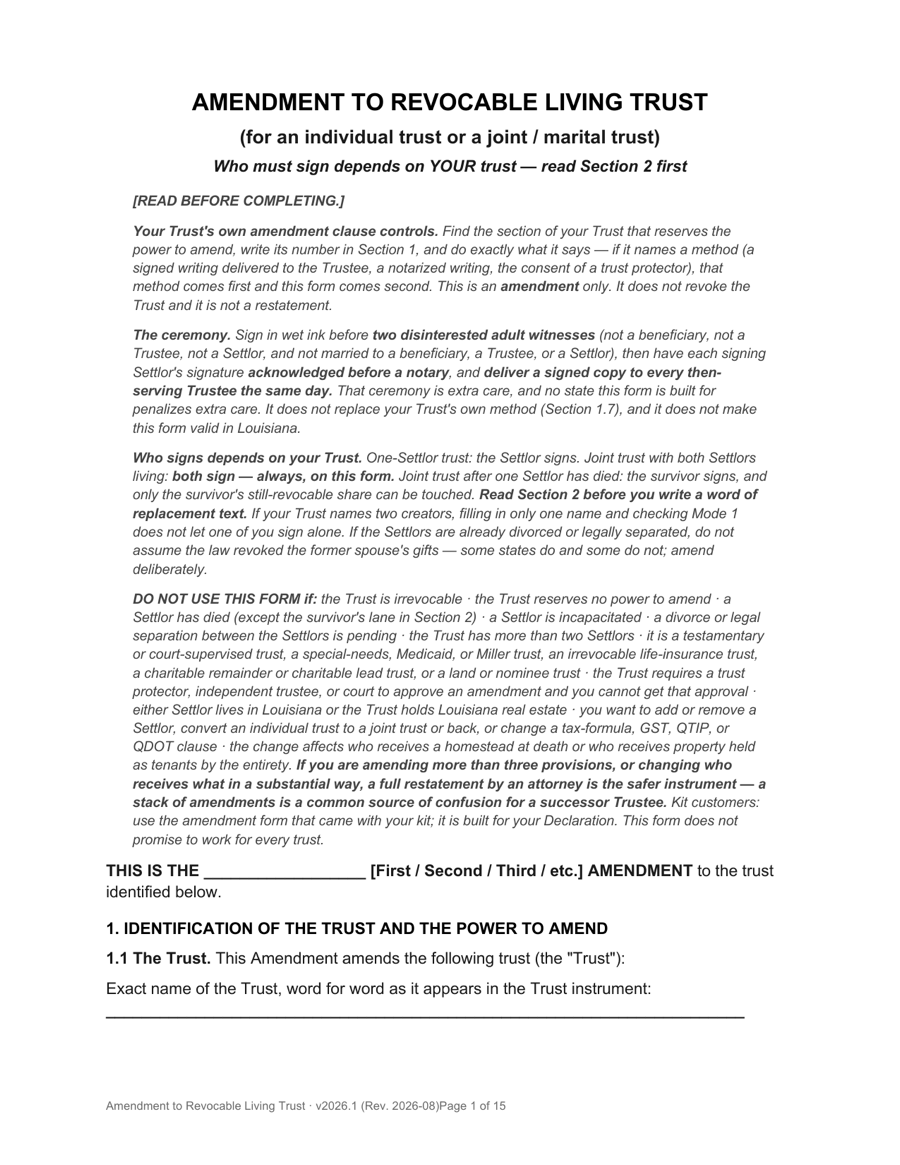
See page 1 of the actual form before you buy. Change your revocable living trust without re-signing the whole instrument — replace, add, or delete a provision, or restate a schedule. One form works for an individual trust, for a joint or marital trust while you are both living, and for the survivor after the first death — you check your mode and the form tells you who must sign. Two-witness statement and a notary acknowledgment certificate for each signer built in. Fillable Word — click the blanks and type, or print and complete by hand. Instant download.
The amendment instrument with its two-witness statement and notary acknowledgment certificate blocks, as a fillable Word file — click any blank or checkbox to type your information, or print and complete by hand.
Review the complete form text below before purchasing. Your licensed download is delivered after checkout.
Legal currency, verified
Change your revocable living trust without re-signing the whole instrument — replace, add, or delete a provision, or restate a schedule — using the amendment power your trust reserves to its creator. Page 1 of the actual form is previewed above before purchase.
The form works for a one-person trust, for a joint or marital trust while both of you are living, and for the surviving settlor after the first death. You check one of three modes, and the form tells you who must sign: a one-settlor trust — the settlor signs; a joint trust with both living — both sign, always on this form; after a first death — the survivor signs, and only the survivor's still-revocable share can be amended (never a share that became irrevocable at the first death, whatever letter or name your trust gives it).
Every trust says how it may be amended — a signed writing delivered to the trustee, a notarized writing, sometimes the consent of a trust protector. You copy your clause onto the form and follow it; the form's signing ceremony (two disinterested witnesses plus a notary acknowledgment for each signer) is careful extra protection on top, and the instruction panel explains same-day delivery to every serving trustee.
Typical changes: add or remove beneficiaries, change what a beneficiary receives or when, replace a successor trustee, update administrative provisions, or restate a property or beneficiary schedule (restate the whole schedule — it replaces the old one completely). An amendment cannot change a beneficiary designation on an account or policy, reach property the trust does not hold, touch any share that has become irrevocable, add or remove a settlor, or change who receives a homestead or tenancy-by-the-entirety property at death — and it is never a revocation or a restatement of the trust.
For revocable living trusts only — never an irrevocable trust, never after the last settlor's death, never when a settlor lacks capacity, and not where a divorce is pending, a trust protector's consent is unavailable, or more than two people created the trust. Louisiana residents and trusts holding Louisiana real estate need Louisiana-drafted instruments. If you are changing more than three provisions or substantially changing who receives what, a full restatement by an attorney is the safer instrument. If you bought one of our trust kits, use the amendment form included in your kit — it is built for your declaration.
This form is not legal advice. It is a national form; consult a licensed attorney in your state for advice about your situation.
ILRG is committed to top-quality legal forms. If you are not 100 percent satisfied after purchase, contact us for a full refund.
No. This amendment is drafted “pursuant to the powers reserved by the settlor” — the amendment power that revocable living trusts reserve to their creator. An irrevocable trust generally cannot be amended by the person who created it; changing one usually requires a court, a trust protector holding that power, a state decanting statute, or in many states the agreement of the settlor and all beneficiaries. Do not use this form for an irrevocable trust.
Typical changes: add or remove beneficiaries, change what a beneficiary receives or at what age, appoint or replace a successor trustee, or update administrative provisions. An amendment keeps the rest of your trust intact. For wholesale changes, a restatement of the trust is usually cleaner than stacking amendments.
The form instructs both for every signing: sign in wet ink before two disinterested adult witnesses, then have each signer’s signature acknowledged before a notary — the ceremony that satisfies the strictest state formalities. Your trust’s own amendment clause controls, so copy it onto the form and follow it exactly, and deliver a signed copy to every serving trustee the same day.
Not on this form. While both of you are living, both sign — always — even if your trust or your state’s default law would let one of you amend as to your own property; a solo amendment of a joint trust is a question for an attorney, not a self-help form. After the first death, the survivor signs alone, and only the survivor’s still-revocable share can be amended.
Yes. Use the exact name and date of your trust as they appear in the original document, and copy the clause that reserves the amendment power. The form works for an individual trust or a joint trust created by one or two people — three or more creators, an incapacitated settlor, a pending divorce, or a trust that requires a trust protector’s consent all need an attorney instead.