
Find legal forms, law schools, and legal resources
Try “residential lease” — forms for your state are shown first.
Try “Yale” or “University of Texas” — the full ABA directory is searchable as you type.
National estate-planning kit
The complete 10-document revocable living trust kit for one person — the trust itself, a READ FIRST signing and funding guide, a property assignment and funding record to actually fund it, extra schedule worksheets, amendment and revocation forms, an individual pour-over will as a safety net, a long-form certification of trust for banks and title companies, and a HIPAA authorization so your trustee can get the physician certifications the trust’s incapacity provisions call for. A trust that never receives your assets avoids nothing — this kit exists to fund it.
This 10-document kit covers the full lifecycle: create the trust, fund it (assignment + funding record + worksheets), change it (amendment) or unwind it (revocation), catch what never got titled over (pour-over will), prove it to third parties without revealing its terms (certification of trust), and let your trustee get the medical certifications an incapacity handoff needs (HIPAA authorization).
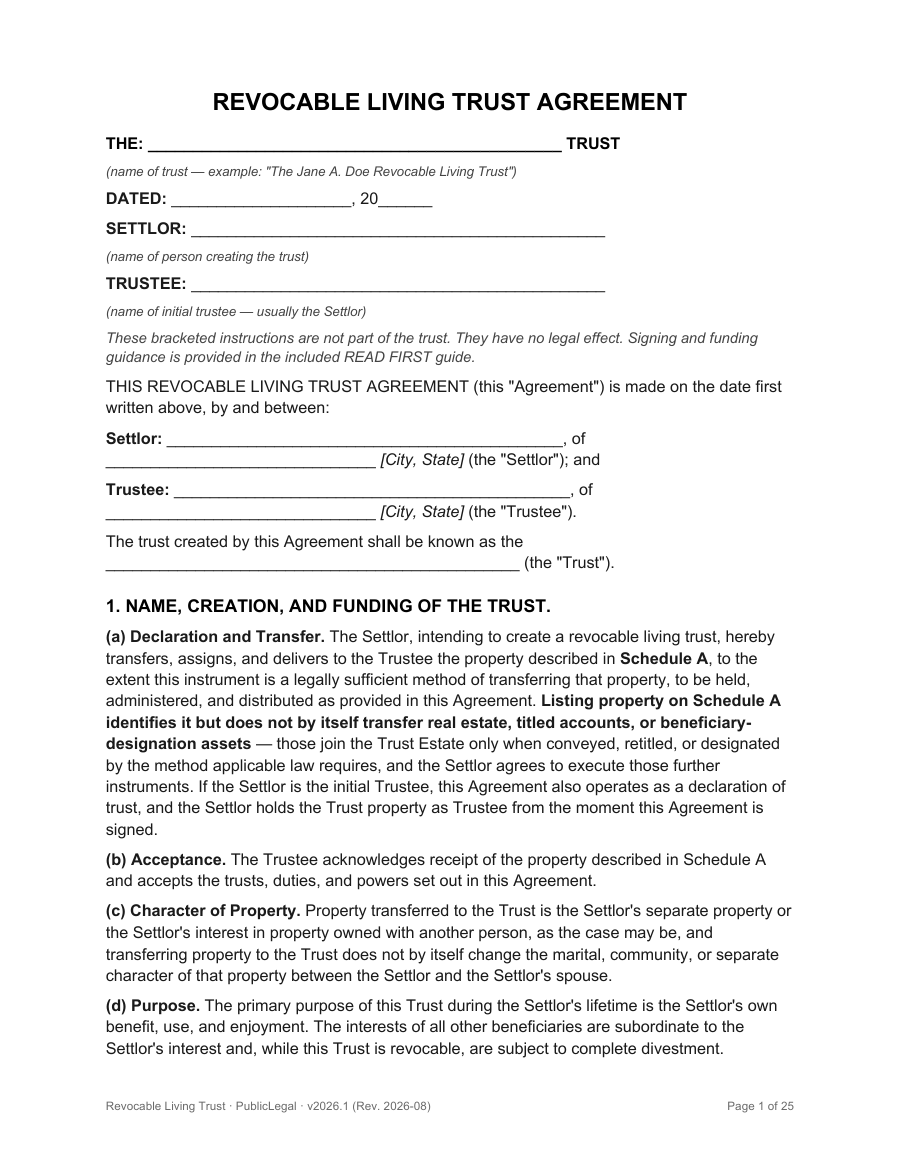
See page 1 of the actual trust instrument below. Your complete fillable Word download starts with a READ FIRST signing & funding guide and includes the funding, amendment, revocation, will, certification, and HIPAA documents listed above — delivered after checkout.
Legal currency, verified
A revocable living trust for one person: you create the trust, serve as your own trustee, keep full control while you are alive and capable, and name who steps in if you become incapacitated and who receives what at your death — without probate for the assets you actually title to the trust. Page 1 of the actual trust instrument is previewed above before purchase.
A trust only controls what you put into it. Alongside the instrument (with Schedules A–D built in), this kit includes the documents that make funding actually happen: a General Assignment for untitled household property, a Funding Record worksheet to log each completed transfer, extra blank schedule worksheets, and step-by-step instructions that walk through deeds, account retitling, and beneficiary-designation cautions.
A READ FIRST signing & funding guide; the Individual Revocable Living Trust instrument; a General Assignment; a Funding Record worksheet; extra Schedule Worksheets (A–D); an Amendment form and a Revocation form; an individual Pour-Over Will with a self-proving affidavit; a long-form Certification of Trust for banks, brokerages, and title companies; and a HIPAA Authorization & Waiver (included, PublicLegal item 1929) so your successor trustee can obtain the physician certifications the trust's incapacity provisions call for. Every document is a fillable Word file — click the blanks and type, or print and complete by hand.
For assets titled to it, the trust avoids probate, keeps your plan private, and provides uninterrupted management if you become incapacitated. Because you keep control and can revoke it, the trust does not reduce estate taxes, does not shield your assets from your own creditors, and does not help with Medicaid eligibility. Listing an asset on a schedule records your intent — it is not a transfer; deeds and account retitling do that, and the instructions show you how.
Drafted for one person creating an individual trust. Married couples should look at our shared/marital kits instead. Retirement accounts are never assigned to the trust; they pass by beneficiary designation, and the instructions explain the SECURE Act conversation to have with your adviser.
This form is not legal advice. It is a national kit; consult a licensed attorney in your state for advice about your situation.
ILRG is committed to top-quality legal forms. If you are not 100 percent satisfied after purchase, contact us for a full refund.
Funding is where do-it-yourself trusts fail: a trust that never receives your assets avoids nothing. The kit’s assignment, funding record, and extra schedule worksheets record and complete what you intend to fund, the instructions walk through retitling accounts and property into the trust’s name, the pour-over will catches anything left out, and the amendment and revocation forms keep the plan changeable for life. The certification of trust is what banks typically ask for when you open an account or sell trust property, and the HIPAA authorization lets your trustee obtain the physician certifications the trust’s incapacity provisions require.
A short will that leaves anything you never titled to the trust “over” into it at death, so one plan governs everything. It still goes through probate for those assets — titling assets to the trust during your life is what avoids it.
No. Because you keep control and can revoke it, the assets remain in your taxable estate and within reach of your own creditors. The benefits are probate avoidance, privacy, and incapacity planning. Creditor protection requires an irrevocable structure.
It is a national kit. Revocable living trusts are recognized in every state; signing formalities vary, and signing before witnesses and a notary is the sound practice everywhere. Community-property nuances and unusual assets are worth a local professional’s review.
See page 1 of the actual trust instrument above; the Included documents list names every file. You receive 10 fillable Word documents, delivered instantly after checkout. Every purchase is covered by the 100% satisfaction guarantee.